

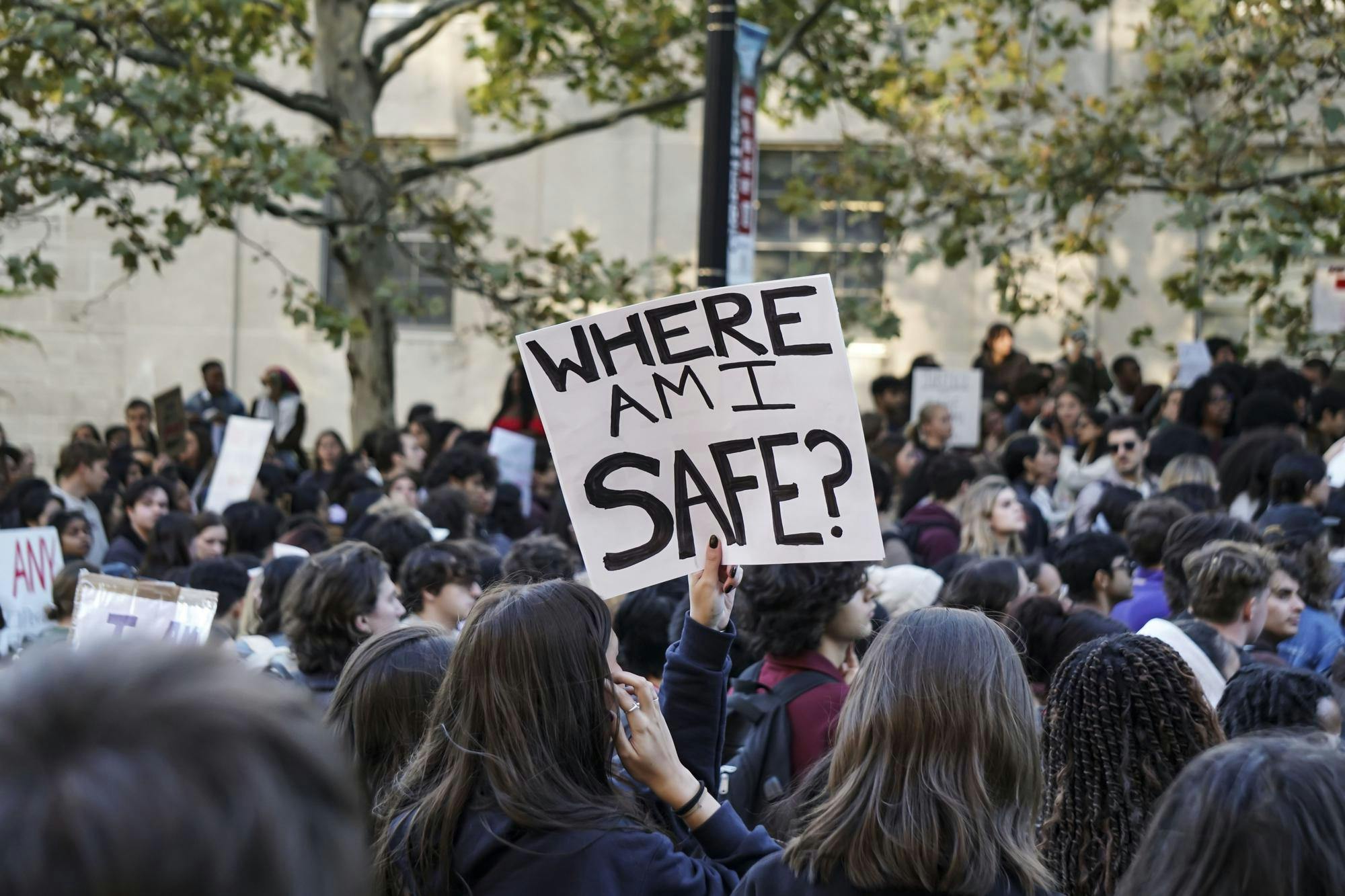
Student organizers hosted an open town hall at Willard Straight Hall in response to the alleged 2024 Chi Phi gang rape on the evening of Oct. 6. Attendees learned about the sexual assault reporting process at Cornell, asked questions about recent events and shared their own stories.
The town hall was organized by more than 20 different student organizations and featured panelists from the Cornell Chapter of the American Civil Liberties Union, Students for a Democratic Cornell, Planned Parenthood Generation Action, Black Students United and the Cornell NAACP. It was co-sponsored by the Department of Feminist, Gender and Sexuality Studies.
The event was planned in response to a Sept. 14 lawsuit filed by a former Cornell student, identified as Jane Doe, who alleged she was gang raped and sexually assaulted by multiple men at Cornell’s Chi Phi fraternity house in 2024.
The town hall opened with a presentation explaining the case and some of the entities involved, including the relevant University offices, policies and Greek Life organizations. An open forum followed, where students could share their thoughts and experiences regarding sexual assault or ask student panelists questions.
“It took all of us to make tonight happen,” said Alysha Adusei ’27, vice president of Wanawake Wa Wari Cooperative, at the event. “We are here for three reasons: so the administration hears us, so anyone who has felt unsafe or unheard knows they are not alone and so we leave this room ready to act.”
WARI is a co-op founded to provide a safe living space for Black women on Cornell’s campus.
Adusei developed the idea for the town hall after reading about the alleged Chi Phi gang rape and feeling that Jane Doe had been “failed” by the University, she wrote in a previous statement to The Sun.
Adusei began planning the town hall by reaching out to organizations for Black women before expanding her outreach to women-run clubs and ultimately encompassing a wide range of student activists.
The presentation commencing the event was given by Cornell NAACP President Athena Holloway ’27 and Cornell ACLU President Jonathan Lam ’27. Holloway told The Sun that her goal for the presentation was to “de-jargonize” the case for students, adding that there were parts of the University’s handling of the case that she found confusing herself.
Holloway and Lam led the audience through a slideshow explaining several factors that they said affected Jane Doe’s initial report, including the entities named in the lawsuit, such as the Xi chapter of Chi Phi and Delta Delta Delta. They also mentioned the organizations that investigated the allegations, including Cornell’s Office of Civil Rights and Office of Student Conduct and Community Standards.
They then defined Title IX and Cornell’s Policy 6.4, described the formation of Cornell’s Presidential Task Force on Sexual Assault and explained how the Office of Civil Rights and OSCCS oversee reported incidents of sexual misconduct and work to ensure student safety.
At the town hall, Holloway told The Sun, she could “see a stark discrepancy between students who know what communication is happening from the University and what communication isn’t.”
After the presentation, students from WARI, including Adusei and the co-op’s president, Emmah Kabbah ’27, spoke about how the town hall was organized.
“At its heart, WARI has been a space that prioritizes the safety and care of women on Cornell's campus,” Kabbah said. “This institution has failed Black women before and when that happened, students refused to stay silent.
The panel for the open forum part of the event included representatives from many of the hosting organizations, as well as Keten Abebe ’27, the student representative for Cornell’s Board of Trustees, and Juno Salazar Parreñas, the director of undergraduate studies in feminist, gender & sexuality studies.
During an off-the-record portion of the open forum, press were asked to leave large cameras outside of the room, cease recording and avoid noting students’ names.
“We're just trying to create a community where students can voice their fears [and] their concerns and hopefully we can help them process,” Melissa Bass ’27, co-president of PPGA, told The Sun.
Jordan Lubinsky ’27, PPGA’s other co-president, told The Sun that she was deeply moved by the survivors that shared their stories during the forum and how the community came together to support them
“I honestly did get chills,” Lubinsky said. “[When] you're hearing the story face-to-face, it's so much different than reading it in an article. … I think this event brought the humanity back into it.”
At the end of the event, students were encouraged to participate in “Zero Day,” and Parreñas informed students of a teach-in hosted by the Department of Feminist, Gender and Sexuality Studies on Oct. 10.
“You have people calling for the resignation of Kotlikoff, you also have people talking about the banning of frats,” Parreñas told The Sun about the teach-in. “All of this is on the table, and I think we are at this point where we really need to brainstorm: What do we want? What will justice be?”
Many students emphasized that their activism will continue until they see the University respond by making tangible changes, rather than responding to the situation as though it is a PR crisis, they described.
“Ultimately, at the end of the day, we want these demands heard,” Holloway said. “I think that it's on us to continue fighting the good fight and pushing forward.”
Bass stressed that this was just the start for student organizers.
“We're trying to show Cornell that we're not going to be silent,” Bass said. “We're not going to have this one protest and then stop our efforts. We are a force that needs to continue to be reckoned with.”

Giselle Redmond is a member of the Class of 2028 in the College of Agriculture and Life Sciences. She is an assistant news editor for the 144th Editorial Board and can be reached at gredmond@cornellsun.com.


