

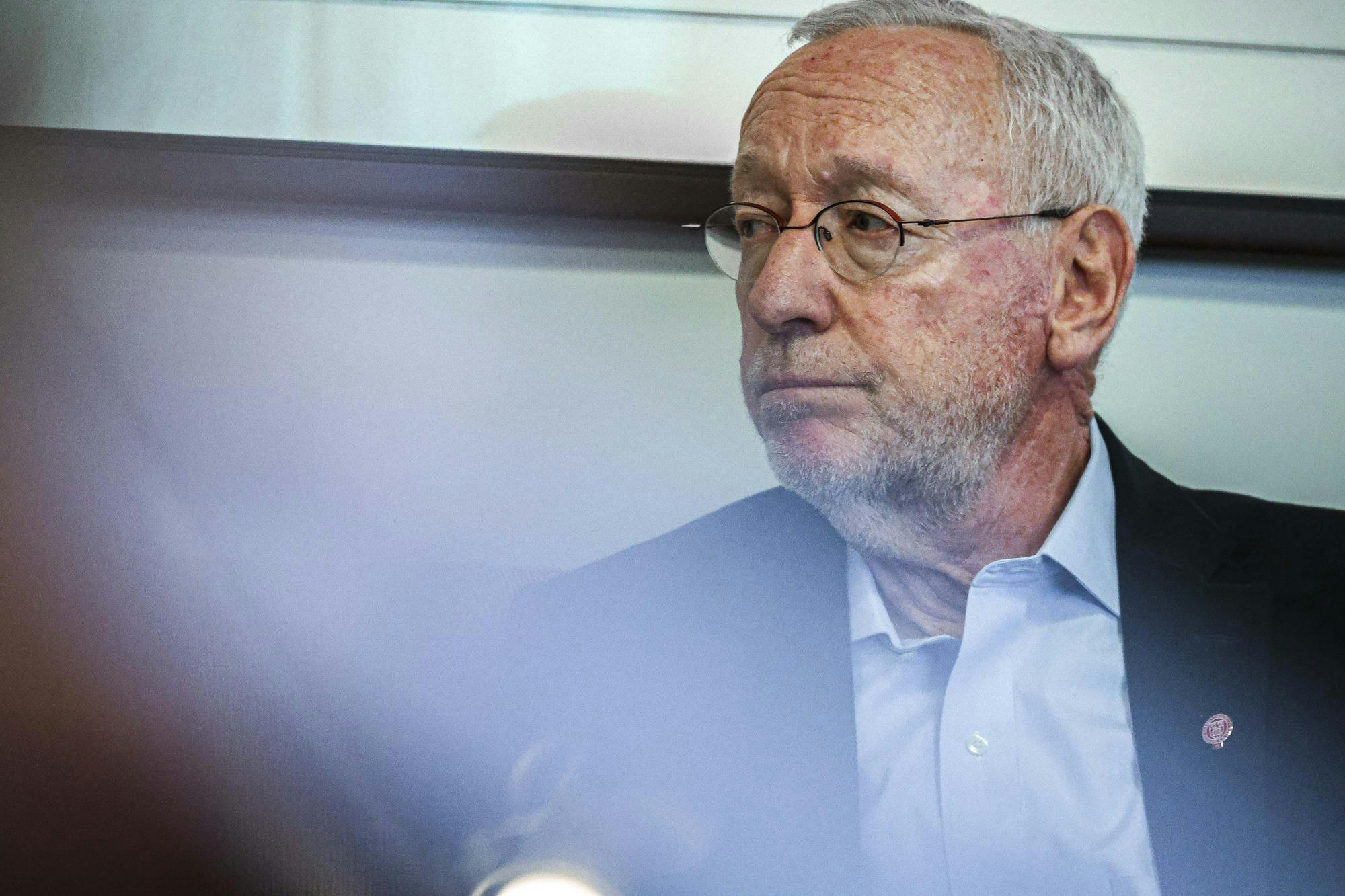
In a meeting lasting over two hours, a conflicted Faculty Senate considered a proposal for a “vote of no confidence” in Cornell's administration and heard remarks from President Michael Kotlikoff during its Wednesday session.
The senate ultimately did not vote on the measure and debate is scheduled to continue on Oct. 28.
The one-sentence proposal, introduced on Oct. 8 in response to the University’s handling of an alleged 2024 gang rape at Cornell’s Chi Phi house, is sponsored by Prof. Paul Ortiz, industrial and labor relations, and signed by 122 supporting faculty. The proposal holds no binding consequence if passed.
“The Faculty Senate has no confidence in the ability of the central administration to effectively address the ongoing crisis of sexual assault at Cornell University,” the resolution reads.
Faculty senators expressed both support and concern regarding the resolution. Some cited a loss of trust in University administration and expressed frustration with its messaging. Other senators conveyed that faculty in their departments were hesitant to pass the resolution, and shared worries about the proposal being overly broad.
Close to an hour of the meeting was dedicated to an appearance from Kotlikoff, who gave remarks on the University’s response to the Chi Phi case and fielded questions about his ability to lead Cornell.
Kotlikoff criticized calls for his replacement as he was asked about a petition with nearly 70,000 signatures pledging for alumni to withhold donations until the removal of Cornell officials they deemed “complicit” in the “cruel passivity” with which they claim administration has handled the case.
“If this university feels that they will solve this problem by replacing a president, that itself is not good for Cornell's reputation,” Kotlikoff said. “I don’t think it's the right way to address situations like this.”
In a lawsuit filed on Sept. 14, a former Cornell student, identifying as Jane Doe, alleged she was gang raped by multiple members of Cornell’s Chi Phi fraternity. The plaintiff, identifying as Jane Doe, accused Cornell of negligence, breach of contract and violations of state human rights and education laws.
In his speech, Kotlikoff explained several initiatives he introduced to the Cornell community on Tuesday, including a ban on Cornell Interfraternity Council fraternity parties and social events for the rest of the academic year, the addition of staffers at the Cornell Office of Civil Rights and a new partnership with New York State Police to create an independent and trauma-informed criminal investigation process.
Kotlikoff stated that the University took these steps and spoke to staff, faculty and student leaders in order to address “the suspicion that individuals have, the feeling that they are unsafe on campus and also some suspicion about Cornell University police.”
However, several faculty members criticized the University’s Tuesday statement, claiming Cornell did not take accountability.
During the meeting, Prof. Suman Seth, science and technology studies, said that he was “deeply disturbed” by the lack of “personal responsibility” taken by the president in his speech to the senators.
“President Kotlikoff has been provost or president for more than a decade,” Seth said. “And over and over again in his comments, what he did was tell us about Cornell policy, as if he has not had a decade in which to change said Cornell policy.”
After Kotlikoff’s appearance, Ortiz described the “vote of no confidence” proposal to the senate, calling the University’s decision to announce its initiatives the day before the faculty senate’s meeting on the no-confidence vote, “appalling.”
“I mourn that it took so much trauma, so much student organizing and especially the suffering of Jane Doe” to bring the University to start making any change, Ortiz said. “Cornell will not do the right thing … unless we, the faculty, demand that it do so.”
During the public comment period, 11 of the 19 faculty senators who spoke voiced support for the proposal.
Among other factors, they cited a Tuesday New York Times interview in which Kotlikoff revealed he had limited knowledge about the case and did not know Jane Doe had dropped out of Cornell until the lawsuit went public.
Others noted that the University’s lack of public statements regarding the incident during the two years between the alleged assault and the lawsuit has led to lessened trust among faculty.
Not all faculty members in attendance expressed support for the no-confidence proposal, with seven senators and the Dean of Faculty, Chris Schaffer, voicing dissent.
Prof. Yuval Grossman, physics, said that members of his department “expressed deep concern” about the alleged Chi Phi gang rape but did not feel they had enough information to make an informed decision about the no-confidence proposal.
Grossman proposed that the University Faculty Committee, which sets meeting agendas, should postpone the vote on the no-confidence proposal until former U.S. Deputy Attorney General Sally Yates finishes her independent review of the University’s handling of the case. If the committee does not postpone the vote, Grossman said he would introduce a similar motion at the Oct. 28 faculty senate meeting.
Several senators representing the mathematics and economics departments voiced support for Grossman’s proposal and echoed that a majority of faculty in their departments were currently opposed to the measure.
Others who voiced dissent included Schaffer, who spoke in a personal capacity, and William Katt, a senior research associate in biomedical and translational sciences. Both Schaffer and Katt called out the Faculty Senate for not taking strong enough action against sexual assault themselves.
“The vote of no confidence should be in this body for refusing to do the hard work of actually fixing problems,” Katt said. “This is the same garbage we see over and over again: attack the administration rather than accept our own responsibility.”
Prof. Richard Bensel M.A. ’76 Ph.D. ’78, government, supported the resolution, and said that he feels an urgency in taking a stand against the Cornell administration while the University has the “attention” of the administration, alumni and the country.
“We should use [this attention] not to authorize the president to appoint yet another hand-picked committee ostensibly for reform, but to claim that ground, and that right, for ourselves — and the only way to do that is to clear the brush,” Bensel said.
Benjamin Leynse is a member of the Class of 2027 in the College of Arts and Sciences. He is a multimedia editor for the 144th Editorial Board and was a news editor for the 143rd Editorial Board. He can be reached at bleynse@cornellsun.com.


