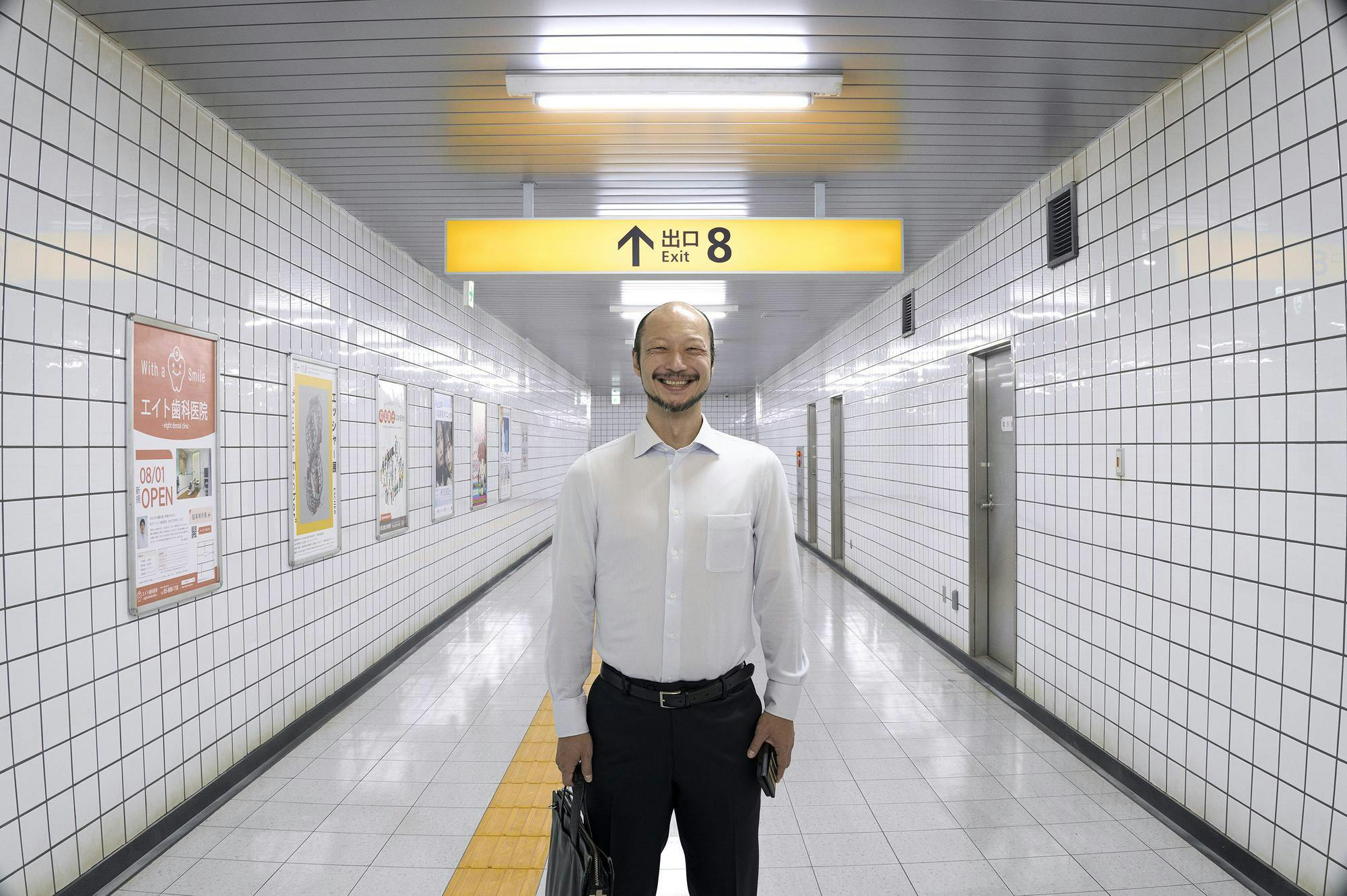
Exit 8 hit theaters April 10 for its U.S. theatrical release. Based on the Steam game The Exit 8 by Kotake Create, it seems it has beat the upcoming film Backrooms as being first to screen in the liminal space genre (this is a thing now?). Through its use of CGI imagery, it crosses the boundary between video game and film in a highly provocative way. And, through the story that director Genki Kawamura has superimposed onto the game, it offers a decent grounding for a couple philosophical musings.
The film is broken into three chapters, but it primarily follows “the Lost Man.” Upon exiting a subway car, he receives a phone call from his ex-girlfriend and learns that she is pregnant. She asks whether she should keep it, but he is speechless and indecisive. The call is reduced to static noise, and it disconnects. The passageway has become deserted and, as he continues, he realizes he is retreading his steps in an identically looped tunnel. The Lost Man fixates upon a sign that explains he must turn back if he spots an ‘anomaly’ in the tunnel, otherwise he must continue forward. By following these rules, he moves up to the next level — starting from zero and ending at eight — upon which he would presumably break from the loop. From here, we follow the trial and error of the Lost Man as he struggles to reach the eighth level and exit the subway. On the journey, the Lost Man confronts his potential future as a father.
The film’s introduction is highly unorthodox. It blends mediums between video game and film, plunging the audience into an uncanny valley between the real and artificial. It begins with a point-of-view shot of the Lost Man’s reflection in the window glass of the train, a notoriously ‘impossible’ shot. The film segues from the subway car into the Exit 8 tunnel in a very long (perhaps three or four minutes) and very impressive continued POV shot as the Lost Man moves from bustling subway platform, up stairs and through a couple winding tunnels, all the while juggling the phone call. He holds the device up to the camera the same way a first person RPG (role playing game) character brandishes a newly equipped item. As he walks, the bobbing of the camera matches his gait in a manner highly reminiscent of the same video games and unlike any gimbal or EasyRig motion I’ve seen. He ultimately passes under the Exit 8 sign, crossing past the same man, the Walking Man, about three times before he realizes he is stuck. At this point, the film finally breaks out of the POV shot.
I realized that this introduction had to have been computer generated, then layered with some real elements. While convincing, the textures were slightly artificial, and it would be practically impossible to pull off the merging of a real subway location with the three built loops if they were filming live action. The rest of the film is largely captured in a practical manner. It similarly adopts a long-take style, but it inevitably cuts between levels. From this I could surmise they had built about one and a half to two of the loops for the set. Through editing, this becomes an infinite maze. I found the technique of the video game walkthrough-like opening to be incredibly compelling. As I questioned whether the walls were fake, whether the hand holding the phone was real and if that passing man was some kind of rotoscoped insert, I was thrown into a state of perceptual paranoia. The artifice enhanced the uncanny valley of the liminal space.
Additionally, I found myself trying to work out the philosophical significance of the film’s central rule: If there is an anomaly, go back, if none, go forward. The example of the Walking Man elaborates most helpfully on this theme. He breaks the rule by exiting when he believes he has found the exit, even though he is on level one. For this, he is called, “no longer a human,” fated to walk the halls as an non-player character for the rest of his existence. The way he perceives the room elucidates the criticism further. When he passes through the room, he only counts the objects in the hall to keep track of them, whereas the Lost Man names them specifically (the contents of the posters that line the walls, for example). What the Lost Man recognizes to be some “blankets and cups” nestled in a crag, the Walking Man calls “garbage.” The central object of critique in the film is unawareness. It is not so much walking the same rote path over and over that is at fault — this is the hard topology of our existence — but being unappreciative of the exact form of those contours, even when they are bland. That is the moral flaw. Going forward obliviously is the sin. Moving through life where an event does happen, but neglecting the very concept of an event, is the sin. The Walking Man, who moves through the passage time after time with the same expressionless face, the same unaffected stride, is the monster so frighteningly close, so disgustingly familiar that we might slink into in our apathy to avoid him.
Exit 8 horror-ifies this idea of apathy. Within the primary storyline, the Lost Man wrestles with this, his struggle with impending fatherhood aptly chosen to embolden the theme. Toward whom could apathy be worse than one’s own child? I struggle very much every day to interact and touch the world and proclaim my presence on it, especially because it is easier to say nothing and breach nothing. I imagine we all do. Exit 8 helps raise consciousness around the danger of apathy. And, hey, at least we only live metaphorically within its liminal space. Ithaca wall-watching is a bit better.
Tommy Welch is a member of the Class of 2026 in the College of Arts and Sciences. He is a staff writer for the Arts & Culture department and can be reached at twelch@cornellsun.com.