


Asteri resident David Carter said he was told by Asteri building management that he “only had one day to get out” of his apartment on March 4. He packed his essentials into two Wegmans bags, he told The Sun, unsure where his next move would be and when he would return home again.
Carter is one of the roughly 200 residents forced to leave their apartments on March 4 after the city ordered residents to vacate due to fire and safety concerns, which created an immediate hazard.
He was also one of the residents offered $2,000 by the Vecino Group, Asteri’s owners, in exchange for his apartment.
That cash-for-keys initiative, which pays residents to move out before their leases end, has been criticized as “predatory” by some, including the Ithaca Tenants’ Union, because residents would be released from current and future leases and are prohibited from pursuing legal action against Vecino, often without fully understanding what they are signing.
Following the order to vacate, residents were displaced to hotels like Quality Inn, where their stays were funded by the Vecino Group. The order to vacate was lifted on March 20.
While the order to vacate has been an immediate concern for the residents, the city of Ithaca and the Vecino Group, it is just the most recent development in a string of ongoing concerns related to the building.
Asteri, a $96 million affordable housing development in the Ithaca Commons, opened in August 2024 with 181 apartments, including 40 with on-site support services for people struggling with homelessness. This project was funded both privately and publicly by Tompkins County, as well as state and federal partners like New York State Homes and Community Renewal, Empire State Development and Tompkins County Industrial Development Agency.
“Ensuring the life safety of the building has been the City’s top priority,” acting City Manager Dominick Recckio said, according to a March 20 press release.
“Predatory” Cash-for-Keys
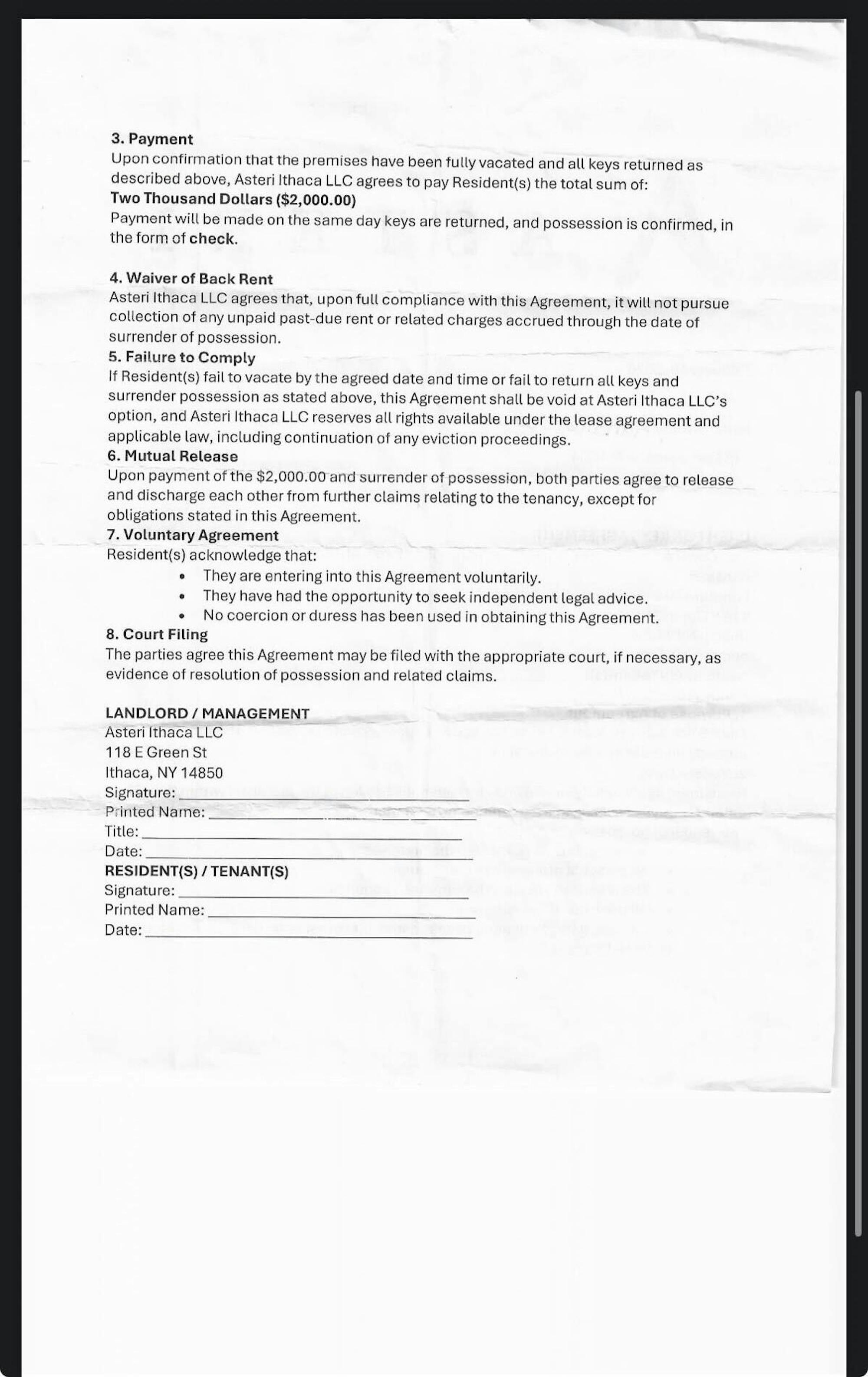
Since February, The Vecino Group has been incentivizing residents moving out through a cash-for-keys initiative. According to agreements made by Asteri obtained by The Sun, the building owners offer $2,000 if residents “fully vacate and surrender possession of the premises” within five days. Signing this agreement releases both Asteri and the resident from any obligations associated with leases.
Alan Karasin, director of the City of Ithaca’s Department of Information and Community Engagement, said that he heard “rumors” about the initiative, but had “not seen anything official confirming it.”
“Anything that would be done kind of on-the-fly like this just sounds — I’m going to use the word ‘predatory,’” Karasin told The Sun.
Under Ithaca housing regulations, landlords are obligated to pay displaced residents double their monthly rent, prorated for each day they are displaced.
“Our concern is that Vecino knows that they’re likely to owe people a lot more money than what they are offering,” Karasin told The Sun.
He added that he would be surprised if residents signing this document in a “time of distress” would actually nullify their leases, but said it “comes across as that’s what Vecino is doing — by taking the $2,000, you’re forgoing whatever those rights are.”
Jordan Berrios, an Asteri resident, told The Sun that this offer is still available. He declined when he was first offered cash for his apartment because he believes he has enough evidence against the Vecino Group to build a habitability lawsuit, where he could earn a payout far more than $2,000.
"I wasted a whole year of my life … and we suffered greatly. ... A lot of bad things happen," Berrios said.
Berrios is not the only one considering litigation regarding Asteri. Another resident, Wytheria Harriet, filed a lawsuit against the City on March 5 due to her displacement during the order to vacate.
This follows a different lawsuit initiated in May 2025, in which Harriet and eight other plaintiffs alleged Asteri failed to provide a place “fit for human habitation.”
The Ithaca Downtown Conference Center, which shares the building with Asteri, sued the Vecino Group in 2025, claiming that Asteri’s building managers did not take action despite repeated concerns about unhygienic building conditions and safety issues.

Ongoing “Dangerous Conditions”
For residents like Carter, who has lived at Asteri for almost two years, while the order to vacate came as a surprise, the “dangerous” conditions which prompted it did not. He described Asteri as an unhygienic place to live, with dog feces scattered around hallways and broken windows. In video footage from 12 News, trash, needles and broken glass within stairwells are visible, along with soot from a fire from over a year prior.
“Vecino hasn't just failed to handle the situation at Asteri. Rather, Vecino's failure to adequately staff and manage the Asteri residences actually created the situation at the building,” Legislator Deborah Dawson (Seventh District), who also serves as TCIDA Chair, told The Sun.
Support services were available for residents who were displaced: many were housed in hotels, and the Tompkins County Public Library offered a warm place to stay during the day. Residents had access to free transportation through the Tompkins Consolidated Area Transit. Foodnet on Wheels and the City of Ithaca additionally provided two frozen meals to each returning resident to help ease the transition once the order was lifted.
While the city and Vecino group provided some support for Asteri residents, some residents experienced setbacks following the order to vacate.
Tony Morrow, a resident of Asteri since it opened, said he was kicked out of the hotel where he was staying after hotel staff thought he was using someone else’s name to stay there, leading to a six-day period where he was left essentially homeless.

Tony Morrow speaks to The Sun during an interview conducted outside the Asteri Building.
“Nothing Like the Brochure”
Dawson said residents are “consistently and dangerously underserved” by the Vecino Group and building management.
According to Dawson, earlier this year, a man’s dead body sat in an Asteri apartment for days due to the “smell of the body being masked by the stench of piles of garbage in the hallway.”
The unnoticed body was one of the many concerns Dawson had about the safety and conditions of the building.
These concerns have prompted the TCIDA to issue a notice of default to the Vecino Group following the order to vacate. If the Vecino group doesn’t remedy their management problems, they could lose their tax abatement, which is roughly half a million dollars per year.
The blocked stairwell that caused the city of Ithaca to issue the order to vacate was just one of over 40 building violation codes the city found earlier this month, according to Dawson.
The Tompkins County Legislature also voted at their March 19 meeting to set aside $50,000 to help residents navigate housing instability and access legal resources in the wake of the order to vacate.
“Access to legal support at critical moments can make the difference between stability and displacement,” Legislator Shawna Black (Sixth District) said at the meeting. “We must do more to ensure that residents are not navigating these situations alone.”
The Asteri website boasts of “sophistication,” “health-minded living” and “urban luxury.” Berrios, who is unemployed and previously incarcerated, had “high hopes” when he was first considering applying for an apartment.
After living in Asteri for one and a half years, he said he realized that “it is nothing like the brochure.”
“People have died because of this circus,” Berrios said, “It feels like all of our brains are being altered … like a freak experiment.”
Asteri provides in-house services from Tompkins County Community Action, such as family support services, sobriety programs, rental assistance and a food pantry, according to its website.
Since the building opened, there have been reports of a woman threatened with an axe, a woman attacked in her apartment and a man stabbed in the chest. Residents describe high rates of crime and drug use.
In a November 2024 interview with The Sun, a resident said he views Asteri as “the new ‘Jungle,’” referring to the homeless encampments outside of Ithaca’s First Ward. Carter added that many residents from these encampments have moved to Asteri since the building opened.
Carter said he has noticed some security improvements since returning to the building, and that the building was “far worse” when he first moved in.
Now, he thinks Asteri may have “just been a bad idea.”
Although Berrios has lived at Asteri for about a year and a half, he only got the lease for his apartment last February; before that, he was couch-surfing at friends’ Asteri apartments.
Before the order to vacate, many homeless people stayed at friends’ apartments in Asteri. However, the era of coach-surfing is likely to end with heightened security following the vacation. Security guards now have lists of official residents whom they are letting back into the building.
According to The Ithaca Voice, residents are no longer able to have key access to the front door. Now, in order to get into the building, they must check in with 24/7 security personnel whose role is to keep non-residents out.
The Vecino Group did not immediately respond to The Sun’s request for comment.
Clarification, April 8, 11:02 p.m.: This article has been updated to more accurately reflect Alan Karasin’s statements on the cash-for-keys initiative.

Valencia Massaro is a member of the Class of 2029 in the School of Industrial and Labor Relations. She is a senior writer for the news department and can be reached at vmassaro@cornellsun.com.


