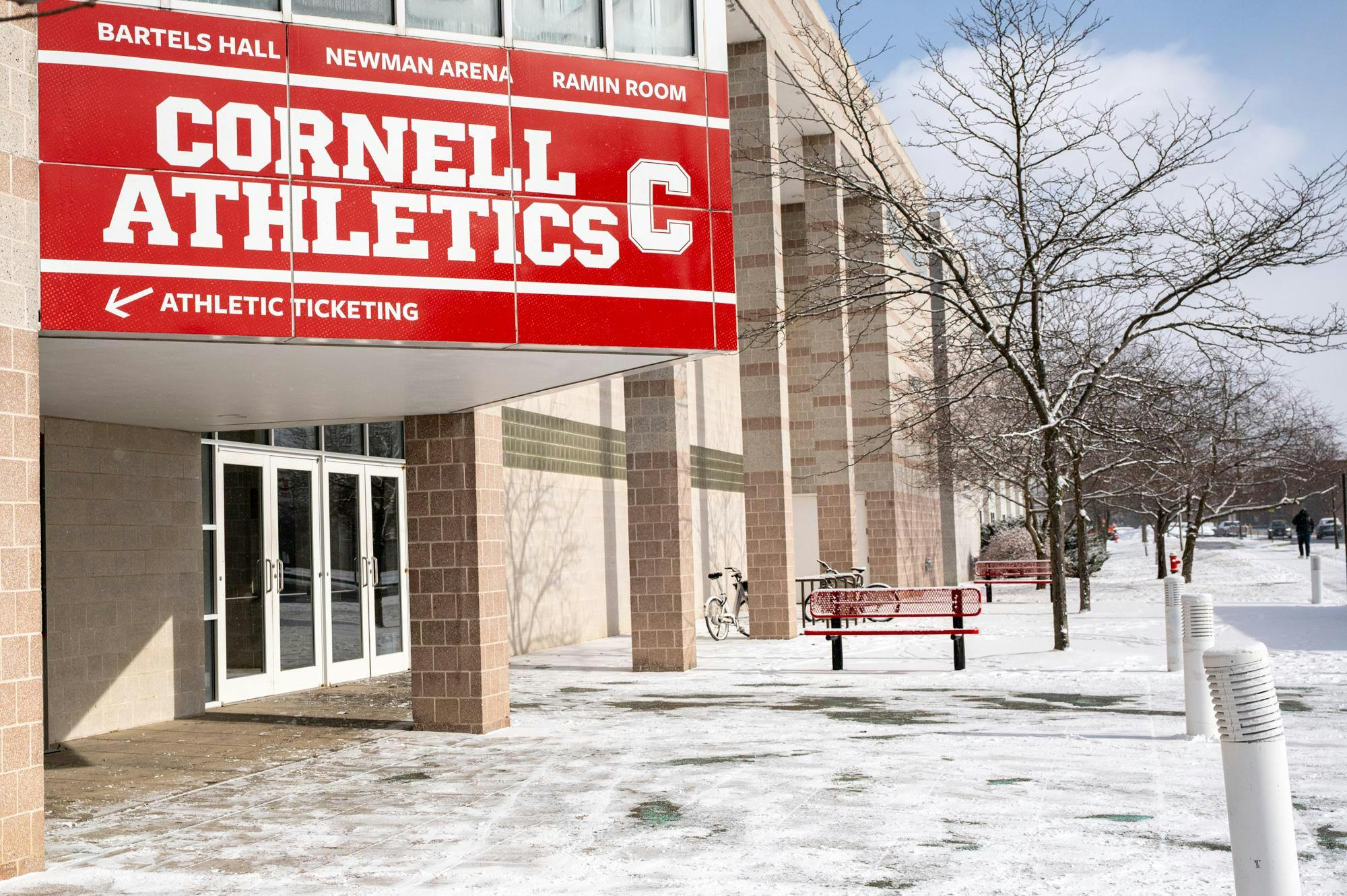
Almost five years after the Supreme Court’s NCAA v. Alston decision allowed college student-athletes to monetize their Name, Image and Likeness (NIL), Cornell Athletics has launched Big Red Exchange, the University’s first official NIL marketplace.
Big Red Exchange, which officially launched on April 15, is a business registry “designed to connect Cornell student-athletes with businesses, brands and community partners” through a single platform maintained by Cornell, according to the Athletics announcement.
NIL allows student-athletes to profit from endorsements, advertisements and other commercial uses of their personal brand. At Cornell, student-athletes may participate in NIL deals if they comply with University guidelines.
In the “Learn More” section of its website, Big Red Exchange outlines the rules and requirements of the platform, especially regarding employee or coach involvement with NIL deals.
“University employees, including coaches and members of the athletics department, CANNOT negotiate deals or contracts. However, they can direct student-athletes to NIL-related opportunities on the Big Red Exchange,” the webpage states.
Built in partnership with Teamworks Influencer, a platform that connects student-athletes with NIL opportunities, Big Red Exchange allows for communication between athletes and businesses while ensuring all activity complies with NCAA, Ivy League and New York State regulations.
In an email to The Sun, Amy Foster, senior deputy athletics director for the student athlete experience, described Big Red Exchange and how it aims to improve student-athlete opportunities with NIL.
“The platform enables student-athletes to market themselves effectively, gain exposure to entrepreneurial concepts, and engage directly with organizations interested in NIL collaborations, while operating within applicable regulations,” Foster wrote.
Foster added that Cornell provides support and resources for student-athletes through education by the Athletics Compliance Office and financial literacy programming.
Since NCAA v. Alston, Foster said the University’s approach with NIL remains grounded in Ivy League principles.
“Cornell’s policies continue to emphasize educational access and equity rather than compensation tied to athletic participation,” she wrote.
Communication lecturer Megan Sawey, a scholar in media culture, wrote that Big Red Exchange may reduce the work that comes with managing NIL deals across different platforms.
“In the broader social media creator economy (within which many NIL sponsorships sit), negotiating sponsor relationships across multiple profiles and inboxes can be a real headache,” Sawey wrote in an email to The Sun. “I’d imagine that, in offering a centralized marketplace platform, Big Red Exchange will afford student-athletes a more streamlined experience.”
Sawey also wrote that while the platform may broaden access to potential sponsors, existing inequalities in NIL visibility are unlikely to disappear.
“NIL will always struggle to be an equitable policy because it locates athletes' earning power in factors that don't always have to do with being a record breaker, a generational talent in your sport, etc.,” she wrote. “While Big Red Exchange might place athletes in front of sponsors who may not have found them elsewhere, I don't know if a single marketplace will be able to upend longstanding patterns in NIL spending.”
Prior to the introduction of Big Red Exchange, student-athletes shared mixed views about NIL opportunities at Cornell.
Grace Dwyer ’26, who plays defense on the women’s hockey team, said Cornell provides athletes with annual compliance meetings on NIL policies, but opportunities surrounding NIL are not a major focus at the University because of its Ivy League status.
“They kind of sweep it under the rug a bit,” Dwyer said, referring to NIL opportunities.
During her time at Cornell, Dwyer has not pursued NIL brand deals. She said that her lack of interest in social media contributed to her choice to prioritize her academics and athletic performance over NIL endorsements.
“That’s not really who I am, I guess,” she said. “It doesn’t interest me.”
Research suggests that while NIL is framed as empowering for student-athletes, it also places an additional workload on student-athletes to manage social media and self-branding.
Dwyer said Ivy League restrictions limiting the use of Cornell branding can make that self-branding work more challenging.
“You can’t use the Cornell logos or anything,” Dwyer said. “You kind of just have to use yourself.”
In spite of these restrictions, Sam Masungo ’27, a wide receiver on the football team, said his team has engaged with NIL opportunities through NIL Club, an intermediary platform that allows fans to make monthly payments to support student-athletes. Masungo described it as “pretty much GoFundMe.”
Masungo said he hopes the Ivy League will adopt changes that allow Cornell Athletics to remain competitive with peer institutions.
“If they could pay players to get an Ivy League degree and also play an Ivy League sport, I feel like that would just increase recruiting and actually give kids a reason to come here,” Masungo said.
In 2025, the Ivy League opted out of the House v. NCAA settlement, so its schools do not share athletics revenue with athletes, offer athletic scholarships or directly pay athletes for NIL deals.
Regarding future changes to Cornell’s NIL policy, Foster wrote that “changes remain likely,” and “NIL regulation is still evolving at the national, state, conference, and NCAA levels.”
Masungo highlighted Big Red Exchange as a possible advantage for prospective student-athletes considering Cornell.
“A lot of players now are probably seeing all the money that other schools are getting,” Masungo said. “Knowing they can make money here increases our recruitment chances.”
As Dwyer prepares to graduate this year, she acknowledged both the potential and uncertainty of Big Red Exchange moving forward.
“Obviously the launch is good,” she said. “It’s going to be interesting to see how they implement this.”

Sophia Koman is a member of the Class of 2027 in the College of Agriculture and Life Sciences. She is a senior writer for the news department and can be reached at skoman@cornellsun.com.