

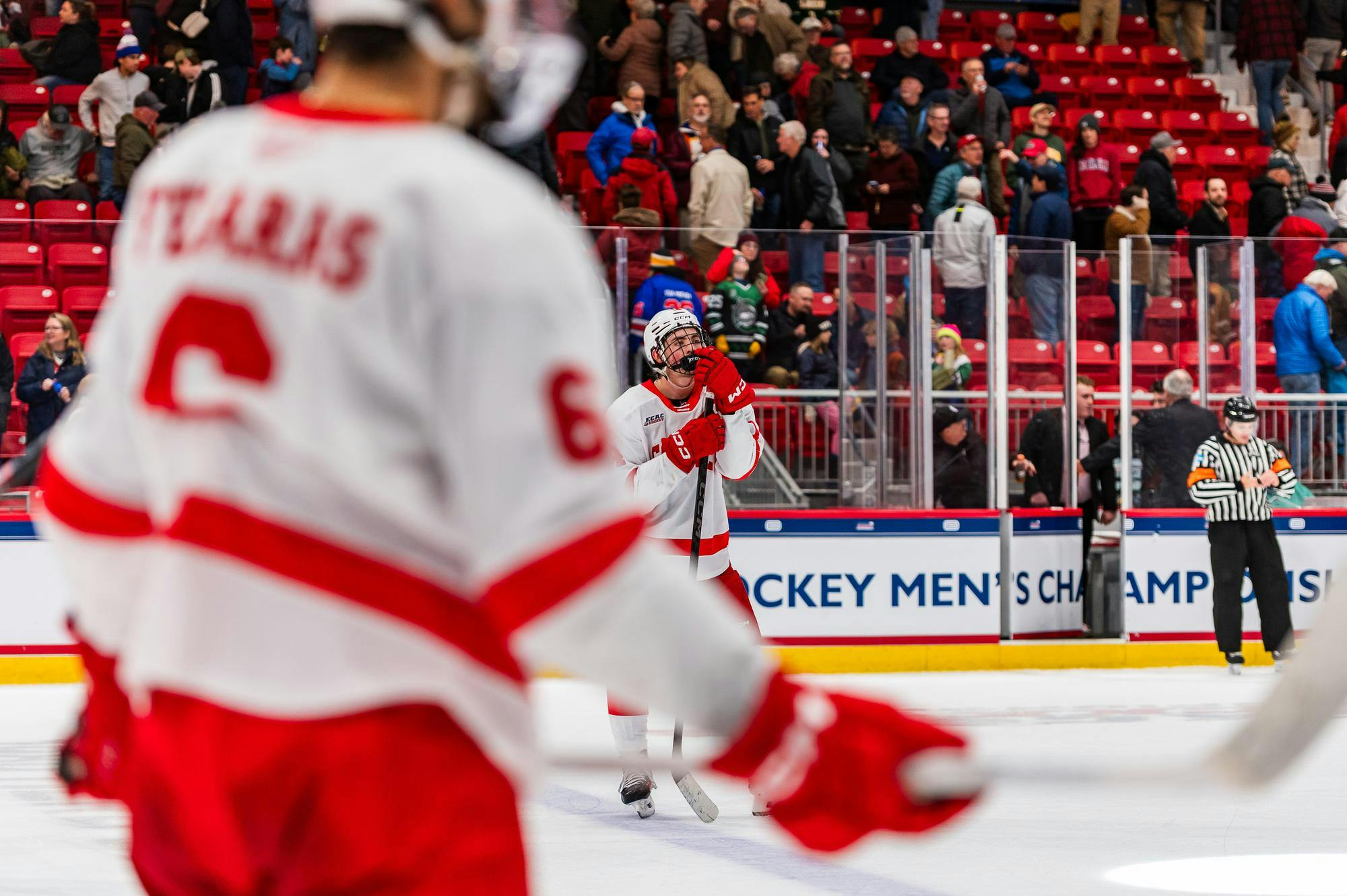
LAKE PLACID, N.Y. — Junior forward Ryan Walsh had his face buried in his glove.
Freshman defenseman Xavier Veilleux bent over, chest heaving, unable to catch his breath.
Freshman goaltender Alexis Cournoyer watched it all transpire from the bench.
When the final buzzer sounded in Lake Placid, New York, a place that has seen so much recent Cornell success, an unfamiliar result soured the Red’s spirits, a deafening silence besides the piercing screams of Tiger skaters and fans.
Princeton 3, Cornell 2.
“At no point do we feel we found our game in that 60 minutes,” said head coach Casey Jones ’90.
The fourth-seeded Tigers upset third-seeded Cornell, 3-2, in the ECAC tournament semifinal game, advancing to the championship for the first time in eight years and spoiling the Red’s three-peat bid.
The score was close — a one-goal victory for Princeton, which has performed well down the stretch to punch its ticket to the title game. But that loss, no matter how narrow, is not something Cornell will have an easy time stomaching.
“We had an underdog mentality all year with our youth, and in the last couple [games], I don't know if we lost that,” Jones said. “All of a sudden, we read about ourselves and have that impression of ourselves that we're really good now. I think tonight will tell them that in college hockey, you can lose any game, any night.”
Princeton (17-12-3), led by longtime Cornell associate coach, Ben Syer, played a suffocating game. Tiger skaters crashed the net, forechecked hard, sent pucks north down the ice and beat Cornell (22-10-1) skaters to them every time.
In essence, the Tigers beat Cornell at its own game.
“The problem is, we never had sustained offensive zone time,” Jones said. “They did a good job, but we weren't connected tonight. We didn't have three guys near pucks. If one guy was going hard, two guys were watching.”
The third period — one where Cornell was searching for a go-ahead goal — was a microcosm of Princeton’s prowess for getting to the hard areas and doing the dirty work. It was evident in Joshua Karnish’s game-winning goal, a tap-in just atop Cournoyer’s crease, a blatant error in the Red’s defending.
The Tigers crashed the net and soaked up offensive zone time — something Cornell struggled to do all night.
“We did not defend well on the third goal — we got beat up the ice on the second goal,” Jones said. “We talk about being a really good transitional team. Well, part of being a good transitional team is going from offense to defense, and we were poor at that today.”
At the time of Karnish’s go-ahead goal in the third, Cornell was lucky to be in that position — a tied game — considering how much it struggled to match up with Princeton’s desire.
And that’s what it boiled down to — desire.
“They just seemed to want it more than us tonight. It was pretty apparent,” Jones said.
Cornell struck first way back in the first period when junior defenseman George Fegaras’ wrist shot snuck through the five hole of Princeton netminder Arthur Smith just 2:32 into the game. The Red narrowly led in shots on goal after 20 minutes, 8-6, but a late Princeton power play in the dying moments of the first period gave the Tigers a much-needed momentum swing.
That momentum carried over into the second period — Princeton did not convert on the power play, but continued to hem Cornell deep in its defensive zone. The Tigers’ pressure culminated in David Jacobs’ game-tying tally — a beautiful deflection off of a point shot that beat Cournoyer just 2:35 into the frame.
The Red was scrambling after that — before the halfway mark of the second frame, Princeton was out-attempting Cornell 10-1 and controlling the faceoff dot, winning 10 draws to Cornell’s two.
It was one of those Tiger faceoff wins that allowed Princeton to take its first lead of the game — after a neutral zone win, the Tigers went full force up the ice and into the Cornell D-zone, and Julian Facchinelli picked a corner over Cournoyer’s right shoulder to make it 2-1 at 13:28 of the period.
Cornell ultimately found some life late in the period, after a Princeton boarding penalty with 4:05 to go yielded a brilliant Cornell power play, culminating in a Walsh goal that tied the game at two. The passing exhibited along the perimeter and the puck batted in by Cornell’s captain was exemplary, and something to take into the third period.
“They're fighting for their lives,” Jones said. “They're trying to extend [their season]. They get a little mojo, they get home ice for the playoffs — they’re a really good home team — and all of a sudden you could sense it.”
The Red did fight — but the Tigers fought harder. The third period was a blood bath, neither team wanting to give up much, with one mistake likely to prove costly in the end.
Queue Karnish — after Veilleux lost his man and couldn’t box Karnish out of the crease, Princeton’s junior forward beat Cournoyer with 7:55 to play.
The dagger.
“I don't know if we weren't expecting it, or if we thought it was gonna be an easy game or what,” Walsh said. “I take a big part of that responsibility. It's my job to get the guys ready and balance that as a leader.”
Cournoyer was pulled with 1:34 to go, and Cornell assembled some of its best zone time yet, but the Tigers saved the best for last.
In all, Cornell attempted five shots with the extra skater. Three were blocked, two went wide and none made it to Princeton’s netminder. The Tigers swarmed him anyway when time ran out.
“[Princeton is] a really well-coached team, and they're selling out, blocking shots,” Walsh said. “We had a goal of getting 35 shots going into the game, and we got nowhere close to it.”
Though Princeton solidified its position in Saturday’s ECAC championship game against Dartmouth, it did not end Cornell’s season. The Red’s regular season success secured it an at-large bid to the NCAA Tournament, meaning Cornell has more hockey left to play.
The Red’s next opponent and regional location remain to be seen — both will be decided after the NCAA Tournament selection show at 3 p.m. Sunday.
But before Cornell can worry about that, it must worry about how it let Friday’s game — and a chance at another championship — slip away.
“Our body of work this year has been good, and this year, you look at some of our best games, they’re after we've been taught hard lessons,” Jones said. “We're going to use a hard lesson here, use it to motivate us and hopefully tell us what's coming.”
“I don’t know if we knew we had a second life behind us so we didn’t play with enough urgency, but we don't have that extra life anymore,” Walsh said.
Jane McNally is a senior editor on the 143rd editorial board and was the sports editor on the 142nd editorial board. She is a member of the Class of 2026 in the College of Agriculture and Life Sciences. You can follow her on X @JaneMcNally_ and reach her at jmcnally@cornellsun.com.


