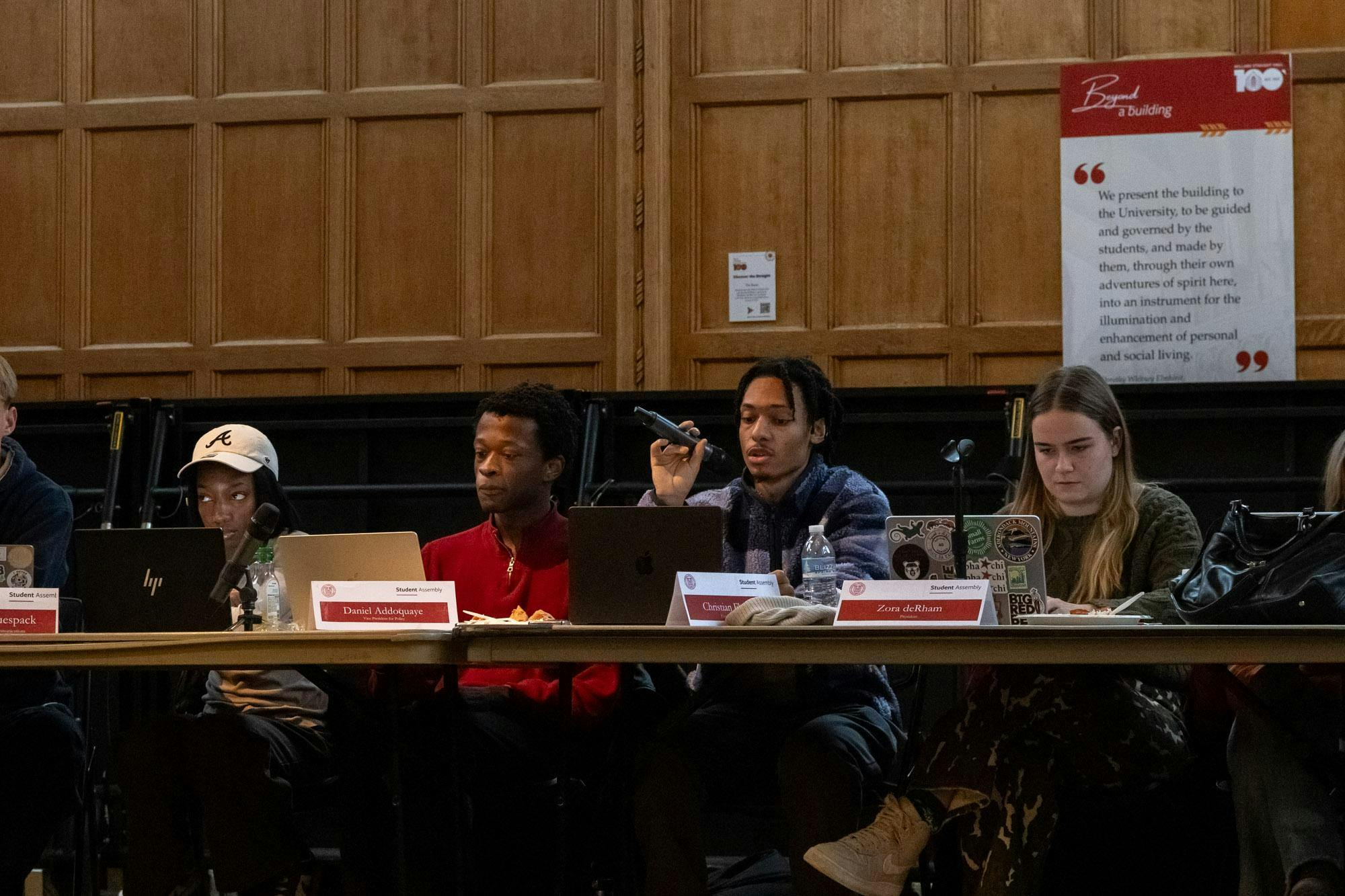
The Student Assembly engaged in a long debate about Resolution 66: “Reassessing Resolution 21:Approving the Recommendation for the 2026-2028 Student Activity Fee" before ultimately running out of time at their Thursday meeting. This follows the rejection of two recent resolutions by President Michael Kotlikoff on Wednesday and Thursday.
The lack of forward progress contributed to mounting frustration about the efficacy of the body from Assembly members.
Kotlikoff Rejects Resolutions 55 and 61
Kotlikoff rejected two controversial Assembly resolutions this week, Resolution 55: “Condemning the University Administration’s Use of Programming to Platform Individuals Implicated in War Crimes,” and Resolution 61: “Calling for the Termination of Cornell University’s Partnership with the Technion – Israel Institute of Technology While Preserving Cornell Tech,” just three days after they were passed — delivering a swift rebuke to the recommendations that contrasts prior complaints concerning delayed administrative responses.
Under the Assembly charter, a presidential rejection effectively halts a resolution, meaning no further administrative action will be taken despite its passage within the Assembly.
These resolutions called for restricting invitations to individuals accused of war crimes from appearing on campus, as well as for severing the University’s ties with Technion – Israel Institute of Technology and Cornell Tech.
The resolutions advanced through the Assembly after two weeks of contentious meetings, during which packed public comment periods revealed sharp divisions among students. Some argued the measures would restrict free speech and limit opportunities for campus dialogue and career development, while others raised concerns about the University’s association with individuals accused of war crimes and those involved in weapons development.
In his formal rejection of Resolution 55, Kotlikoff asserted his strong opposition to the measure.
The resolution “unacceptably seeks to curtail freedom of speech on Cornell’s campus, thereby limiting the scope of knowledge and ideas available to students at Cornell,” he wrote.
This resolution criticizes the administration for hosting, funding or sponsoring programming that features speakers whom the resolution’s sponsors say have been “implicated in war crimes and grave human rights violations.”
Among those referenced is Tzipi Livni, former vice prime minister and former foreign minister of Israel, who participated in the University’s “Pathways to Peace” panel in March 2025.
Livni was subject to war crimes allegations and a warrant for her arrest in the United Kingdom in 2009 for decisions made before and during Operation Cast Lead while she was Israel’s foreign minister and a member of the Israeli security cabinet. The warrant was withdrawn after authorities determined she was not in the country.
Resolution 55 argues that hosting such speakers at University-sponsored events “endanger[s] student well-being.” Kotlikoff rejected this premise, citing Cornell’s Expressive Activity Policy and emphasizing the institution’s commitment to fostering the exchange of ideas — even when those ideas are controversial.
Hosting thoughtful exchanges, especially ones concerning highly contentious topics, give students an opportunity to engage in civil discussion and debate, Kotlikoff argued, describing such engagement as, “key to the function of both a university, and a democracy.”
Kotlikoff also criticized what he believed to be “clear indications of political bias” in the resolution, and quoted it directly, saying that, “exposure to controversial ideas and individuals does not ‘create a hostile and coercive academic environment.’”
“Indeed, I see this resolution by the Student Assembly as a regrettable attempt to further the notion that there is virtue in silencing speech with which we disagree”, Kotlikoff wrote. “Any attempt to restrict the sharing of perspectives — whether by shouting down speakers, disrupting events, or imposing political litmus tests on invitations — is anathema to the principles and purpose of our university, and has no place in our community.”
Kotlikoff also rejected Resolution 61, a measure which urges the University to end its institutional partnership with Technion.
Cornell Tech and Technion jointly established the Joan and Irwin Jacobs Technion-Cornell Institute, an applied sciences campus in New York City that offers dual master’s degree programs and a postdoctoral program, in 2013.
The resolution cites ethical and legal concerns related to Technion’s alleged involvement in the development of military technologies connected to human rights violations.
In his rejection statement, Kotlikoff warned against the broader implications of ending academic partnerships for political reasons.
“Severing our relationship with Technion — or with any entity affiliated with governments, institutions, or enterprises with which some of our community members disagree — as a statement of political protest, would not only hinder our research, teaching, and public engagement; it would imperil our academic principles,” Kotlikoff wrote.
Kotlikoff also referenced what he described as the seemingly “selective” nature of the resolution in evaluating institutional partnerships and their morality, noting that Cornell currently maintains 159 active agreements across 59 countries and regions, many of which, he said, involve institutions engaged in military and security-related research.
“The political bias evident in this selective approach is deeply disturbing,” Kotlikoff added, “and the resolution is incompatible with both the Student Assembly’s purpose and Cornell University’s core values. I reject it fully and forcefully.”
The author of the two resolutions, Yasmeen Masoud ’28, did not immediately respond to a request for a comment from The Sun, however, she addressed the criticism of her recommendations during last week’s Assembly deliberations, pushing back against claims that the measures targeted specific individuals or political groups.
“This resolution does not at all, in any place, in any line, in any of my speech, target Israeli politicians specifically at all. This does not target Israeli war criminals specifically at all,” Masoud said. “It is any and all war criminals, accused war criminals, somebody who's implicated in war crimes that this is talking about.”
Thursday Meeting
Resolution 66 re-proposed a recommendation for the 2026-2028 Student Activity Fee after Kotlikoff rejected Resolution 21, the original proposal, on Feb. 6, saying the proposed increase would strain the University, which supplements the fee for students who cannot afford to pay it.
Resolution 66 proposed keeping the SAF at its current rate of $424 rather than increasing it.
Debate over the resolution consumed nearly the entire meeting before the Assembly ran out of time. The resolution will now be moved to the top of the third reading calendar for debate at the next Assembly meeting on March 26.
The drawn-out proceedings added to growing frustration among Assembly members, many of whom expressed concern over the body’s inability to move forward not only on Resolution 57, but on a backlog of other undiscussed measures.
Amid these tensions, representative Max Ehrlich ’26 asked all Assembly members who had authored a resolution during the current academic year to raise their hands.
“In my opinion, if you're not raising your hand, you should not be running for re-election for Student Assembly,” he said, framing this legislative engagement as a baseline expectation for holding office in the Assembly.
His remarks come amid a series of increasingly tense meetings this spring, where frustrations have mounted over what members described as a lack of substantive action from within the Assembly, as well as delays or an absence of response from the administration on passed resolutions.
“This is a broader problem with this entire Assembly…it's one word: it's apathy,” Ehrlich said. “I see people all across this room right now who are apathetic about the things that we do, or apathetic about the things that the finance committee do[es] or apathetic about our weekly meetings.”
At the February 19 Assembly meeting, frustration mounted again over what many perceived as the Assembly’s failure to enact meaningful change through its meetings and resolutions.
Eeshaan Chaudhuri ’27, an undergraduate representative, emerged as a particularly vocal advocate for greater action.
“No wonder the student body thinks we’re a joke,” Chaudhuri said at that meeting, addressing fellow Assembly members. “The problem right now is that you are not being active members.”
Following another contentious meeting this week, marked by ongoing procedural disputes, Chaudhuri rose to speak once again, announcing to the room, “I will be running for Student Assembly President next year.”
Student Assembly elections, held each spring, are approaching in late April — placing renewed scrutiny on member participation and accountability as the next election cycle approaches.
Correction, March 22, 11:04 p.m.: This article was updated to correct the resolution, which was originally incorrectly listed as Resolution 57. The debated resolution was Resolution 66. Additionally, a previous version of this article indicated that the Assembly running out of time was equivalent to a rejection. The resolution will actually be moved to the next meeting for further discussion.
Correction, April 22, 7:06 p.m.: This article was updated to correct a broken link to Resolution 66.
Vivienne Cierski is a freshman in the College of Agriculture and Life Sciences. She is a Sun Contributor and can be reached at vsc38@cornell.edu