

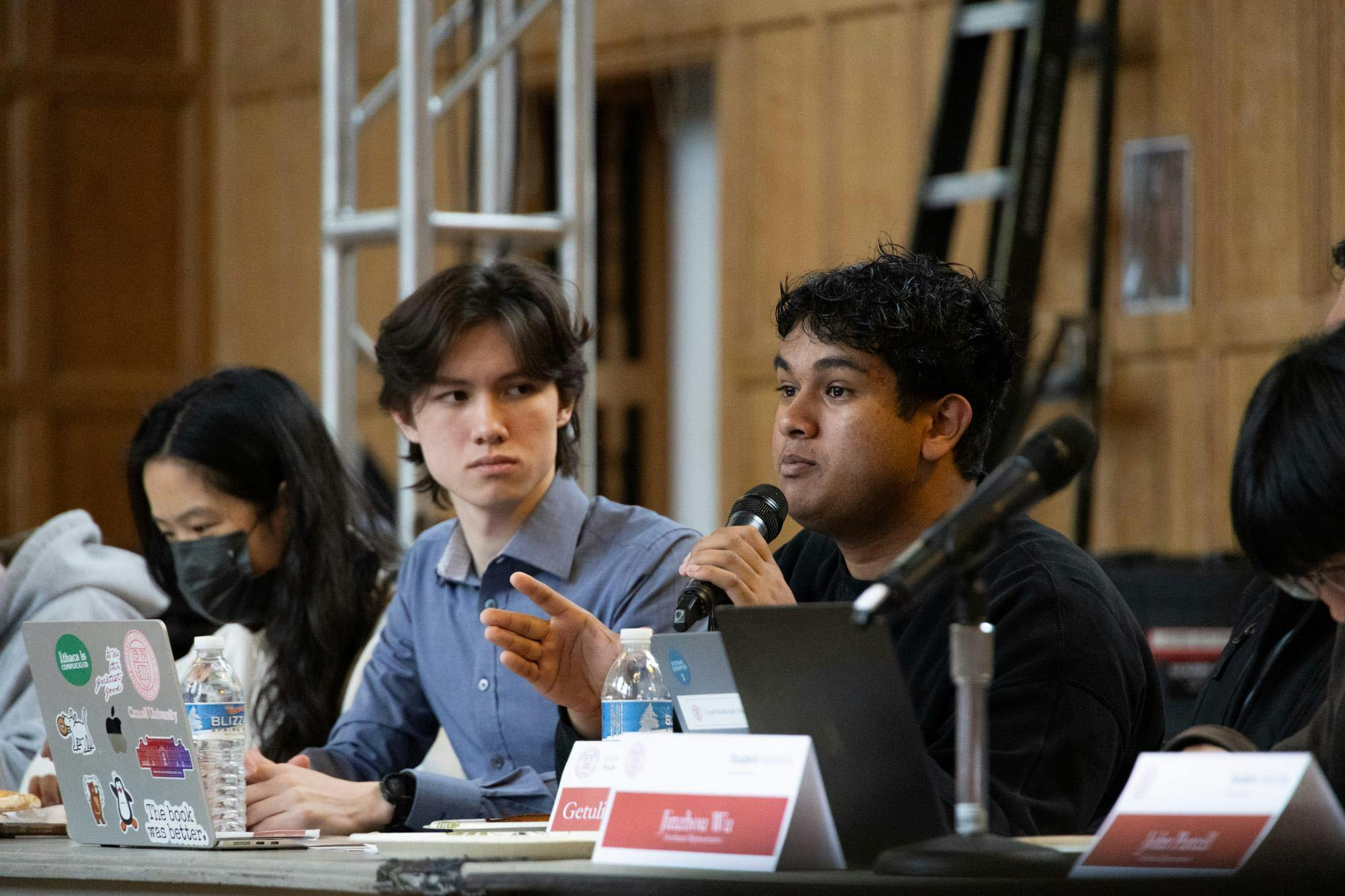
Frustration with internal dysfunction dominated the Student Assembly’s Feb. 12 meeting, as representatives introduced a slate of resolutions aimed at addressing what several members described as persistent inactivity, poor communication and a lack of accountability within the body.
The Student Assembly considered 14 resolutions, many of which criticized internal policy. 13 resolutions were collectively authored by Christian Tarala ’27, Nolan School of Hotel Administration representative, Eeshaan Chaudhuri ’27, undergraduate representative and Lydia Blum ’27, College of Agriculture & Life Sciences representative, who framed the resolutions as a response to low member contribution and the Assembly’s need to contribute more.
Chaudhuri said the volume of resolutions presented reflected what he believes should be standard practice, emphasizing that representatives “should want to come together, work together and represent the communities in this public service role that has so much power, and that's what this conversation is all about."
Throughout the meeting, representatives expressed their grievances with the Assembly’s internal operations, including a lack of Assembly Executive Cabinet meetings — the last of which occurred in October.
“I don’t think our Executive Board right now is doing what it needs to do; everyone needs to step up their game,” Chaudhuri said.
According to the Student Assembly Bylaws, Executive Vice President Christian Flournoy ’27 is tasked with meeting with committee chairs each month. Chaudhuri said that infrequent Executive Cabinet meetings have made it difficult for chairs to provide feedback on issues affecting the student body.
“No wonder the student body thinks we’re a joke,” Chaudhuri said, addressing members of the Assembly. “The problem right now is that you guys are not being active members.”
Resolution 41: “Restructuring the Executive Board” was presented by Chaudhuri and Blum. Chaudhuri expressed frustration over poor communication within the Assembly and a lack of participation, pointing to the small number of resolutions introduced by Assembly members. The resolution sought to restructure the Executive Board to include the chairs of the policy, finance, communications and diversity, equity, and inclusion committees.
President Zora de Rham ’27 acknowledged subpar participation from members of the Executive Board.
“As chair of the Executive Board, it has been herding cats to find a meeting time for people who are supposed to be dedicating more than just two and a half hours to this body every week,” de Rham said.
However, de Rham cautioned that a restructuring of the Executive Board’s responsibilities requires a comprehensive understanding of the Assembly’s governing documents.
“I am not comfortable with this moving forward without a redlining of bylaws and the charter,” de Rham said, referring to a comprehensive line-by-line review of proposed changes to the Assembly’s governing documents.
de Rham said the current structure can function effectively when members are dedicated and consistently engaged, warning that “shifting responsibility away from irresponsible members does not light fire in their ass. It just makes them more lazy and makes them more enabled.”
Resolution 41 was tabled for a week.
The Assembly also engaged in debate regarding Resolution 40: “Sponsorship Requirements For Assembly Resolutions.” This resolution, presented by Tarala and Chaudhuri, sought to bar resolutions from being sponsored by non-Assembly members and instead require all resolutions to be sponsored by members of the Assembly.
“What is the point of having representatives if anyone can just endorse resolutions?” Tarala asked. “It dilutes the point of the Assembly.” Tarala argued that sponsoring resolutions should be the responsibility of elected representatives.
Ameera Aftab ’26, representative at-large, voiced her disapproval of the resolution, noting that two of the biggest resolutions last year were presented by student organizations and students outside of the Assembly.
“Why should we take credit for other people's work, just because we hold a seat?” Aftab asked. “We can’t just take credit for their work because we won an election.”
After disagreement between representatives, the resolution was passed to the third reading calendar.
Resolution 39: “Rebranding the Student Assembly to the Cornell Student Senate,” presented by Chaudhuri, argued that the Student Assembly’s abbreviation to S.A. has negative connotations. The resolution offered Student Senate and Student Government as alternatives.
de Rham pointed out that the Student Assembly does not have direct power like the Faculty Senate, and using the term Senate could undermine “the gravity of [the] Senate.” However, she agreed with the sentiment of the resolution, instead supporting the term “Student Government.” The resolution was moved forward to the third reading calendar.
Resolution 45: “Creating a Membership Spotlights & Accountability Mechanism” was presented by Chaudhuri. The resolution aimed to promote participation and accountability by establishing a public semesterly Student Assembly report, summarizing each representative’s work or otherwise documenting a lack of participation that semester.
Max Ehrlich ’26, School of Industrial and Labor Relations representative, presented Resolution 42, a resolution enacting the enforcement of Resolution 9: “Ending Career Services Collaboration with ICE.” Ehrlich coauthored Resolution 9, which was conveyed to President Michael Kotlikoff on Oct. 8. According to Ehrlich, President Kotlikoff’s failure to request reconsideration to Resolution 9 within 30 days violated a binding agreement with the Assembly.
de Rham commented that since the President’s office notified the Assembly that Kotlikoff’s response would be delayed, the administration may view the resolution as being responded to within 30 days. Ehrlich replied that while the President’s office responded within 30 days, they failed to fulfill their obligation to formally reconsider the resolution.
Resolution 43 was passed to the third reading calendar.
The Assembly also passed the following to the third reading calendar: Resolution 33: “Making General Election Day A Campus Holiday,” Resolution 34: “Standardizing Resolution Authors and Endorser Rules,” Resolution 37: “Maximum Printing Cap,” Resolution 38: “Increasing Outreach Requirements,” Resolution 43: “Creating Restrictions & Evaluation Criteria around the Special Projects Fund,” Resolution 45: “Creating a Membership Spotlight & Accountability, Resolution”, Resolution 47: “Chair Information Transfer,” and Resolution 48: “Public Comment Duration.”
Resolution 35: “Transferring Funds to the Administrative Account,” and Resolution 45: “Creating a Membership Spotlights & Accountability Mechanism were passed via the consent calendar, while Resolution 36: “Establishing a Student Assembly Year-Round Grant and Review Committee” was tabled for one week.
The Assembly also approved reimbursements for several student organizations’ off-campus travel related to educational and professional activities, including the Ethiopian Student’s Association, Cornell Capitol Club, Med in Black Association, Air and Sea Hospitality, and Speech and Debate Society.

Sofia Loayza is in the College of Agriculture and Life Sciences. She is a senior writer for the News department and can be reached at sloayza@cornellsun.com.


