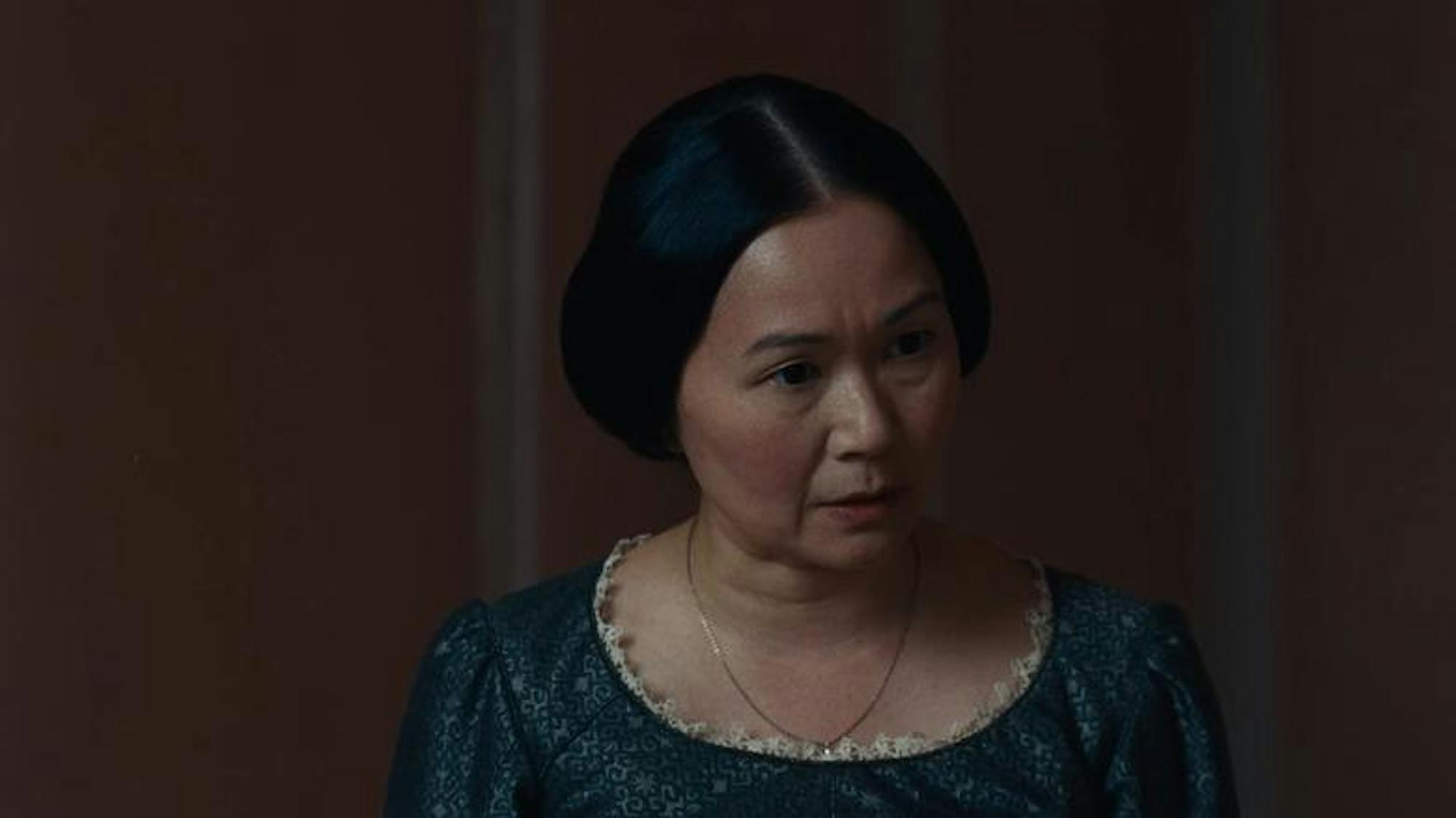
I should preface this with the fact I haven’t read Wuthering Heights yet. Thus, my experience of the characters is informed entirely by Emerald Fennell’s controversial movie adaptation. Criticism of the film focuses on the lack of chemistry between Catherine Earnshaw (Margot Robbie) and Heathcliff (Jacob Elordi), casted as a white man to play an originally non-white character in the novel, the gross historical inaccuracies in the costuming and overall set decoration. However, no one seems to be discussing the characterization and treatment of Nelly Dean (Hong Chau).
The audience is introduced to Nelly, Cathy’s paid companion, at the start of the film; unlike free-spirited Cathy, Nelly is portrayed as quiet and proper. Their personality differences immediately show their incompatibility, and when the family takes in Heathcliff, Cathy begins distancing herself from Nelly in favor of Heathcliff’s companionship. Years later, Nelly’s position remains, taking on a more servant-like role.
Nelly is forced to remain under Cathy’s beck and call due to her status within society. As an illegitimate daughter of a lord, Nelly does not have the same opportunities as Cathy, the simple daughter of an untitled man. Her life is already relegated to companionship or similar employment, and if she were even to marry, it would be to someone in the servant class. Nelly has no chance at happiness or an independent life, something she fairly grows to resent.
Her trapped status is constantly reminded to her by maids and eventually by Cathy. After Cathy accepts her wealthy neighbor Edgar Linton’s (Shazad Latif) proposal, she has a breakdown in front of Nelly. She begs for Nelly’s advice before immediately lamenting her problems. To Cathy, her heart belongs entirely to Heathcliff, who is beneath her in both status and wealth. As her father gambled and drank all their money away, Cathy felt she must marry Edgar to survive her situation. While Cathy continues sobbing over this decision, Nelly grows rightfully agitated, as the decision, while unfortunate, is glaringly obvious.
During their conversation, Cathy directly insults Nelly, saying that no one has ever loved her and no one ever will. It’s a spoiled and terrible thing to say to someone you’ve been companions with for decades, and Nelly is rightfully hurt. Cathy throws her ability to be married and loved in Nelly’s face for no justifiable reason. The remark is a declaration of war, something no relationship or friendship can ever truly heal from.
Nelly is destined to a life of servitude and unhappiness without freedom of choice due to her status and employment. For Cathy to reduce Nelly to her inabilities, she shows how spoiled and self-centered she is, something that could be understandable for a teenager — Cathy is 18 years old in the novel — but rings hollow when Robbie is a mature woman in her mid-30s.
After experiencing this horrific remark, Nelly chooses not to tell Cathy that Heathcliff was at the door, resulting in him eavesdropping that Cathy could not lower herself to marry him. He walks away without listening to her full speech, unaware that she also deeply loves him. This results in his departure from the property, leaving Cathy devastated and stuck with marrying Edgar. When Heathcliff returns years later, Cathy realizes that Nelly could have prevented their separation, declaring her a traitor.
Yet, Cathy forgets that she betrayed her companion first by remarking that no one could or would ever love her. Her insult during that conversation was the ultimate betrayal of their relationship. Cathy may see Nelly as the ultimate traitor to her supposed happiness, but she refuses to see that she herself caused the scenario by choosing to be horrible to Nelly.
Additionally, it’s not on Nelly that Heathcliff left. He chose to leave; she didn’t tell him to go. Even if Heathcliff had stayed, would Cathy have married him then? Would her father have permitted it? Likely not. She was probably going to have to marry Edgar regardless, considering she already agreed to his proposal.
Nelly is also portrayed as the person who allows Cathy’s death, as she doesn’t take Cathy's claims of illness and the baby’s death seriously. While true, Cathy is also remarkably uncommunicative in her heartbreak when Heathcliff marries someone else. So, while Nelly should have seen the signs and taken Cathy seriously, she never maliciously meant harm.
I assume in the novel, Cathy and Nelly’s characterizations are treated with respect, showing how both women are flawed in different ways. However, Fennell’s adaptation treats neither character with the dignity of complexity, instead relegating Cathy to the constantly validated protagonist and Nelly to the villain.
Although definitively not an angel, Nelly’s portrayal in the narrative as an almost Judas-level betrayer is incredibly unfair. Her status as an illegitimate lord’s daughter prevented her from both a childhood and a life, forcing her into a role she must remain in until Cathy dies. Additionally, Cathy's continual behavior as a spoiled and unlikable person who frequently looks down on Nelly leaves her justified in her resentment.
Nelly is many things, but she is not the main villain. There is no villain. They all suck.

Kate LaGatta is a member of the Class of 2029 in the College of Arts and Sciences. She is a columnist for the Arts & Culture department and can be reached at klagatta@cornellsun.com.