


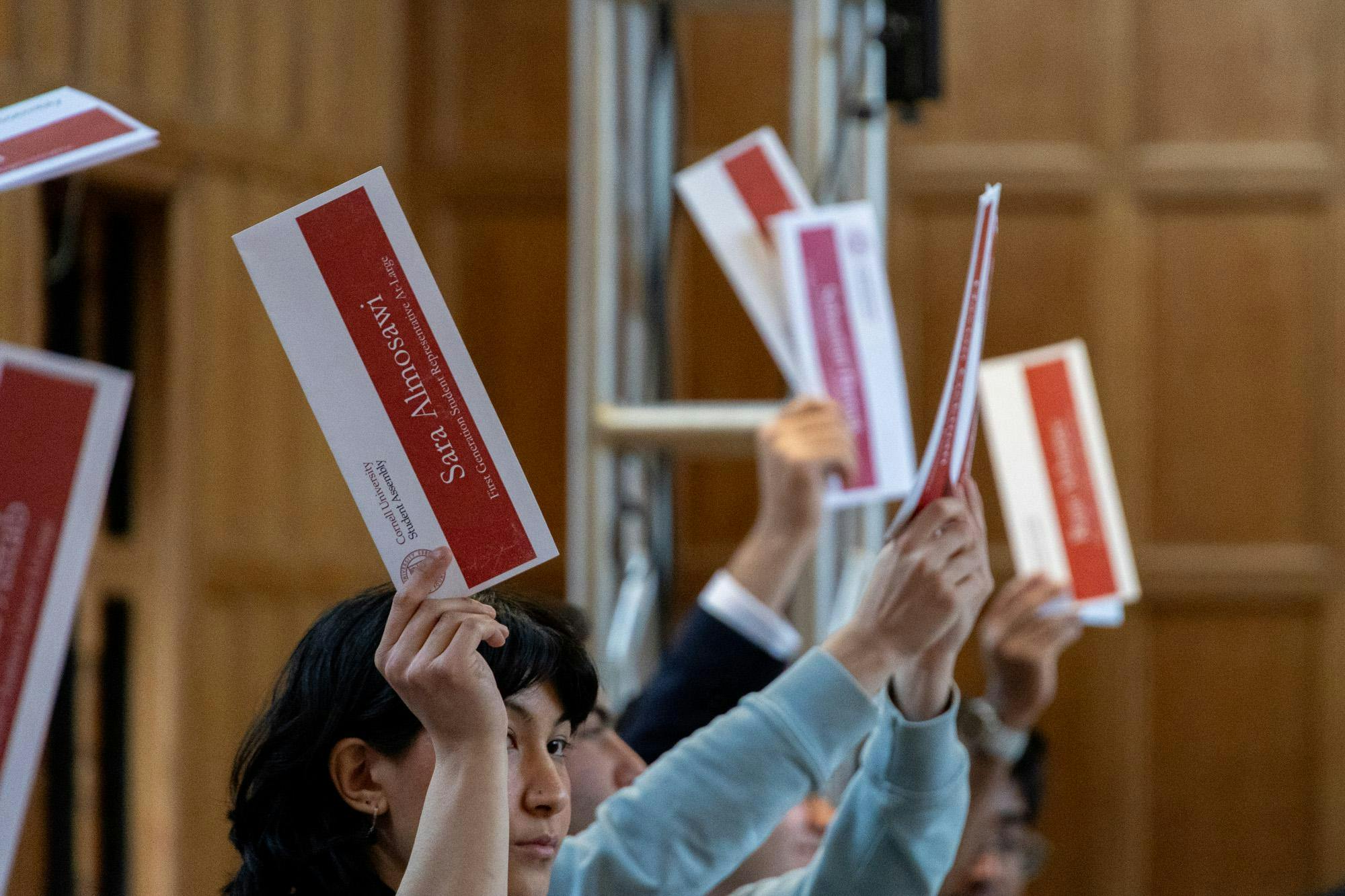
The Student Assembly voted Thursday to rename itself the Student Governance Assembly, marking one of more than a dozen resolutions passed during a meeting that also renewed pressure on President Michael Kotlikoff to enforce a previously passed anti-Immigrant and Customs Enforcement resolution.
The meeting adjourned before all tasks on the agenda were addressed due to time constraints.
Enforcement of Anti-ICE Resolution
The Assembly passed Resolution 42: “A Resolution Enacting the Enforcement of Resolution 9,” which calls for the immediate enforcement of the previously-passed Resolution 9 in light of Kotlikoff’s failure to respond within 30 days.
Resolution 9: “Ending Career Services Collaboration with ICE,” passed on Sept. 25, called for Cornell to end Career Services’ events with Customs and Border Protection and remove all ICE and CBP postings from the job platform Handshake.
Under the Assembly charter, the president is required to respond to conveyed resolutions within 30 days. While the Office of the President notified the Assembly that Kotlikoff’s response would be delayed, he failed to formally issue an acknowledgement until 63 days after Resolution 9 was conveyed.
“Cornell values students having the opportunity to consider a comprehensive set of possibilities for their careers after graduation, and does not screen employers on Handshake for political motivations or affiliations,” Kotlikoff wrote in his acknowledgement.
“Resolution 9 should have been enforced. They did not respond timely, so it should now be enacted,” Max Ehrlich ’26, ILR representative, said during the Thursday meeting.
Resolution 42 asserts that because the 30 day response requirement was not met, the earlier resolution should now be considered enacted.
Debate quickly turned to procedural and legal implications.
“There is a requirement to request reconsideration within 30 days,” Ehrlich said, referring to the Assembly charter. “This is, to an extent, a legal matter.”
Some members alluded to taking “further action” beyond producing resolutions, since the president broke the charter agreement — an agreement several Assembly members referred to as “binding” — through inaction.
“[Kotlikoff] is contracted to do these things,” asserted Kennedy Young ’28, vice president of diversity, equity and inclusion for the Assembly, referencing the president’s formal obligation to acknowledge Assembly resolutions in a timely manner.
Frustration was evident among some representatives who argued that inaction by the administration undermines the Assembly’s authority.
“We need to make it clear that we won't abide by Kotlikoff stepping all over us, because that's B.S.” Ehrlich said.
Resolution 42 ultimately passed 28-1.
Student Assembly Renamed to Student Governance Assembly
Resolution 39 proposed a name change from the Cornell Student Assembly to the Cornell Student Governance Assembly. The body's name will not be formally changed until the resolution is approved by President Kotlikoff.
“There’s consistent confusion between … ‘SA’ meaning Student Assembly and ‘SA’ meaning sexual assault,” said Eeshaan Chaudhuri ’27, vice chair of operations for the Univeristy Assembly during the meeting. “That confusion undermines the clarity of our institution.”
Student Assembly’s new acronym will be SGA, and they will continue to use “the Assembly” when referring to the body in shorthand.
Members also framed the change as part of a broader effort to modernize the Assembly ahead of the upcoming student body election cycle.
“A rebrand is necessary … as we move into this next election cycle,” Chaudhuri said. “We need a name that reflects what this body actually does.”
While the measure ultimately passed without opposition, several representatives noted that the change would require extensive updates to official documents, digital platforms and branding materials.
Supporters pushed back against arguments that logistical inconvenience should delay reform.
“Just because something is hard and annoying doesn’t mean we shouldn’t do it,” Chaudhuri said.
Special Projects Fund Restrictions
The most extended debate of the evening centered on Resolution 43: "Creating Restrictions and Evaluation Criteria around the Special Projects Fund" , which creates new restrictions and evaluation criteria for the Special Projects Fund.
The Special Projects Fund distributes money from mandatory student activity fees, to support student organizations and programming. Members expressed growing concerns over how the fund has previously been allocated and whether its structure promotes equitable access.
“How can we actually use this money for the betterment of the student body?” Chaudhuri asked when introducing the resolution.
Chaudhuri argued that the fund lacks sufficient guardrails, and that clearer criteria are needed to ensure student fees are distributed fairly. “We’ve been treating it as an endless pile for far too long,” he said.
Chaudhuri described the issue as structural rather than personal, stating, “There’s a huge equity issue coming into play.”
Central to the debate was whether student organizations with selective or interview-based membership should receive funding from the Special Projects Fund.
Supporters of the resolution emphasized that the measure does not target cultural organizations or affinity groups, but seeks to distinguish between open-membership and closed-membership groups.
However, critics warned that tightening funding criteria could unintentionally harm communities that rely on the fund for programming.
Daniel Addoquaye ’28, vice president for policy, cautioned that this change risks undermining “safe spaces for communities,” expressing concern that the policy could have unintended consequences.
The resolution calls for clearer evaluation standards and additional oversight mechanisms to guide future funding decisions.
Debate stretched for more than 40 minutes before the Assembly moved to a roll-call vote, with members eventually voicing their fatigue of the discussion.
“Why are we even trying to pass this … resolution right now?” Ehrlich asked.
The measure ultimately passed 14-12-1, reflecting the division among members over how the funds should be spent.
General Election Day Holiday
The Assembly also passed Resolution 33: “Making General Election Day a Campus Holiday”, recommending that Cornell close during General Election Day to facilitate student voting turnout.
“We should make it easy for students to vote,” Ehrlich said during debate.
Supporters argued that academic obligations can present barriers to voter participation, while critics questioned whether the University could adjust the academic calendar to accommodate the change.
Additional Measures
Several additional internal policy resolutions passed.
Resolution 37 implements a maximum printing cap per course, Resolution 38 increases outreach requirements for Assembly members, Resolution 45 requires an “Assembly Roundup” to be compiled and released to the undergraduate body once per academic semester and Resolution 47 establishes clearer information transfer procedures for committee chairs.
Resolution 40, which would have established sponsorship requirements for Assembly resolutions, was tabled indefinitely.
Correction, Feb. 23, 7:19 p.m.: This article was updated to clarify that the name change is not immediately effective, and to delete a paragraph connecting the Special Projects Fund to discourse regarding the byline funding cycle, which comes from a different fund.

Emma Spindler is a member of the Class of 2028 in the College of Arts and Sciences. She is a senior writer for the news department and can be reached at espindler@cornellsun.com.


