Now in its sixth year, the Cornell project team CU GeoData bridges engineering and earth sciences to design and deploy environmental sensors, including a sensor network across the Finger Lakes and a specialized weather balloon for atmospheric research. Through these projects, the team hopes to make data more accessible to local communities and contribute to research on environmental change.
GeoData is divided into five subteams — the Air, Rock, Water, Data and Tech teams — that collaborate to design sensors and instrumentation to collect environmental data under the project team’s shared tagline “Design, Build, Deploy.”
“There is a lot of focus when it comes to building models and stuff that the Ithaca community can use,” said Orion Hoch ’28, GeoData’s current secondary lead and Water Team lead. “But realistically, a lot of our work is just in providing as much as we can to the research field.” The Water Team leads water quality assessment, water resource management, and related projects.
As an engineering project team in the earth and atmospheric sciences department, GeoData brings together students from computer science, engineering and earth and atmospheric sciences, providing a unique interdisciplinary approach. These diverse perspectives have helped GeoData take on projects from both a research and product development perspective, according to Kylie Miller ’26, current primary lead of GeoData and former air team lead.
“[For] a lot of people, instead of designing their own stuff, they'll order it and then focus on the data,” Miller said. “But since we have electrical engineers, mechanical engineers, chemical engineers, everybody's taking their expertise and then focusing on what they can develop.”
According to Nour Kastoun ’26, former primary lead of GeoData and current senior advisor, the team hopes to move towards more team-wide projects that integrate the strengths of each subteam. “It's cool because we all have different strengths,” she said. “And we're all interested and passionate in bringing all of our different strengths together to solve relevant problems.”
Currently, GeoData is focusing on an ambitious project to develop a sensor network around Cayuga Lake that will deploy air, water and soil sensors at thirteen proposed or existing sensor sites around the lake.
The team has already deployed some soil moisture sensors and weather stations at locations including the Cayuga Nature Center and Cornell Sailing Center. They also plan to install a weather station at the Montezuma National Wildlife Refuge, located at the north end of Cayuga Lake. For future installations, the team is developing a 3-D printed weather station that will be less expensive to produce than commercially purchased models.
The sensor network aims to fill a gap in the available earth and climate data of the Ithaca region. Soil moisture and air quality sensor networks around Cayuga Lake are minimal and infrequently maintained. Weather forecasts in Ithaca are primarily sourced from a national weather service center in Binghamton, which can decrease the accuracy of weather forecasts, according to Miller.
Using the sensor data, GeoData hopes to create improved forecasts and environmental models that are accessible by the local community. Previous data that the team has collected is stored on the Network for Environment and Weather Applications, a database run by Cornell and various regional environmental organizations. However, the team is developing a new website to collate air, soil and water data that they hope will be more accessible to the public as a single hub for environmental data.
The air team also hopes to connect their weather data to Weather Underground, a commercial weather service that provides real-time weather information and forecasts, with the intent of improving the quality of weather forecasts in Ithaca.
Ultimately, the goal of the sensor network is “having more local weather stations and data [and] being able to provide that, free of charge, to agricultural professionals and farmers, so that they can actually make better informed decisions about when to plant, when to harvest,” Kastoun said.
Hoch emphasized the importance of this type of sensor data for understanding environmental change.
“I really think that environmental data research is all about finding new ways to find proxies for climate trends, finding proxies for how things are changing in our environment, especially with the anthropological effects,” Hoch said.
For Miller, developing these sensors has provided valuable experience working with real-world data.
“If you take a data science class, they give you already-cleaned, ready-to-use data, which is not stereotypical of what you would collect in the real world,” she said. “It's been very useful trying to get real-life messy data from the environment and then making that clean and trying to analyze trends from that.”
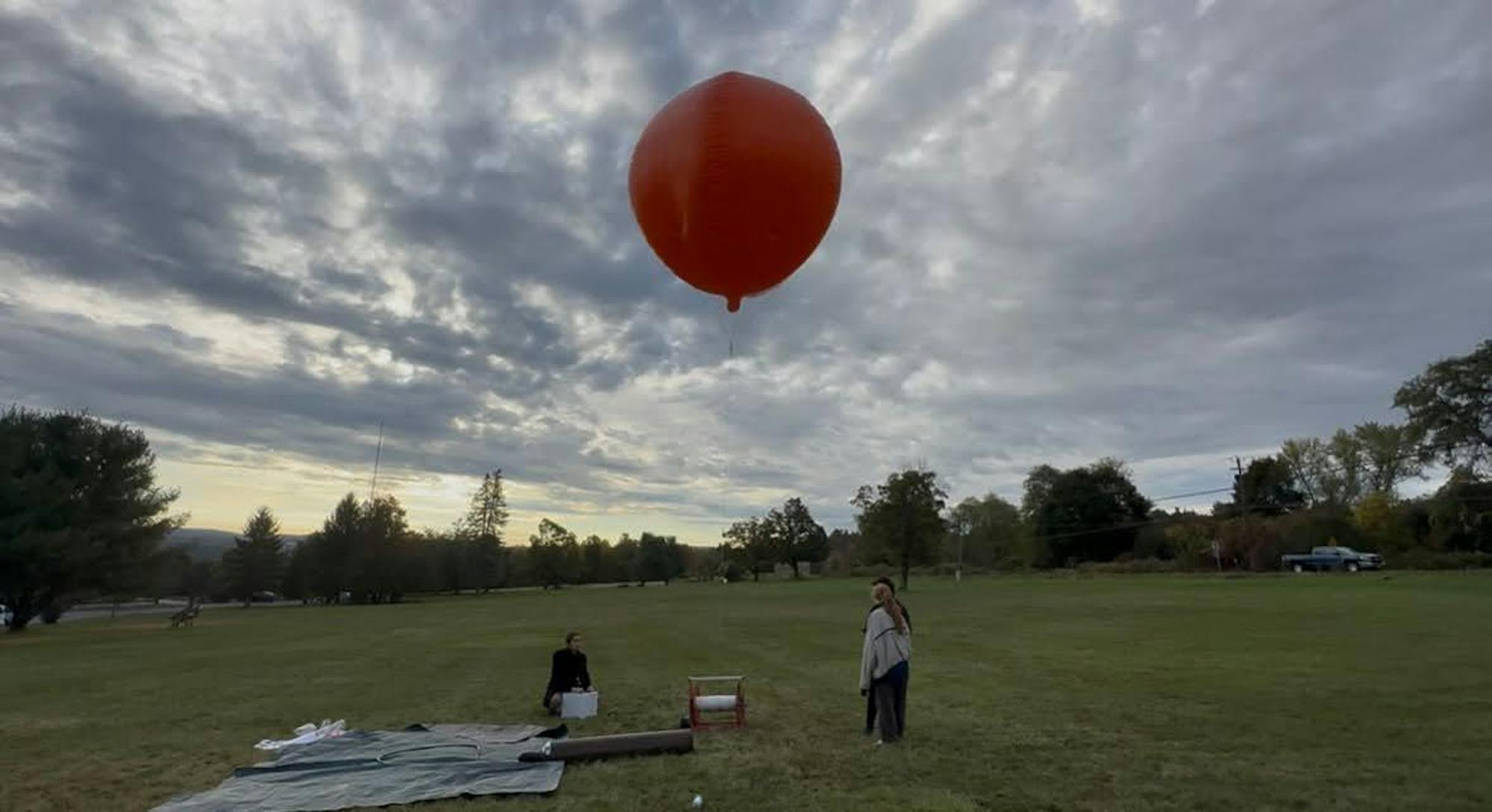
Aside from the sensor network project, GeoData’s Air Team is currently developing a specialized sensor, called a tethersonde, for weather balloons to collect atmospheric data. The tethersonde is attached to a weather balloon that moves vertically at a fixed location and collects data on temperature, wind speed, humidity and dew point.
As of now, the team is using the tethersonde collecting baseline data of weather conditions around Ithaca. Once they have collected enough data, they hope to conduct a study on lake effect events — when cold air absorbs moisture passes over warm lake air and creates snow — and their impact on weather conditions.
Other projects that the subteams are working on include a collaboration between the Rock Team and Prof. Rowena Lohman, earth and atmospheric sciences, to collect baseline soil moisture data using GeoData’s sensors for a NASA earth imaging satellite. The Rock Team leads development of a method to correlate ground truth measurements surrounding the Empire State Mine to satellite imagery derived from Google Earth Engine.
GeoData’s Tech and Water Teams are also developing a simple sensor that will allow landowners to measure water turbidity, temperature and pH, according to Hoch. “Our eventual goal is to be able to give sensors into the hands of the community, at a very low cost,” he said.
For engineering students like Hoch, who is studying computer science and statistics, GeoData provides an opportunity to explore the applications of engineering and how it connects to the environment and the real world.
And for students coming from environmental science backgrounds, GeoData is a way to pursue hands-on, self-led fieldwork.
“Something that a lot of us … really crave is we want to be able to get out in the field and do things,” said Kastoun, an earth and atmospheric science major. “It's very empowering to be able to collaboratively have a completely student-run research project, be able to decide and even configure some of the equipment ourselves and dabble into some of that engineering as well.”
Tania Hao is a member of the Class of 2028. She is a science editor for the 144th Editorial Board and can be reached at thao@cornellsun.com.