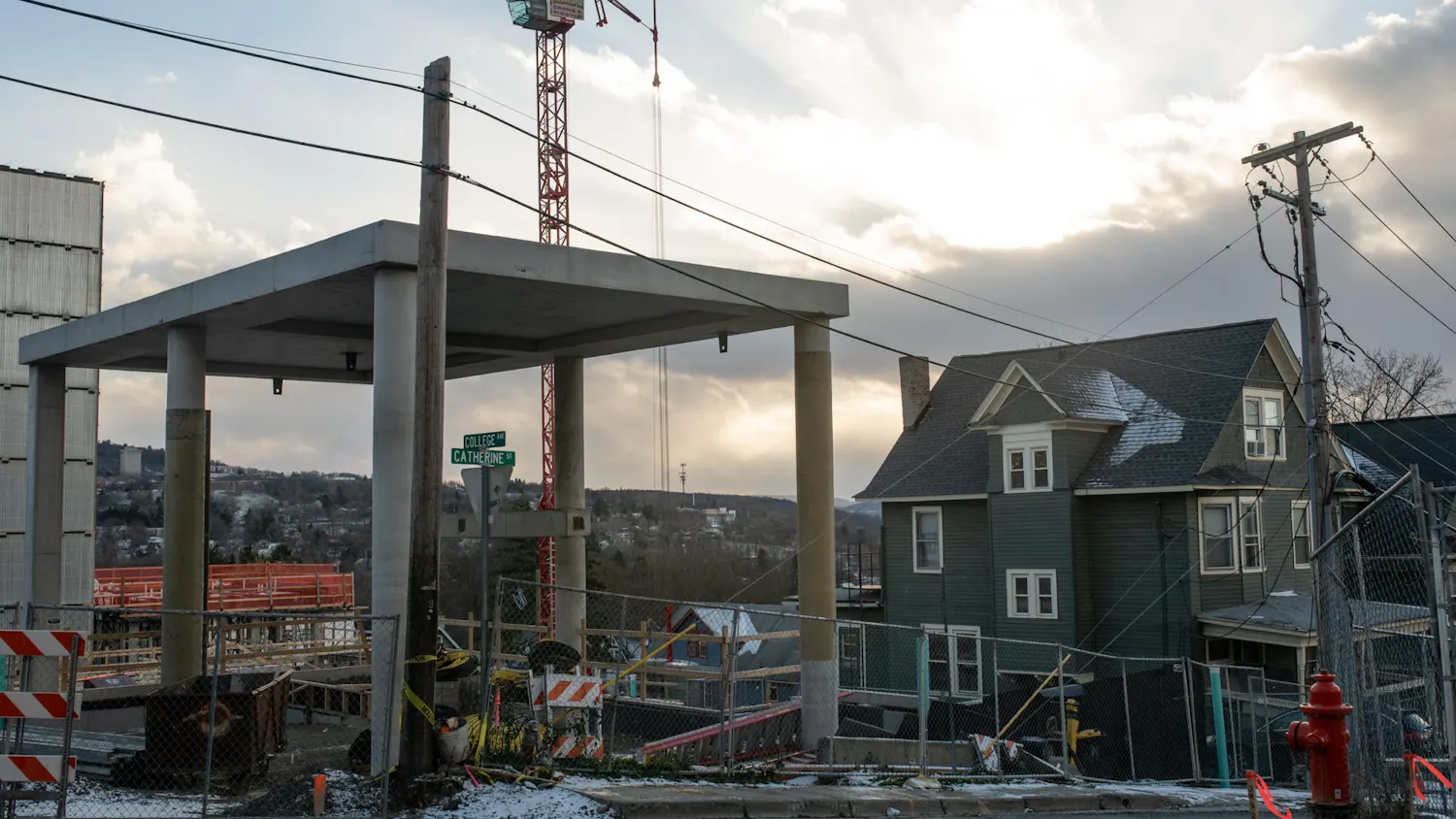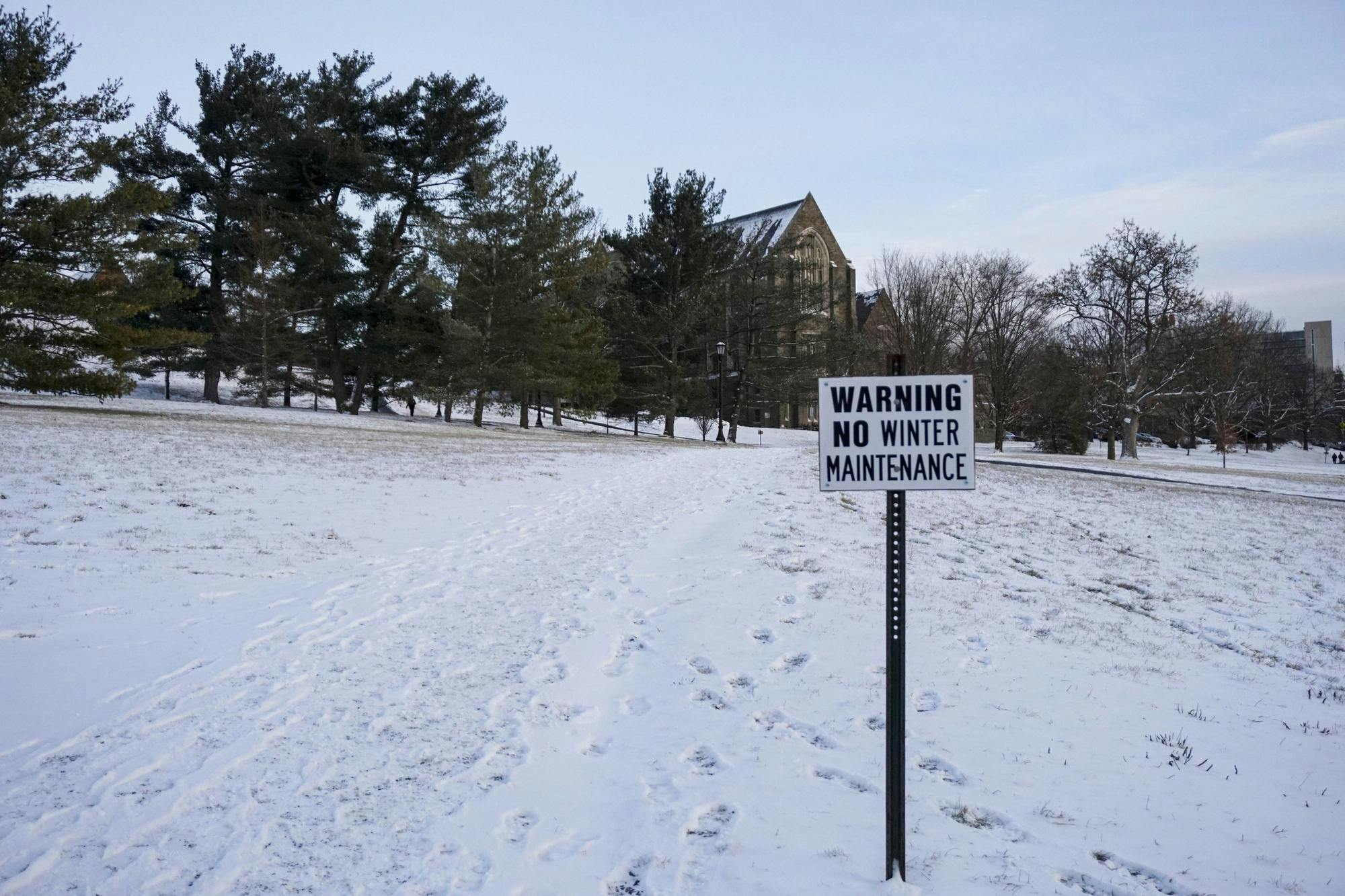
If asked to describe this past winter in one word, the average Cornellian would likely respond with some variation of “cold.” But the data reveals a deeper story. Here’s how this season stacked up against historical averages, recent winters and memorable deep freezes.
Coldest Winter in Over a Decade
In the winter of 2024-2025, the average temperature in Ithaca was 1.1 degrees Fahrenheit colder than normal. Before that, the most recent winter with a colder-than-average temperature was 2021-2022, also at 1.1 degrees Fahrenheit below normal.
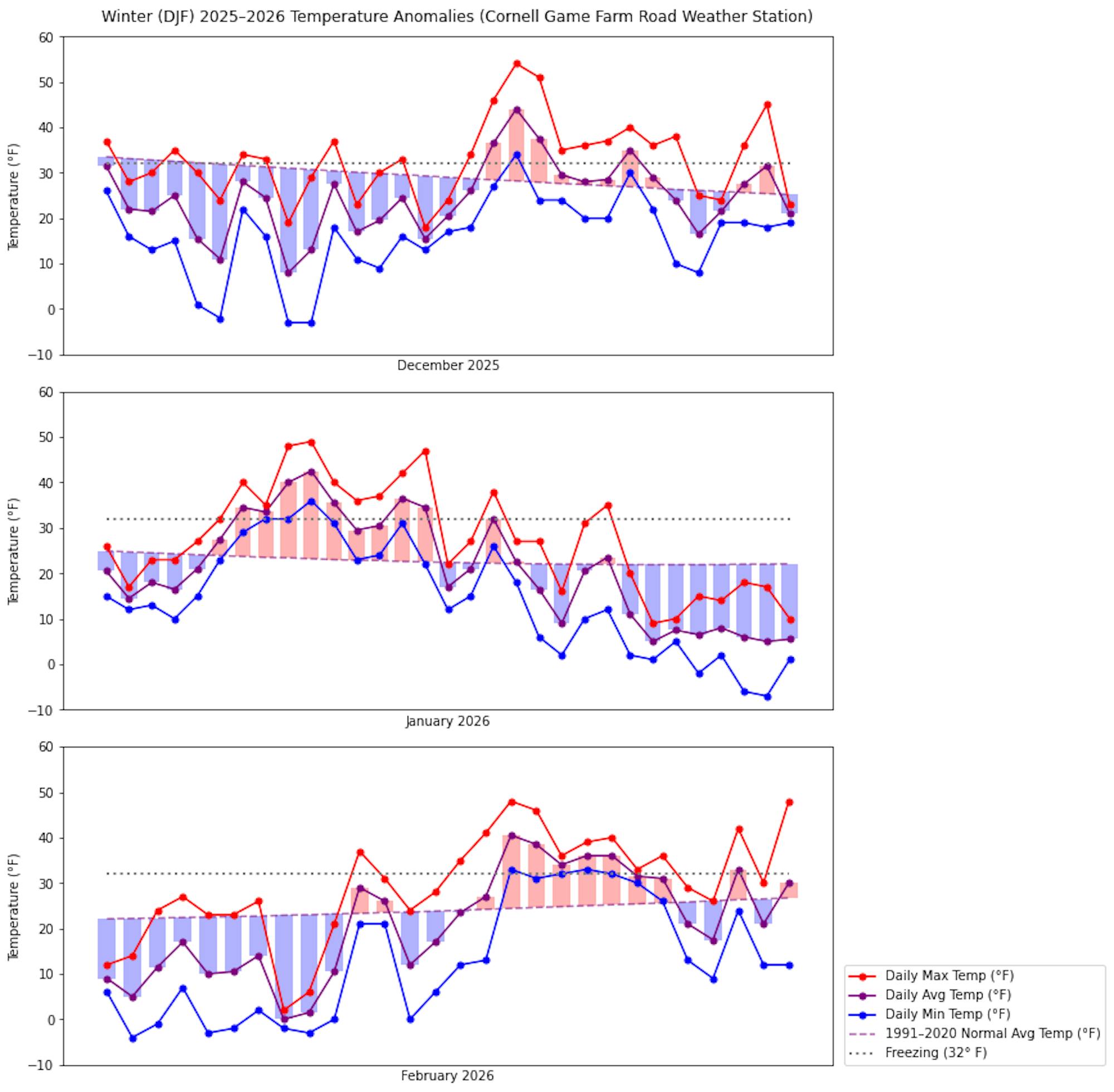
The winter of 2025-2026 was markedly colder than both, with an average temperature anomaly of -3.1 degrees Fahrenheit — making it the coldest winter in over a decade.
The last winter with a greater negative average temperature anomaly than this winter was the infamous winter of 2014-2015, which was an average of 5.6 degrees Fahrenheit colder than normal.
65.8 inches of snow fell during the 2014-2015 winter as well, 2.9 inches above the historical average. This winter is on track to receive significantly less.
The winter of 2025-2026 was not uniformly cold, however, as Ithaca saw alternating periods of extreme cold and relative warmth. Notable colder periods included the first half of December as well as a severe cold spell beginning in late January and extending into the middle of February.
The most notable warmer period spanned the second half of December and the first half of January, when many students were off-campus for winter break. Excluding the winter break when classes were not in session, the season’s average temperature anomaly was -6.3 degrees Fahrenheit, colder than even the 2014-2015 winter.
While Ithaca had its coldest winter in over a decade, this winter was the warmest on record for much of the Western United States, including the states of Oregon, Nevada, Utah, Arizona, Wyoming, Colorado, New Mexico, Texas and Oklahoma.
This was largely the result of upper-level ridging — regions of high pressure in the upper atmosphere — dominating the western half of the country through most of the season, whereas upper-level troughing — regions of low pressure in the upper atmosphere — prevailed in the eastern half.
Overall, this winter was the second warmest on record in the contiguous United States.
Third-Most Severe Cold Spell Since 1969
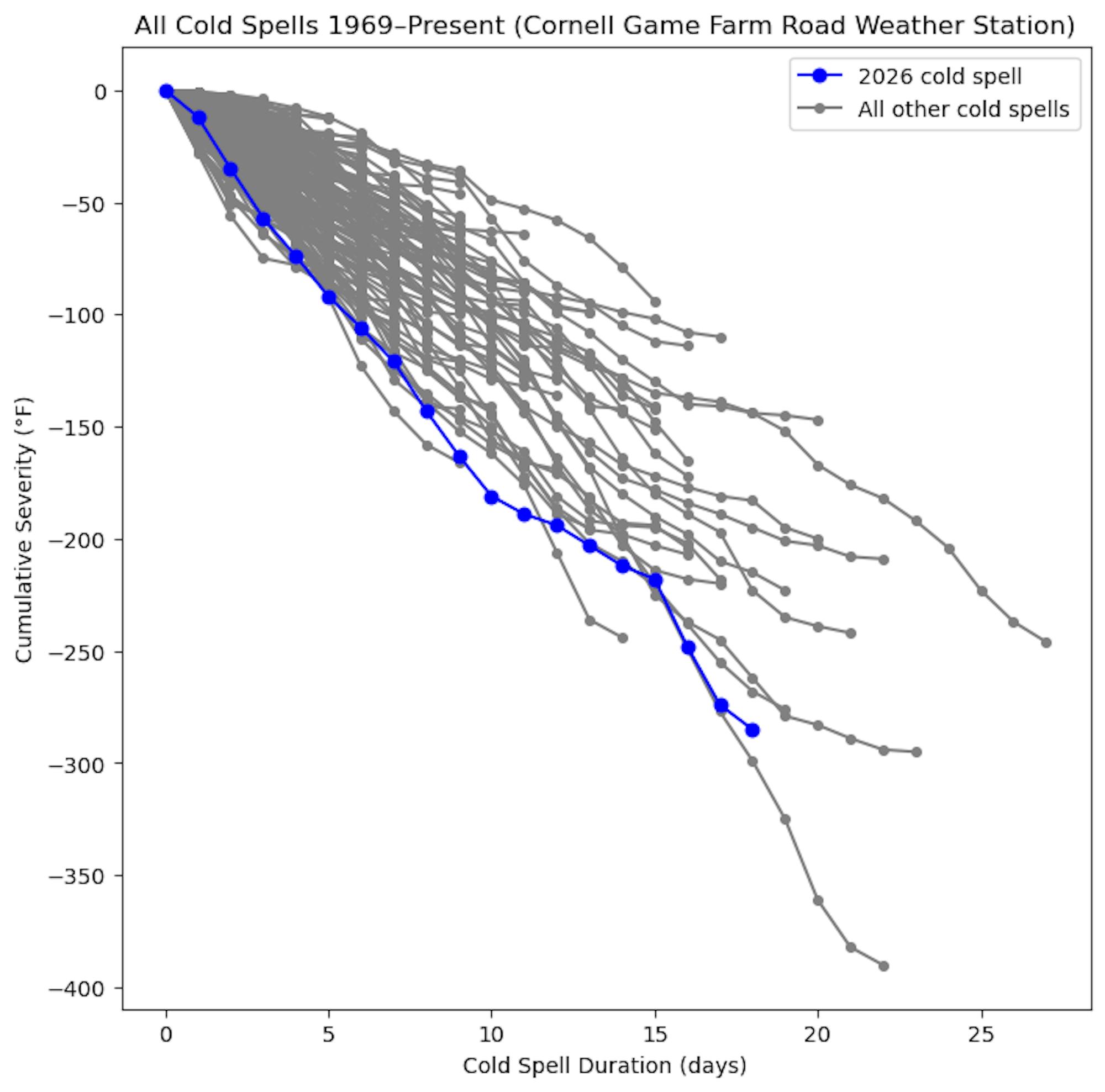
On the afternoon of Jan. 23, three days into the spring semester, the temperature rose above freezing for the last time in nearly 19 days. It would not break above freezing again until Feb. 11. This was the tenth longest cold spell in Ithaca since 1969.
The season’s coldest low temperature of -7 degrees Fahrenheit on Jan. 30, coldest high temperature of 2 degrees on Feb. 8, and biggest snowfall of 7.0 inches on Jan. 26 all occurred within this extended cold spell.
The cold spell was also the third most severe in terms of cumulative degree days — cumulative degrees below freezing recorded over the course of the cold spell — dating back to 1969, highlighting the magnitude in addition to the duration of the cold. From Jan. 25 through Feb. 2, there was a period of nine consecutive days with daily average temperatures below 10 degrees Fahrenheit.
The coldest daily average temperature of the cold spell and of the entire winter was 0 degrees Fahrenheit on Feb. 8.
Below-Average Snowfall
Through Mar. 12, Ithaca has received 42.1 inches of snowfall since the beginning of the season on Oct. 1. Although the season began on par with the 1991-2020 normal, the pace of snowfall fell behind historical averages during the warmer periods from mid-December to mid-January and the most recent one from mid-February into March.
Barring an abnormal snowstorm in late March or early April, the winter is on track to finish with significantly below-average snowfall.
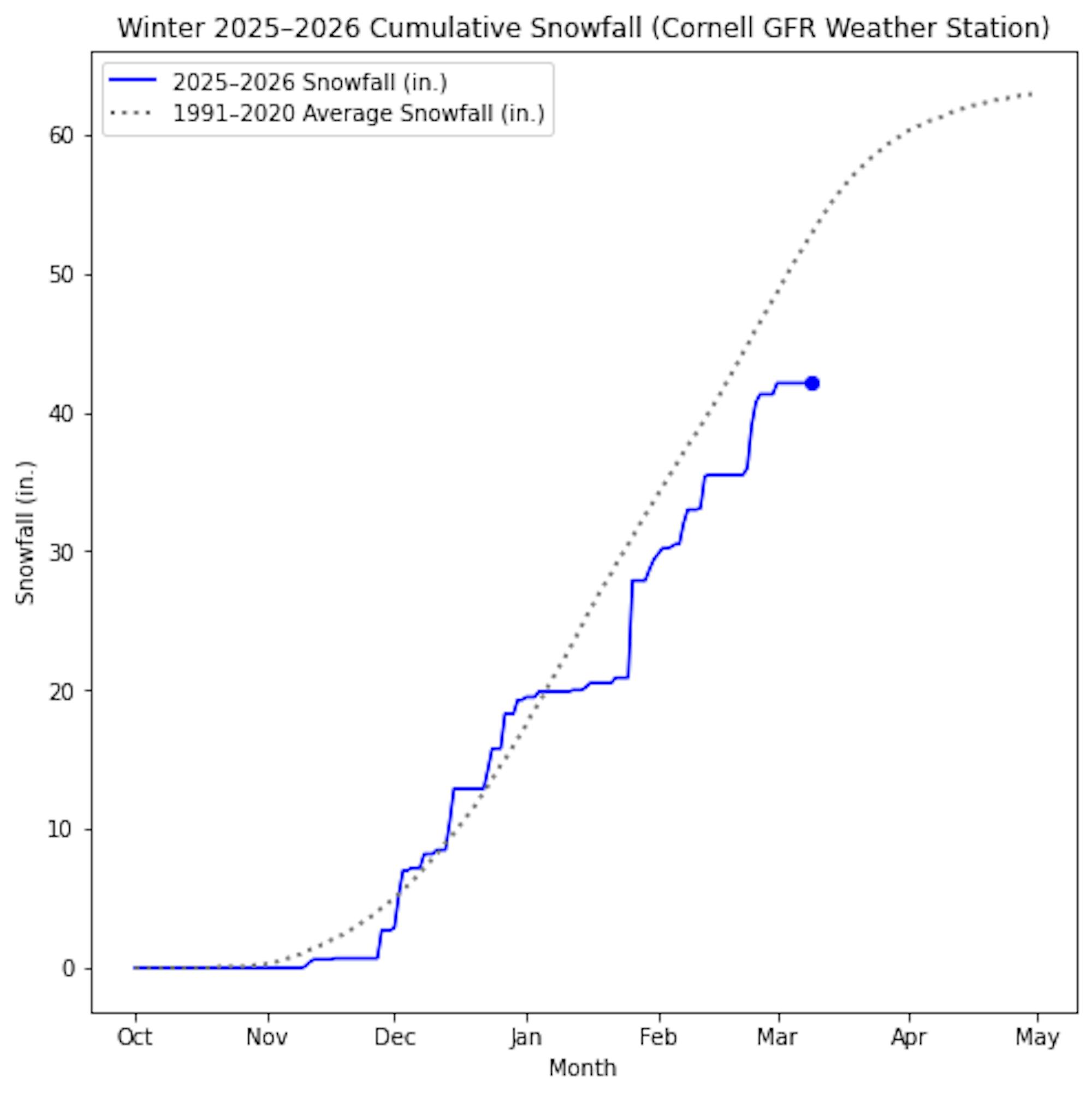
The biggest snowstorm of the season, which occurred on Jan. 26 and saw 7.0 inches of snowfall, was a significant underperformance, as forecasted amounts were nearly twice as high. The University’s Ithaca and AgriTech campuses were closed for 24 hours from noon on Jan. 25 to noon on Jan. 26 as a precautionary measure, given forecasts of 12 to 18 inches of snow.
The reason the snowstorm underperformed — not just in Ithaca, but across the entire Finger Lakes region — was the presence of subsidence, or sinking, cooler air. On the other hand, areas farther to the south of the region — roughly central Ohio to southern New England — saw rising, warmer air, which is much more conducive to high snowfall rates.
Other notable events included 4.1 inches from Dec. 2 to Dec. 3 and 3.0 inches on Feb. 23. During the latter event, Ithaca was on the outer edge of a powerful blizzard off of New England, which dropped nearly 40 inches of snow in some coastal areas.
Looking Ahead
February ended with temperatures rebounding above historical averages for the first time since early January. This trend continued into the first half of March, with daily average temperatures up to 20 degrees Fahrenheit above historical averages and high temperatures in the sixties and seventies on multiple days.
During this warmer period, students have been seen enjoying the beautiful weather on the Arts Quad and Slope en masse for the first time since fall.
As has been the case all winter, the warmth that began this month will not last, and will instead be followed by a prolonged period of cooler weather.
Upper-level troughing will build back into the Eastern United States heading into the second half of the month, bringing below-average temperatures and the chance for some nuisance snow events. This pattern is likely to hold into late March.
March came in like a lamb and is likely to go out like a lion, inverting the classic proverb. Fortunately, below-average temperatures in March are significantly warmer than below-average temperatures in January, and the worst of winter is in the rearview mirror.
Jihan Bhuiyan is a member of the Class of 2029 studying atmospheric science in the College of Agriculture and Life Science. He is a contributor for the science and technology department and can be reached at jsb469@cornell.edu.