With a click of the mouse, people can experience the everyday lives of birds in real time through live cameras run by the Cornell Lab of Ornithology. Launched in 2012, the Cornell Lab Bird Cams have reached millions of viewers around the world, bringing people closer to nature in ways never before possible.
A Window Into a Bird’s Life
The bird cams project operates between five to twelve cameras all year round. Some cameras focus on feeders, while others follow individual birds through an entire breeding season, allowing viewers to witness eggs hatch and chicks grow.
Charles Eldermire, live media lead producer at the Cornell Lab of Ornithology, led the project when it started in 2012. He explained that unlike documentaries, live cameras give people access to a more authentic experience with birds.
“The program was really designed around trying to offer an immersive, beautiful experience,” Eldermire said. “The lab really recognized that that could be a really powerful way to reach people and expose them to birds.”
One of the project’s most popular streams features the Treman Bird Feeding Garden at the Lab of Ornithology. The birdfeeders attract dozens of local and migrating species throughout the seasons, from chickadees and finches to pileated woodpeckers. Visitors to the lab can even watch the feeders live in action from an indoor observation area.
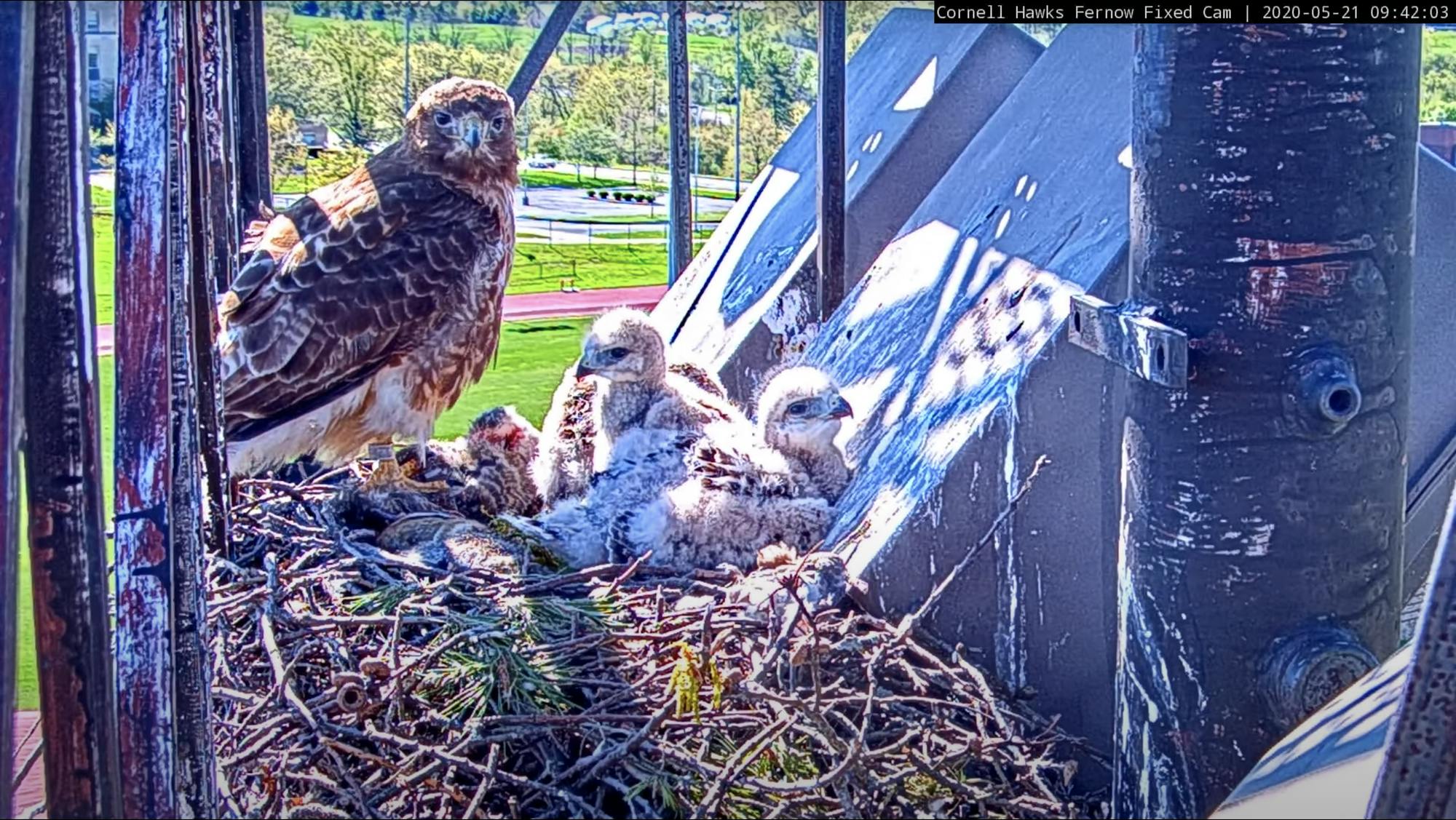
Another camera follows Big Red, a red-tailed hawk nesting atop the light towers on Cornell’s campus. A remarkably consistent and responsible parent, Big Red has returned to the nest year after year, successfully laying eggs and fledging chicks since 2012.
Other cameras show barred owls, great horned owls and ospreys. Eldermire explained that big birds such as hawks and owls usually reuse the same nest every year, making it possible to install the cameras before the birds return for another breeding season.
“When they come back, it’s just part of the environment. We would never go up and put a camera on while they’re nesting,” Eldermire said.
Reaching a Broader Audience
When the project first began, setting up wildlife cameras was something few people had attempted. The team had to figure out how to connect cameras, streaming systems and online platforms so that live footage could reach viewers’ homes.
Today, many of these technological barriers have disappeared. As livestreaming technology becomes easier to use, hundreds of wildlife cameras have appeared online. The challenge now is less about making the cameras work and more about helping people find them.
“It’s like having a library full of books, but no system numbers to organize them,” Eldermire said. “So [we’re] continually trying to pay attention to where people are spending time and making sure our content gets there.”
The team works to distribute content across multiple platforms, including social media and email newsletters. Rather than expecting all viewers to watch the livestreams for hours at a time, the team showcases notable moments such as rare birds appearing at a feeder or chicks taking their first flight. These short clips serve as an entry point for new viewers and, for many, are the main way they experience the cameras.
“Most people may not have the time or even inclination to actually spend time watching it,” Eldermire said. “But they still want to see the highlights.”
Benjamin Walters is the current project leader of the Cornell Lab Bird Cams. He and his colleagues spend much of their time editing those highlights and helping viewers interpret what they are seeing. He emphasized the importance of connecting what people see on camera to the birds’ behavior and natural history.
“Our job as science communicators is to not only give people access to the birds through these cameras, but help them discover a deeper sense of learning so that they can begin to build their education and love for the birds,” Walters said.
A dedicated group of online volunteers also play a crucial role in this effort. Spanning the Americas, Europe and Oceania, they operate the cameras and provide running updates throughout the day. When a rare bird appears at a feeder or something unusual happens at a nest, volunteers are often the first ones to notice and alert the team.
Bird Cams Around the Globe
The Lab of Ornithology’s first few cameras were set up at sites close to home. Over the years, the project has expanded through partnerships with organizations and scientific institutions worldwide. These cameras give viewers a chance to see a variety of bird species that they may not otherwise encounter.
“We look for opportunities to showcase species that we don’t already have on cameras,” Walters said. “You get to experience a whole new world of species in your computer that you would never get to see without visiting there.”
At Canopy Lodge in Panama, the project hosts a fruit feeder camera in collaboration with The Canopy Family, an ecotourism organization that specializes in birding. The site has been visited by nearly 100 species since streaming began in January 2018, offering a colorful display of tropical wildlife. At its sister site at Canopy Tower, a hummingbird feeder attracts a stunning array of tropical hummingbirds.
Another camera broadcasts a Northern Royal Albatross nest on New Zealand’s South Island. The camera streams each year during breeding season and allows viewers to watch a pair of albatrosses raise their chick. With a wingspan of over ten feet, the mysterious species is among the largest seabirds in the world.
“They’re just alien,” said Eldermire. “They soar for thousands of kilometers over the ocean. They just are in places where we never see them. And the only place we get to overlap is where they are breeding.”
The colony is the only one on the mainland in the southern hemisphere and is endangered in the face of numerous threats. The camera documents the work of the New Zealand Department of Conservation, including incubating eggs during hatching and weighing the chicks.
Bird Cam Challenges
When asked about the biggest challenge of working on the Bird Cams, both Eldermire and Walters pointed to when something goes wrong — when an egg fails to hatch, a chick dies or other mishaps occur.
Viewers often grow attached to a bird after following it for several months, so the losses can be especially difficult. During these moments, the team believes it is important to communicate clearly about what is happening.
“Things happen all the time,” Walters said. “That’s something that we try to communicate, that there’s always a chance that things may not go as well, and there’s no guarantee that birds are going to be successful when they enter a breeding season.”
Eldermire hopes that these unfortunate events can raise awareness about the challenges birds face in an increasingly human-dominated world. If a chick dies after a window strike, for example, viewers might learn about the dangers windows pose to birds and consider ways to reduce those risks.
“You can’t tell anybody how to feel. Our hope is to provide them the support to feel that way,” Eldermire said. “But also, here’re some ways we can all work to hopefully make the world a better place for birds, so that there’s a net gain for birds.”
A Community Built Through Birds
Millions of viewers watch the Bird Cams each year. Many return daily to check on the birds they follow, as if they are extended family members.
“[Viewers will] follow their stories for months and months at the same time every year, checking in and just rooting for them to be successful and learning about birds all along the way,” Walters said.
Online communities have formed organically around the cameras. Experienced viewers are often happy to answer questions from newcomers and share observations about what they see.
For many people, the cameras are a meaningful connection to nature, especially for those who cannot easily access the outdoors. From elementary school classrooms to nursing homes and hospitals, viewers have found great comfort and joy in watching birds.
Eldermire said the team initially thought the cameras would encourage people to become birdwatchers. However, the impact has grown far beyond that.
“We didn’t realize that there’s bigger possibilities that are coming from not even having anything to do with becoming a birdwatcher, necessarily, but finding emotional peace, finding space to connect to nature, feeling like you’re just a part of something,” Eldermire said.
The team hopes that by giving people access to nature, the cameras will inspire a deeper sense of appreciation for the natural world.
“The more people understand about the natural world around them, I think the more they care for it,” Walters said. “And hopefully that’ll help them make decisions in their lives that make a positive impact on our natural world as a whole.”
Susan Su is a member of the Class of 2029 studying linguistics and psychology in the College of Arts and Sciences. She is a staff writer for the science and technology department and can be reached at ssu@cornellsun.com.