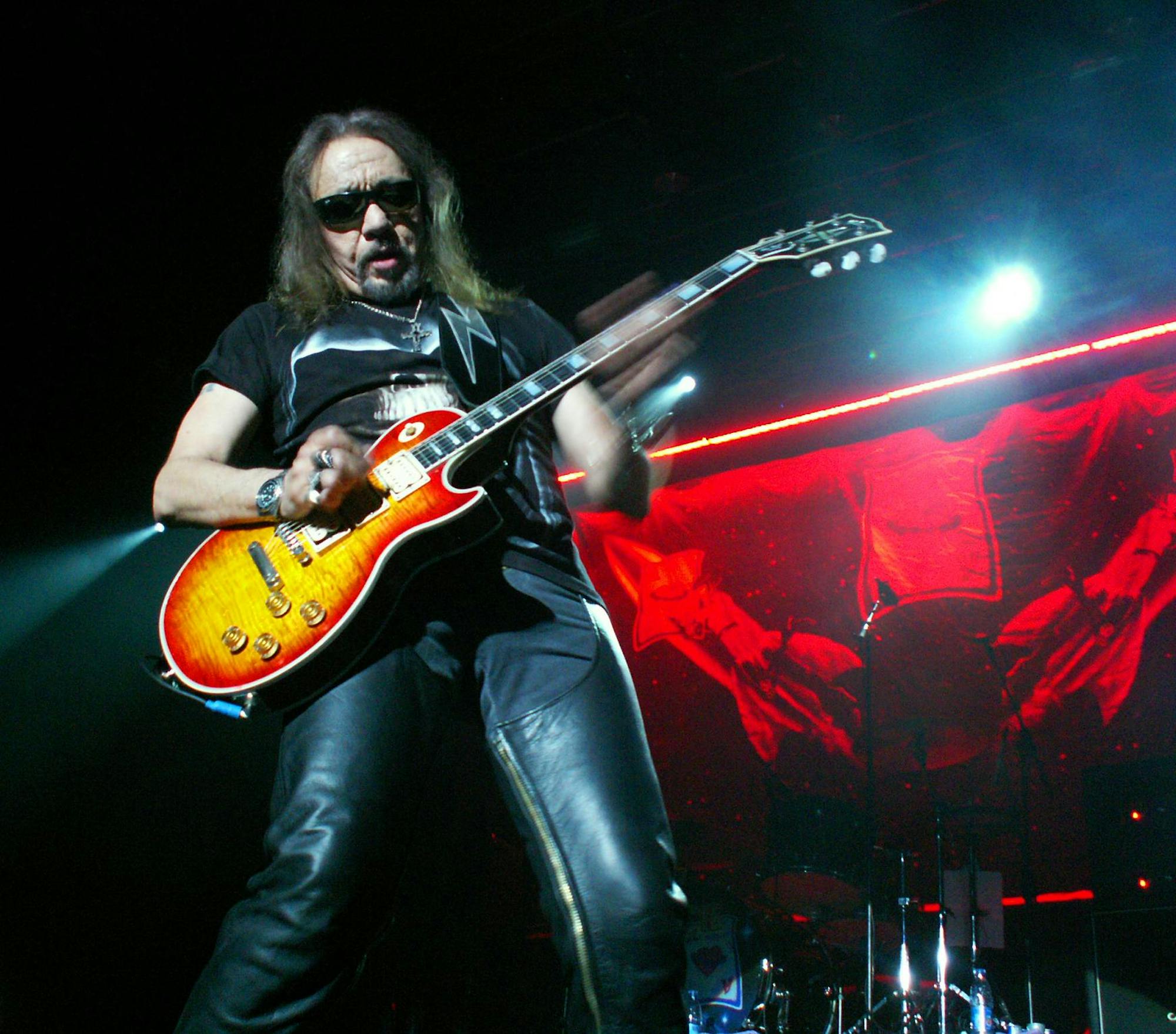
The Spaceman has left the stage. With Kiss, Ace Frehley rose to stardom and left a musical mark as recognizable and indelible as the stars on his face. An early proponent of the Gibson Les Paul, Frehley refined the role of the guitar hero in his everyman’s band through his unorthodox approach to the instrument. His leads were inviting, his stage presence mesmerizing and his influence farther-reaching than perhaps any other guitarist of his generation. Perhaps no other guitarist in history has inspired a greater collective taking-up of the electric guitar among the lost youth. He died on October 16, 2025.
Paul Daniel Frehley was born in the Bronx, New York, in 1951. He was Cherokee through his mother, making him one of history’s first Indigenous rock icons. He received his first guitar when he was 13 and quickly taught himself to play. As such, he developed an infamously unschooled approach to the instrument, which has marked his career for better or for worse. In many ways, he was the first guitar superstar to reach his audience so profoundly; his playing was as impressive as it was attainable, as exciting as it was encouraging. His hot licks demanded your attention, especially when they appeared to send plumes of smoke from his guitar.
By the time he was 18, he was working as a roadie for Jimi Hendrix. In late 1972, he auditioned for a band comprising singer/guitarist Paul Stanley, singer/bassist Gene Simmons and drummer Peter Criss, soon to be christened “Kiss.” Within the year, they had found their niche: smoke machines, fire breathing, fake blood and distinctive makeup set them apart from their peers. Their costumes and makeup evolved into personas: the Starchild, the Demon, the Spaceman and the Catman. They released their self-titled debut in 1974 and began touring the US. Despite a lack of commercial success, their audiences only grew bigger. Hordes of teenagers flocked to see the fire-breathing freaks and their spectacle. Kiss became the first band you went to see, rather than listen to.
Kiss was selling out shows all over the country without a single hit. After unsuccessful attempts to capture the energy of their live shows in the studio, the band began recording their concerts. Their efforts produced Alive!, a double live album, and their unexpected commercial breakthrough. The album produced definitive versions of their most beloved songs, including the radio mainstay “Rock and Roll All Nite.” It remains one of rock and roll’s most beloved live albums, and a worthy testament to the power of the stage show. Alive! showcased Ace Frehley’s frenetic guitar playing. His razorblade tone and volatility, combined with his penchant for melody and hooks, made him both exceedingly popular and memorable. Guitarists noted his British blues influence, especially from the likes of Pete Townshend and Jimmy Page, as well as his bizarre technique that left professionals stunned. He downpicked exclusively with an almost careless precision. He stayed firmly in the pentatonic box and attacked the strings with a stiff, angular momentum. A flurry of hammer-ons and pull-offs, resolved by furious bends constituted many of his solos. He crafted them as a performer would, building up to melodic unison-bend figures and occasionally falling to his knees in a dramatic skid when the occasion so demanded. His raucous, extended live solos were near trance-like in their repetition and persistence, building up to the anticipated moment when smoke would spew from his pickups mid-lick.
By the end of the decade, Kiss were one of the biggest live rock acts in the world. Destroyer and Love Gun housed their newfound hits, and Frehley scored one of his own with “Shock Me,” a song he wrote and sang inspired by an on-stage electrocution. Their commercial success culminated in “I Was Made for Lovin’ You,” a pseudo-disco hit that perfectly embodied their desired trajectory. The rift between Criss and Frehley and the songwriting unit of Stanley-Simmons grew and spilled over at the turn of the decade. Criss was booted and Frehley left with little say. By 1982, Frehley’s participation had dwindled to virtually nothing, and he left the band, being replaced by Vinnie Vincent.
The dissolution of the original quartet marked the beginning of the end of Kiss’s creative peak. By the mid-’80s, they had removed their masks and devolved into a derivative glam band. Frehley began his solo career with Frehley’s Comet, garnering moderate yet unsustainable success. By the end of the decade, his solo band had dissolved, leaving him in obscurity. In the near future, he would reunite with Peter Criss for short stints but remained semi-retired until the first Kiss reunion in 1996.
Kiss and the age of outlandish, theatrical rock had all but died by the time the grunge age began, but the band found an unlikely salvation in the nascent MTV Unplugged series. The ever business-minded group welcomed the craze and invited Criss and Frehley for an encore at their 1995 performance. The reunion was announced at the Grammys the following year and the band embarked on a blockbuster world tour. After several more years of touring as the world’s biggest rock band, Kiss prepared to retire on a high note in 2001. Criss and Frehley officially departed once again, only for intermittent touring to commence after several years, with Eric Singer and Tommy Thayer taking their places. Since then, Kiss has all but become a legacy act, perhaps one that just can’t call it quits.
Frehley returned to his solo career for the next two decades, away from the pressures of Kiss and the limelight. He continued making music on his own terms and toured with his solo band up until health issues forced him to cancel several dates last month. He died shortly after, leaving behind a legacy of rock and roll heroics and superstardom. He leaves behind the archetypal guitar hero, the Spaceman, and his endless crowd-pleasing antics. And he remains in the fingers of everyone who has wielded a guitar since.
Josh Yiu is a junior in the College of Agriculture and Life Sciences. He can be reached at jy793@cornell.edu.