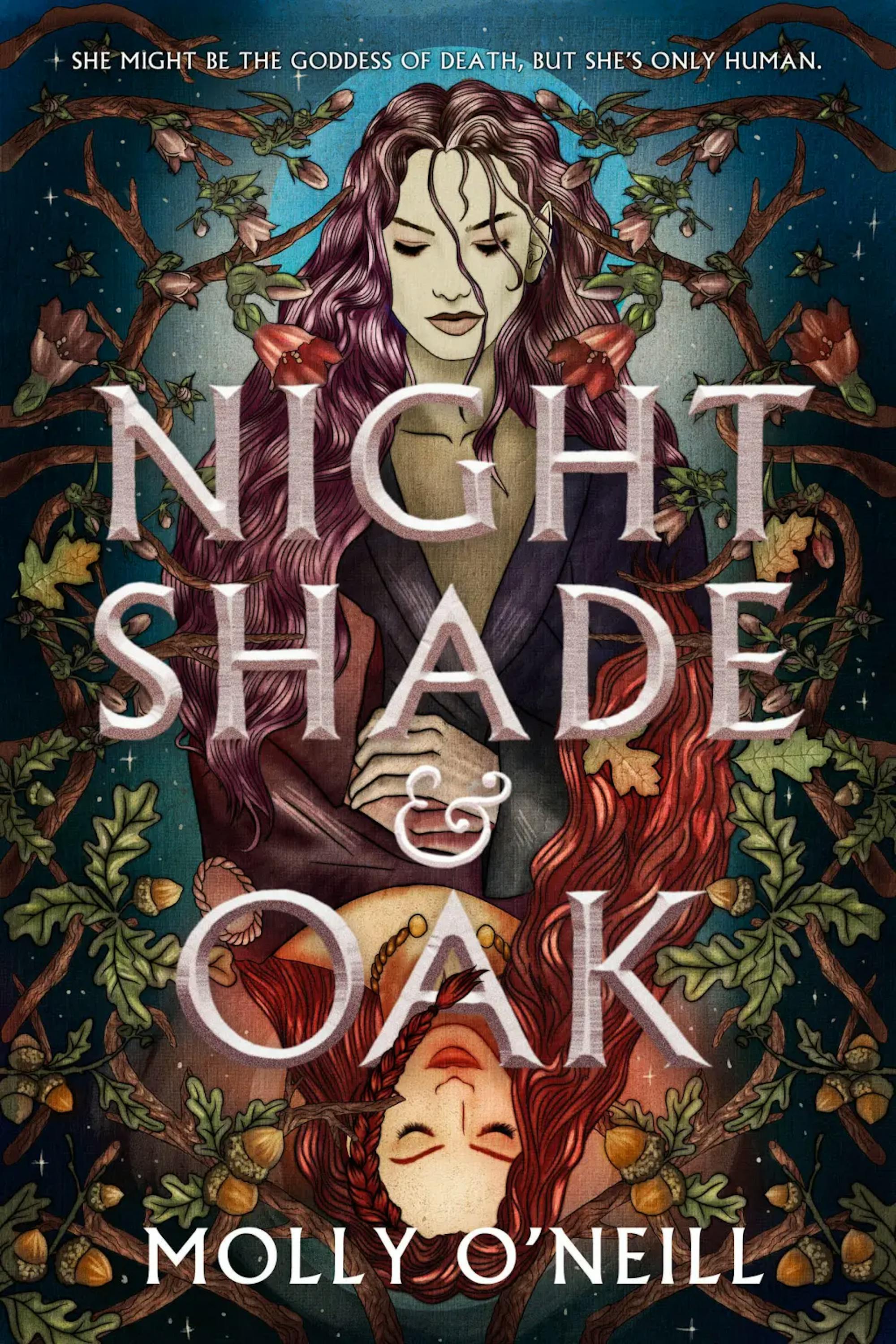
Myth, magic and a fantastic quest fill Nightshade & Oak, Molly O'Neill's newest novel that follows the guide of the unquiet dead and a spear-maiden as they seek out the Afterworld. I had the pleasure of reading Greenteeth over winter break and I fell in love with O'Neill's storytelling, which felt like returning to the fairytales of my childhood with quirky characters and a mythical quest across the magic realm. I was expecting something similar with Nightshade, but whereas Greenteeth was sunlight filtering through the leaves, Nightshade was the pounding rain that tears through empty branches. Set in Roman-occupied Britain, Nightshade & Oak follows Mallt y Nos, a goddess of death in Celtic folklore, who is turned mortal by a wayward spell. Used to immortal strength, grace and beauty, Mallt is jarred by the transition and entirely unprepared for a human life riddled with constant pain — from heartache to stubbed toes.
The cause of Mallt's troubles rests with Princess Beliscena, or Belis, the daughter of Boudicca, the Queen of the Iceni. The Iceni were a real Celtic tribe, however, the fate of Boudicca’s daughters was lost from the historical narrative. In her fictional retelling, O'Neill writes them back in. Belis is a hardened warrior whose life was uprooted when her wayward spell struck Mallt. As the goddess of death, Mallt is supposed to guide souls to Annwn for their eternal rest, but the spell stops her from completing the process — leaving Belis’ sister's body living on without her soul. So Mallt and Belis form a reluctant alliance to journey to Annwn to get Mallt's powers back and retrieve the soul of Belis' sister.
This novel is rooted in folklore, for instance, Annwn (pronounced AH-noon or AN-oovn) is the Otherworld in Celtic mythology. Interestingly, O'Neill does not present Annwn as the Otherworld, but instead as the Afterworld. This is not a huge stretch as, historically, one of the ways to reach the Otherworld was by venturing beneath mounds in the earth. Hence transforming Annwn from the Otherworld to the land of the dead works and better supports the plot of Nightshade. The flow of time being altered is also a common motif for the Otherworld. In Nightshade, O'Neill reverses days and nights so that when the sun sets in the mortal world, it rises in Annwn. Mallt's white dogs with bright red ears, the Cwn Annwn, are also an important detail. The Otherworld dogs are one of the clearest signs that one has entered the Otherworld and are always described with these traits. There are so many other references that are exciting to find for those with an interest in myth and folklore!
I really enjoyed the pacing of the novel. I think the quest format helped the plot flow nicely, taking the reader by the hand and pulling them through the Chalks, the forests and villages of Britain. I also found Mallt's character development to be moving throughout the novel. Her first journey is from goddess to mortal and grappling with what it means to go from one of the strongest beings to one of the weakest. Mallt often comments on feeling helpless in a frail human body that becomes the weakest link even amongst mere humans. Her legs are quick to tire, her chest burns too easily and her mind fights back. O'Neill captures the confusion of feeling guilt, fear and heartache for the very first time, rooting it in tangible chest pain or stomach discomfort. It turns out learning to be human is learning all the ways there are to hurt.
Her journey back to herself does not follow the familiar fantasy heroine trope where she becomes a skilled warrior in like two weeks — she improves, but believably. She panics, swords are still heavy and her movements are clumsy, but her grit noticeably improves. The first lesson Belis teaches Mallt when fighting is how to fall down, and as she does so, over and over again, she learns the best lesson: How to keep getting back up.
Nightshade is a fantasy, but it is also historical in some elements. Boudicca was a real queen who led one of the most successful rebellion attempts against the Romans. O'Neill does not let this part of the plot take a back seat, she returns to it and keeps the fantasy elements from taking precedence. O'Neill even draws connections between Britain and Annwn with the wrongness of Roman conquest creating a physical scar in the Otherworld. I thoroughly enjoyed both storylines and felt each was weighed perfectly throughout.
One part of the novel I struggled with was Belis’ character. I felt I learned so much about Mallt and immersed myself in her narrative, but I could never get there with Belis. I understood her as a character foil to Mallt, but as the story developed and their connection became more than simply contrasts and petty arguments, I lacked the depth needed to understand her motivations. I could understand how Mallt could learn to love Belis — her human guide that found her soul — but I struggled to feel Belis’ reasons which overall weakened the chemistry when it should have been pulling at my heartstrings. Another issue I found was that readers are never given a physical description of Mallt outside of an ambiguous immortal beauty. As a reader who vividly sees what they read, this acted as quite the mental block.
Overall, I found the book to be just what I was hoping it would be: A commentary on the pains of mortality, grief and what it means to be human. I felt the ending was perfect and inevitable with no loose ends. Nightshade & Oak reminded me that strength means something different to each person, but it is important to remember that strength also looks like surviving. It looks like surviving the ordeal that is mortal life and still finding the strength within yourself to cherish it.
Thank you to Orbit for an ARC of Nightshade & Oak!
Ayla Kruse Lawson is a junior in the College of Human Ecology. She can be reached at akruselawson@cornellsun.com.
Ayla Kruse Lawson is a member of the Class of 2027 in the College of Human Ecology. She is a staff writer for the Arts & Culture department and can be reached at akruselawson@cornellsun.com.