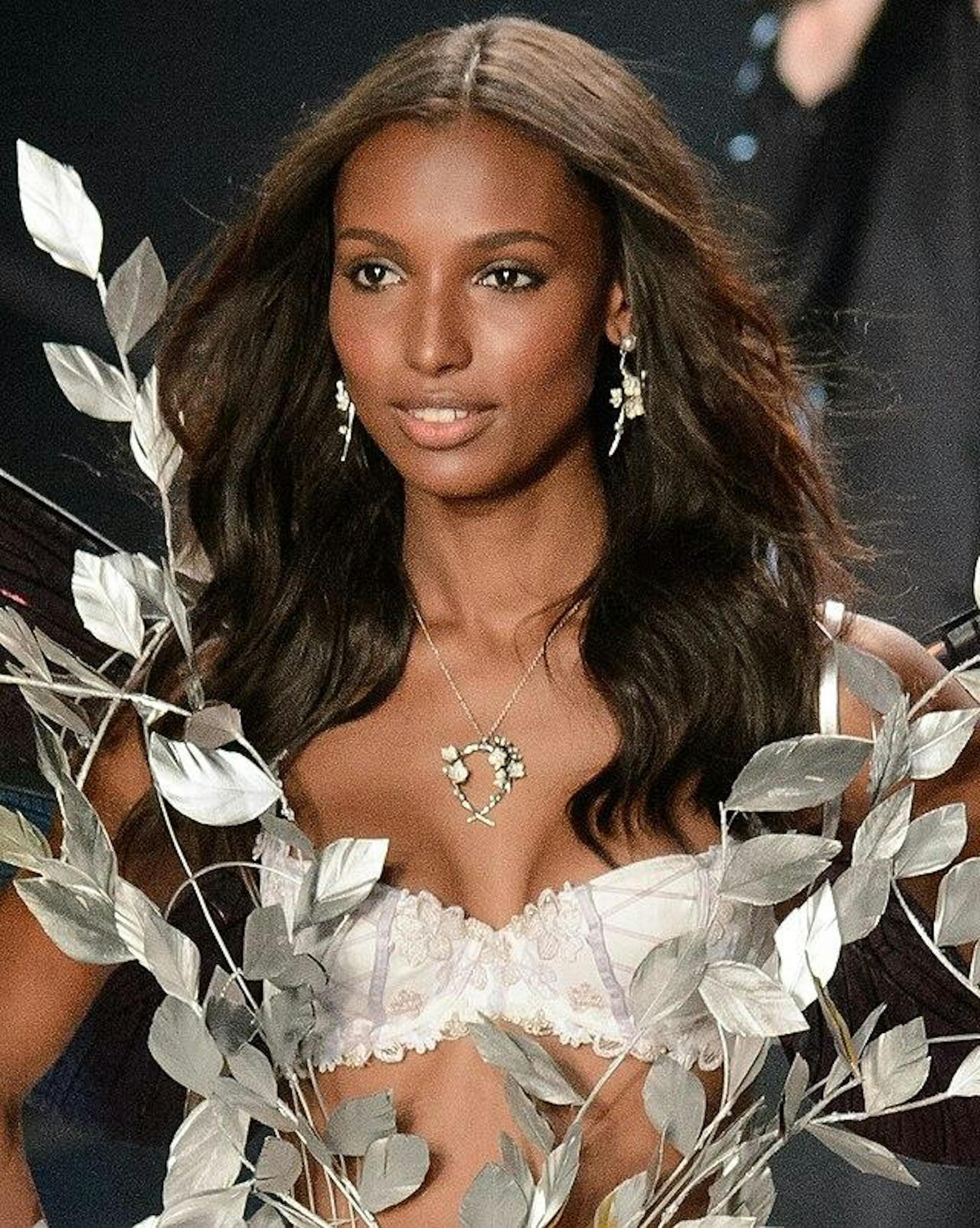
On the evening of October 15, Steiner Studios in Brooklyn, New York made way for a spectacle. A bright light illuminated the stage, casting a soft golden glow as a dark silhouette emerged. Out stepped Jasmine Tookes, opening the 2025 Victoria’s Secret Fashion Show in a custom gold macramé dress adorned with pearls and crystals, complete with oversized shell-shaped wings. She became the first Angel to open the show while pregnant, already paving the way for a new kind of runway icon. This year, the Victoria’s Secret Fashion Show made one thing clear: it wasn’t just a revival — it was a reckoning with its own legacy.
After years of criticism, cancellation and a slow attempt at rebuilding, Victoria’s Secret has returned to the runway once again, determined to prove it has truly evolved amidst shifting cultural tides. This year’s show was streamed live on Prime Video, YouTube and across social media platforms, trading its once-exclusive television broadcast for a more accessible, global format. Since its return in 2024, Victoria’s Secret has partnered with Amazon, allowing viewers to click on items as models walk the runway, adding them directly to their shopping cart while watching on Prime Video or Amazon Live. The official website also features a dedicated “Shop the Show” section launched immediately after the broadcast, showcasing every look and turning what was once an untouchable fantasy into a fully interactive experience.The result is a striking blend of fashion, entertainment and commerce, redefining what a modern runway spectacle can be.
But beneath the sparkles, confidence and choreography, the show wrestled with the same tension that defined it for years, a performative ideal of beauty. In its early 2000s prime, despite its dazzling production, the Victoria’s Secret Fashion Show was less a celebration of womanhood than a carefully choreographed performance of what femininity was supposed to be. Sculpted, perfected bodies, signature blowouts and rehearsed facial expressions moved in sync with the pop anthems of the era. It was spectacle as aspiration, projecting an image of what desirability and power should look like.
The 2025 show seemed to take this into account, reimagining the spectacle with more awareness while keeping the signature allure of Victoria’s Secret intact. Iconic faces like Adriana Lima, Candice Swanepoel, Lily Aldridge, Bella and Gigi Hadid and Barbara Palvin returned to the runway, dazzling under the lights and proving that nostalgia still draws audiences in. Yet beside them walked new Angels who expanded that image: Angel Reese, the WNBA-star-turned-model, and Suni Lee, the Olympic gymnast, both graced the runway with athletic confidence. The show also featured a lineup of social media influencers such as Quenlin Blackwell, a TikTok personality with modeling experience, and actress Barbie Ferreira. While the mix of newcomers and established supermodels sparked some debate across online communities, it reflected a shift toward a more inclusive and evolving definition of beauty. The juxtaposition of veterans and newcomers, tradition and transformation, created a new sense of performance, one that aimed to feel more grounded and authentic.
Visually, the production embraced a fantastical approach with a modern polish, featuring a spectrum of themes and tones: golden glows that shimmered like sunlight, soft blush and floral motifs, bold streetwear, fiery reds and a dreamy gradient of blues, pinks and yellows that flowed together like a painted sky at sunrise. Striking silver and black metallics punctuated the runway, grounding the spectacle in classic Victoria’s Secret glamour. The result was unmistakably the brand, yet less focused on overt seduction and more on individuality and identity. Long criticized for narrow representation, the company seemed to embrace diversity while remaining mindful of the delicate balance between reinvention and repetition.
In my opinion, the music elevated the entire experience. Performances from Latin superstar Karol G, K-pop group TWICE, pop singer Madison Beer and rapper and singer-songwriter Missy Elliott, who closed the show, brought a sense of energy and global flair to the runway. The performances transformed the catwalk into a cross-cultural celebration, merging fashion with rhythm, with my personal favorite being Madison Beer’s "Make You Mine" segment. Victoria’s Secret is learning that empowerment cannot be strictly scripted or performed; it needs to feel authentic. Casting more diverse bodies and individuals from a variety of backgrounds is definitely a start, but the deeper work lies in reimagining what it means to be an Angel while still preserving the signature allure of Victoria’s Secret.
The 2025 show does not have all the answers that fans are seeking, but it marks a significant turning point. The spectacle remains; it has not disappeared, but is simply being reframed. As the final confetti fell and the livestream came to an end, the moment felt both familiar and new — an iconic legacy brand attempting to rebuild its story in real time. And while there may still be hurdles, the Victoria’s Secret show can continue to shine, evolving with the times while honoring its signature glamour.
Mikayla Tetteh-Martey is a junior in the College of Agriculture and Life Sciences. She can be reached at mkt62@cornell.edu.
Mikayla Tetteh-Martey is a member of the Class of 2027 in the College of Agriculture and Life Sciences. She is a staff writer for the Arts & Culture department and can be reached at mtetteh-martey@cornellsun.com.