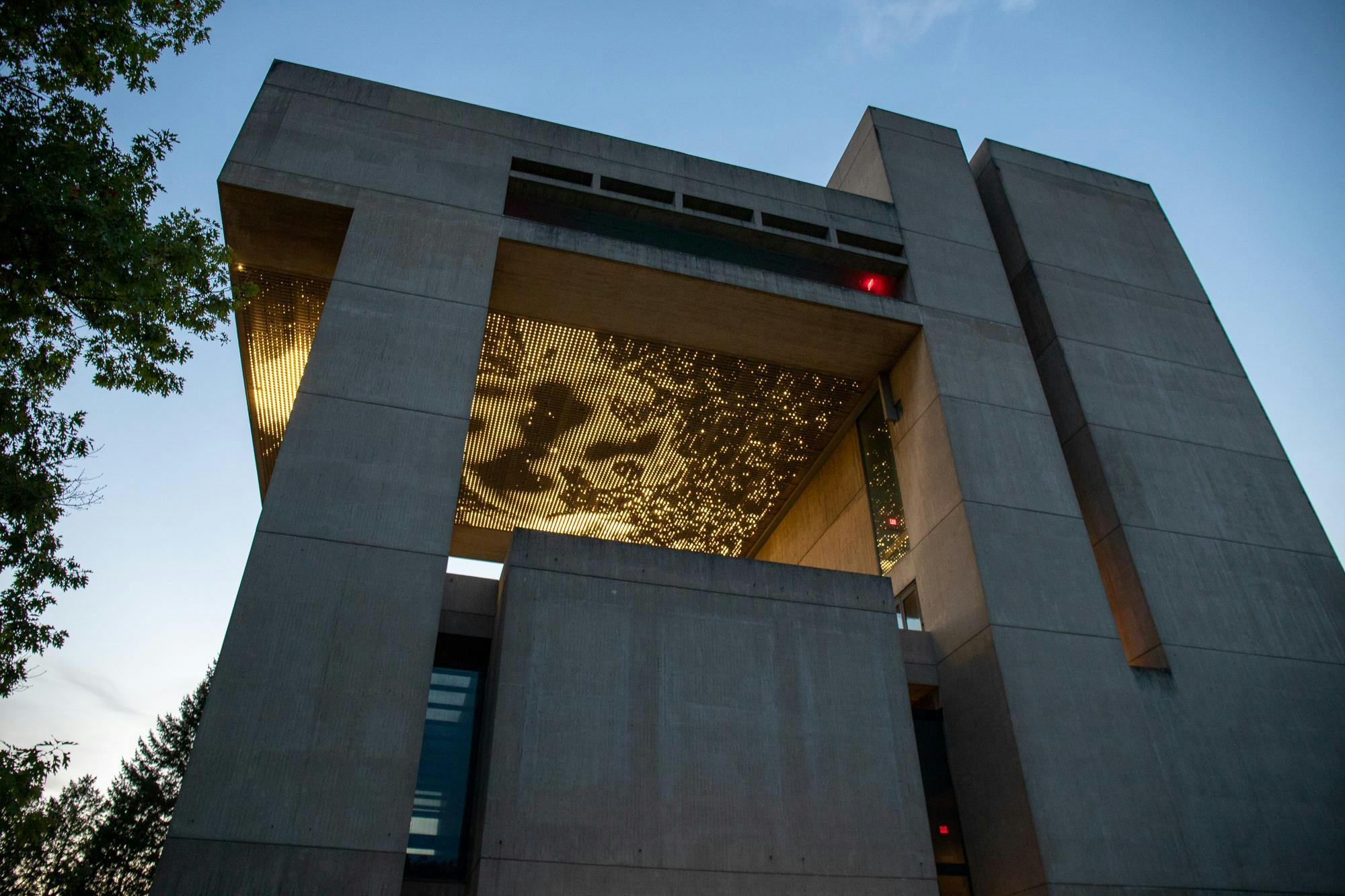
The Johnson Museum has stood on Cornell’s campus since its opening in 1973. Every student has walked past it on their way to class at least once, yet many have actually never been inside. When I first went freshman year, I also did not truly appreciate the breadth of the museum’s collection, however after visiting recently I had found so many new masterpieces that I had simply missed the first time. This is my comprehensive overview of the hidden gems I found at the Johnson Museum:
Funeral Portrait Head of a Woman (Roman Syria)
When turning the corner of the antique collections in the Johnson Museum, the first thing that struck me was a well preserved bust of a woman. Found in a tomb in Palmyra, this funeral portrait is one of the many that were placed for each deceased person within family tombs in the city. The portrait reflects both Roman and Near Eastern features, something that can likely be attributed to Palmyra being along the route that carried caravans from the Orient to the Roman world.
What’s most striking from the Roman Syria Collection is the unfortunate fact that these artifacts are preserved in the US, not in their native countries. Those from the region have never seen them before coming to Cornell. One of my Syrian acquaintances noted: “I lived in Syria my whole life, but I rarely got to see historical artifacts. Abroad, I found them preserved much better, and I realized that if they had stayed in Syria, I might never have seen them. Poor government management, lack of resources, and the struggles of daily life made artifacts feel unimportant. I honestly never thought about my ancestors or history until I left Syria. I even lived down the street from one of the biggest museums in my city, but I only visited it once. The entire collection could be seen in a short 15-minute tour, and most artifacts were displayed in an unorganized way.” It made me realize just how privileged it is to be right on campus with a museum that has preserved this history for us to see.
Virgin and Child and Saints (Ethiopia)
One of the most fascinating parts about Christian history for me is how Ethiopia has one of the oldest traditions of Christian worship in the world. Dating back to the 4th century, the triptych depicts the Holy Mother Mary and a baby Jesus Christ in the center. Around them are scenes of the saints such as Saint George slaying the dragon, as well as the 12 apostles and a scene from the Crucifixion of Christ. These are all common themes in Christian artwork. The most notable part of the composition to me was the use of colors. Made of mostly bright blues, reds and yellows the artwork has a distinctly Ethiopian style. Not to mention that it has survived in such good condition since the mid-17th century.
Saint James the Greater by El Greco (Spain)
Moving throughout the museum to the religious art section on the 4th floor, I was baffled to find an original of El Greco. This artist is known for his religious paintings of the Apostles (beautifully displayed in his museum home in Toledo). El Greco’s unique use of color and brush strokes creates an illusion between both the mortal figure and the divine figure in one — Saint James. A man and a saint at the same time. The pale skin of the figure matches the tones of the sky, yet the colors of the drapery contrast so much that the whole figure seems to be the center of the stormy heavens above.
In Christian belief, Saint James is said to have been responsible for spreading Christianity to the Iberian Peninsula before his execution in Jerusalem. His mortal body was laid to rest in North Western Spain and eventually turned into a pilgrimage location for many. This may have influenced the decision to depict him as a pilgrim himself.
Sake bottle, Imari Ware (Japan)
One of Japan’s most famous imports has always been porcelain. This 18th century sake bottle is no exception. “Imari ware” is a term used to describe brightly colored porcelain imported from Japan (specifically from Arita, on the island of Kyushu). The reason I picked this piece specifically from the collection is because of the significance of the sake bottle in Japanese culture. This is a beverage that has been made in Japan for centuries, with the first mention of sake in historical sources dating to the 3rd century. The “imari ware” sake bottles both perfectly exhibit the continued tradition of this ancient Japanese beverage but also one of Japan’s most beautiful porcelain styles.
All of these beautiful artworks converging in one place after centuries of separation is a blessing for the students on campus if only they would take the time to go and see them. These are just a few of the artworks that are housed there and are worth exploring.
Lusine Boyadzhyan is a Junior in the College of Arts and Sciences. She can be reached at lboyadzhyan@cornellsun.com.

Lusine Boyadzhyan is a member of the Class of 2027 in the College of Arts and Sciences. She is a staff writer for the Arts & Culture department and can be reached at lboyadzhyan@cornellsun.com.