

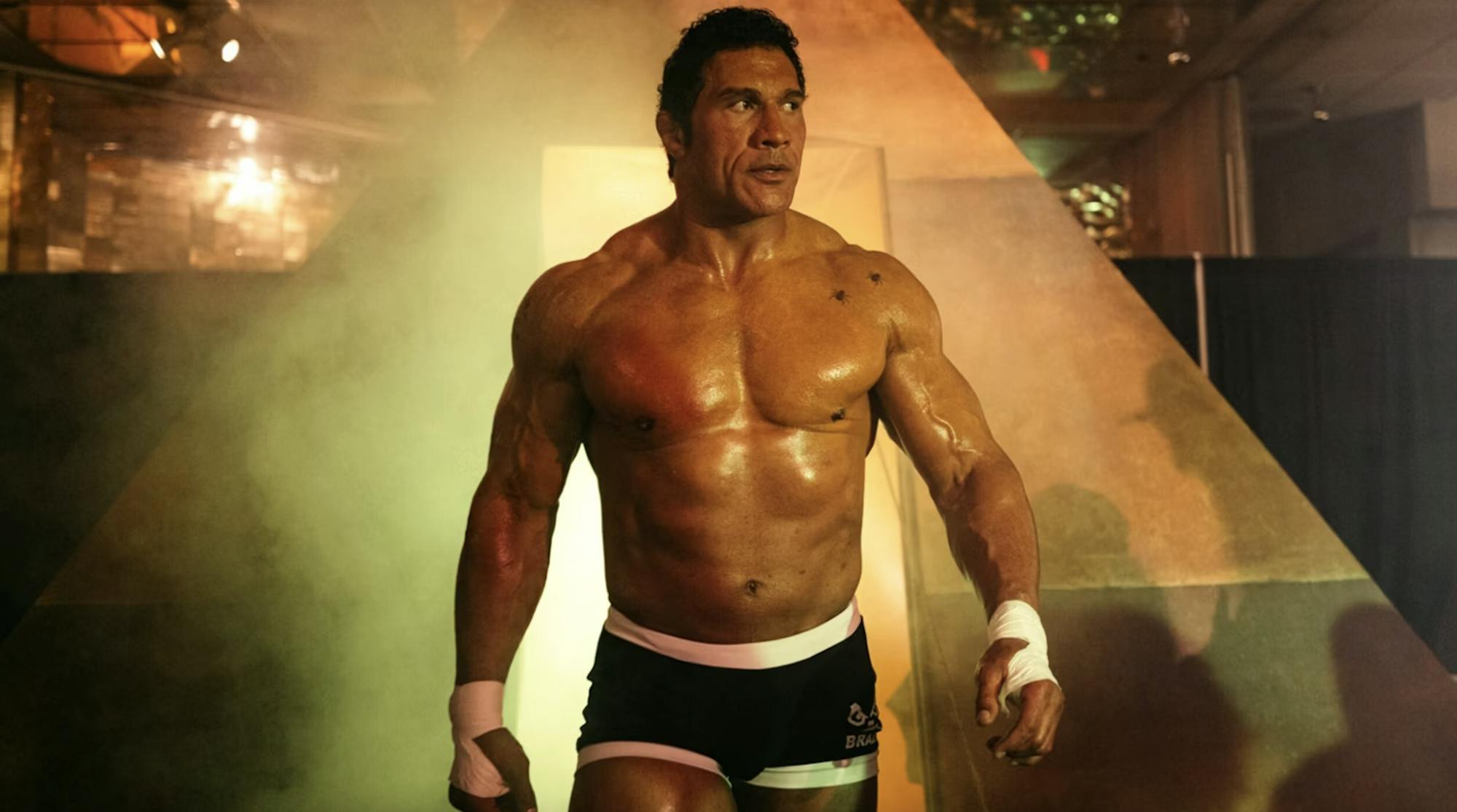
I was genuinely shocked watching the trailer for The Smashing Machine. I first encountered it on YouTube’s trending page, featuring the official A24 logo stamped in the corner, with a muscular fighter shining front and center. As I watched Mark Kerr talk to an old lady at the hospital about mixed martial arts, I realized, “Wait, this person looks a lot like The Rock.” I clicked on another tab to look it up, and there he was, smiling back at me. I was taken aback; The Rock is actually acting here.
Dwayne “The Rock” Johnson isn’t really an actor in the same category as a Leonardo DiCaprio or a Denzel Washington. All are well-renowned, well-paid, successful leading men of their time, whose presence on a movie poster enough to generate hype for an upcoming film. However, all these other famous actors actually try to give a performance, to inhabit a role and convince the audience that they are indeed someone else. For two or three hours, they are different people than their real selves, adopting different expressions, mannerisms, voices, personalities, etc. The Rock, on the other hand, is a movie star. When you are watching a Rock film, you’re not watching it to see a different person. His movies feature the thinnest veil of disbelief; the only real thing distinguishing The Rock’s public persona and his characters being the names. He typically plays a slightly-exaggerated version of his public persona — the charismatic, muscled, funny badass, always victorious, always ready to promote his personal brand. Yet in The Smashing Machine, a sports biopic drama chronicling the rise and fall of MMA fighter Mark Kerr, The Rock wants us to know that he is an actor.
A24 is an interesting pick for The Rock’s debut as a “real” actor. The film studio has prided itself on its directors-first business model, giving voice to some of the strangest, most exciting filmmakers working today. And this model has yielded great success for the independent studio, now a company worth $3.5 billion with 76 Oscar nominations under its belt. Millions of fans, tired of a movie industry obsessed with sequels and IP, enthusiastically pay $9.99 a month to get free merchandising, movie tickets and early screenings of its films. In short, they stand against everything The Rock represents.
The Smashing Machine was supposed to be A24’s $50 million blockbuster, a film that smashes box office sales without abandoning its auteur-first approach. Yet, when I went to see this film on a chilly Friday night, there was only one other person with me. I asked the good people working at Cinemapolis, “How many people saw the movie on opening day?” They said only five. This experience isn’t unique, apparently, as this film is now the lowest growing opening week for The Rock in his entire movie career. I walked out of the movie theater thinking, “What happened?”
Things would be quite simple if the film were straightforwardly bad. If it played into the worst cliches of the biopic genre, formulaic to its core, filled with melodramatic fight scenes or triumphs, then the story of its failure would be simple. It would be the sign of doom for A24, a betrayal of its ethos designed for The Rock to get that Oscar nomination. Yet, there aren’t really any glaring issues with this film. The performances are all amazing, especially The Rock as Mark Kerr and Emily Blunt as his fiancée Dawn Staples (who breathes so much life into an otherwise underdeveloped character). The soundtrack composed by Nina Sinephro is absolutely fantastic, a perfect companion to the film’s fight scenes. Crucially, the film does not compromise Benny Safdie’s vision. The co-director of stressful masterpieces such as Good Time and Uncut Gems, he now has full reign as director, writer, co-producer and editor of the film. Though way less heart-attack-inducing than his other films, The Smashing Machine has everything that has come to mark him as a filmmaker, from his handheld documentary-style cinematography to his focus on characters who struggle with personal and addiction issues. There is just something about this movie that didn’t resonate with viewers, that failed to really excite or bring people to the movie theatre.
The most widespread reaction to The Smashing Machine is one of vague dissatisfaction. Richard Brody most succinctly voices this reaction in his New Yorker review of the film: “Safdie takes a story of passion and fury, of rage and torment, and reduces it to the arm’s-length mode of the interesting.” I’d wager that this reaction stems from one element of the story's structure: its refusal to give grand payoffs to narrative threads. I noticed this particularly in the film’s treatment of Mark Kerr’s friendship with Mark Coleman. The movie spends so much of its runtime building their friendship, so when we see these two slated to compete at the Pride Grand Prix tournament, we expect some kind of massive rupture. As in movies like The Social Network and Captain America: Civil War, the friends-to-enemies trope is a reliable source of drama within a narrative. Yet these friends never rupture. Kerr gets knocked out early in the tournament, they remain good friends and Coleman wins the tournament. There is no huge fight scene, no screaming matches, no shoving, no indication that they don’t love each other. Just an ending scene where Kerr smiles and laughs at the shower while Coleman sits alone with his championship belt and trophy. The Smashing Machine refused the time-honored payoff for something quieter: a conclusion truer to the film’s ambition and themes.
I may be wrong, but I suspect time will be kinder to this film. It was not meant to be a big blockbuster; it’s too muted and calm to grab anyone’s attention. For a film about a fighter starring The Rock, there is little action in this film. Yet, I also think it’s what makes the film worth at least a single view, and what may attract people to it someday.
Basil Bob is a junior in the College of Arts and Sciences. He can be reached at bob27@cornell.edu.

Basil Bob is a member of the Class of 2027 in the College of Arts and Sciences. He is a staff writer for the Arts & Culture department and can be reached at bbob@cornellsun.com.


