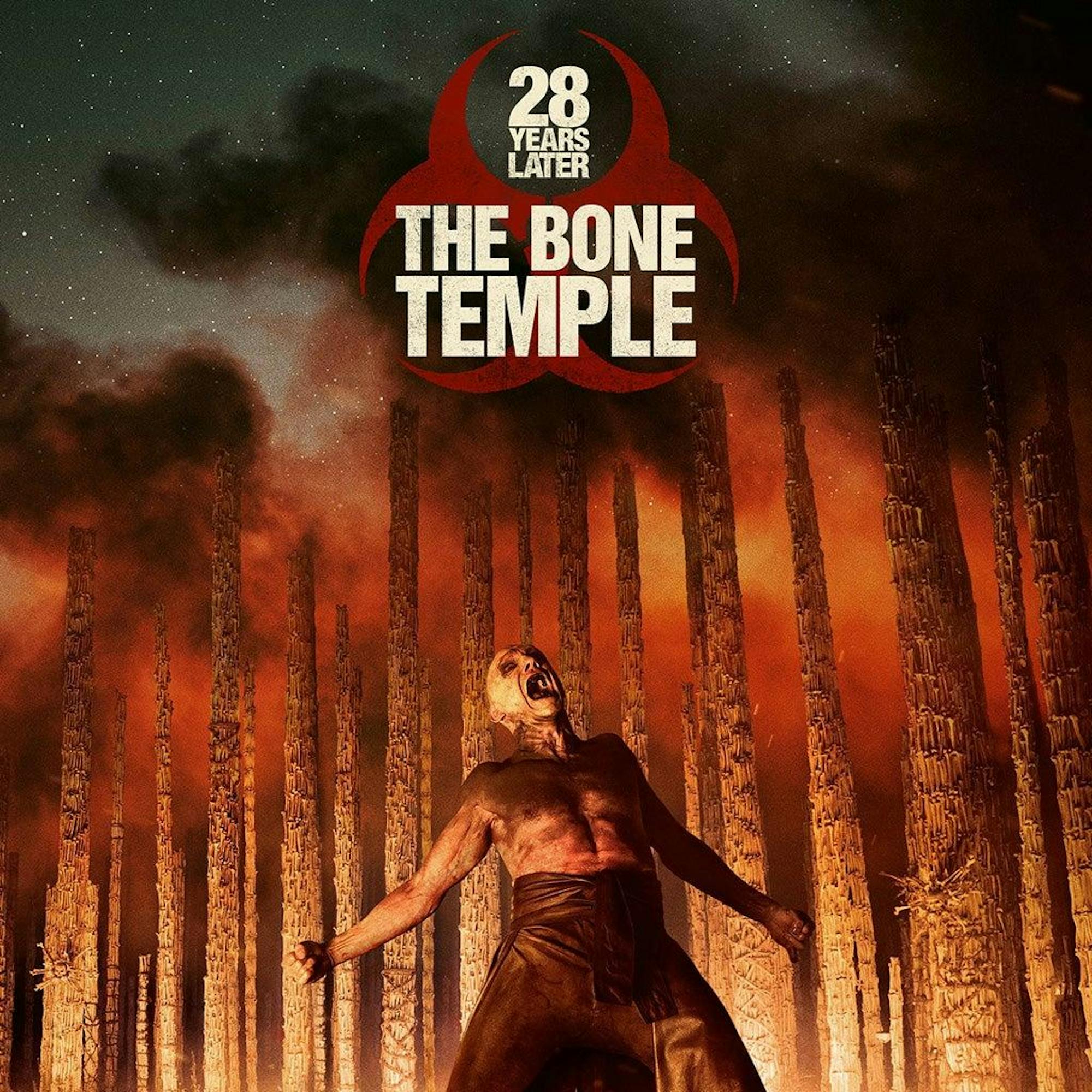
While January is typically the weakest month of the year for new films, 2026 is already shaping up to break this trend. Less than a year after the release of 28 Years Later, the next installment in the 28 Days franchise is almost as strong as its predecessor, which ended up remaining one of my top five films of 2025. Don’t let January’s reputation as a ‘dumping ground’ for bad movies turn you away. While 28 Years Later: The Bone Temple is missing the direction of Danny Boyle, it is still an extremely strong entry into one of my favorite film series of all time.
Directly following the events of 28 Years Later, The Bone Temple follows Spike (Alfie Williams) as he joins a group of sadistic fighters using the apocalypse as cover to murder and sacrifice fellow humans. The “Fingers” are led by “Sir Lord” Jimmy Crystal, the grown version of the pastor’s son we saw in the opening sequence of 28 Years Later. After his portrayal of the vampire Remmick in last year’s Sinners, Jack O’Connell takes on an even crueller role in Jimmy Crystal, whose experiences in the beginning of the Rage Virus have turned him into a self-proclaimed Satanist. We quickly realize that everything about Jimmy’s worldview is warped, based on fuzzy childhood memories that would never be corrected. The onset of the Rage Virus in his youth and the subsequent death of his parents have left Jimmy idolizing and imitating figures like Jimmy Savile (whose crimes didn’t come to light until 2011, long after the in-universe apocalypse) and creating a story of Satanism based on no current religion.
The horrific acts of brutality we see committed by Jimmy Crystal are sharply contrasted with a story of hope. The film’s subplot follows Dr. Kelson (Ralph Fiennes) and his continued belief that humanity still remains within the infected. The audience sees a softer side of the Alpha from 28 Years Later, whom Dr. Kelson names Samson, as the two begin to find connection. Played by Chi Lewis-Parry, Samson’s inner humanity, long suppressed by the Virus, begins to come to light under Kelson’s guidance.
In 28 Days Later, Danny Boyle flipped the zombie genre on its head, framing his human characters as the true monsters of the film, and exploring how an apocalyptic event might bring out the darkest parts of human nature. Last year, 28 Years Later went even further, changing zombies from nameless villains for our protagonists to mow down into offsets of humanity. I was struck by the film’s choice to explore how the infected might have evolved over the course of 20 years and how those impacted by the Rage Virus had formed their own culture and way of life. It makes sense, then, that in The Bone Temple, we delve even deeper. Here, the brutality of Jimmy and his Fingers is juxtaposed with the kindness, empathy and connection found between Dr. Kelson and Samson, two outcasts of society. The film draws a strong parallel between Jimmy Crystal and Samson: both characters are affected by psychosis brought on by the Rage Virus in two vastly different ways. Whereas Samson has created life, through the birth of his daughter, and has found friendship with Dr. Kelson, Jimmy’s mental state has turned him into nothing less than a monster.
The 28 Days franchise has cemented itself as one of the most fascinating film series of all time. While The Bone Temple is missing some of the flair of its precursors in its cinematography and editing, director Nia DaCosta’s less eccentric style serves the somber tone of the film. It’s difficult to feel like anything is missing, even without Danny Boyle’s direction, when the story and direction are so strong. At the center of the film is Ralph Fiennes’s performance, who brings a much-needed sense of humanity to a story so devoid of it. His empathy, for the infected, for Spike and even for Jimmy, gives the film a sense of hope.
While the visuals of The Bone Temple don’t quite live up to its predecessor, I would argue that its screenplay is even stronger than 28 Years Later’s. Its exploration of the effects of trauma and the continued blurring of lines between human and monster make it one of the most interesting mainstream films in recent memory. So far, the box office for The Bone Temple has been undeservedly lackluster. While January releases certainly have a reputation, don’t let that stop you from making the trip. Just as 28 Years Later has stuck with me almost a year after its release, I expect The Bone Temple will remain one of the best films of 2026.
Nicholas York is a junior in the School of Arts and Sciences. He can be reached at nay22@cornell.edu.
‘Projections’ is a column focused on reviewing recent film releases.
Nicholas York is a member of the Class of 2027 in the College of Arts and Sciences. He is a columnist for the Arts & Culture department and can be reached at nyork@cornellsun.com.