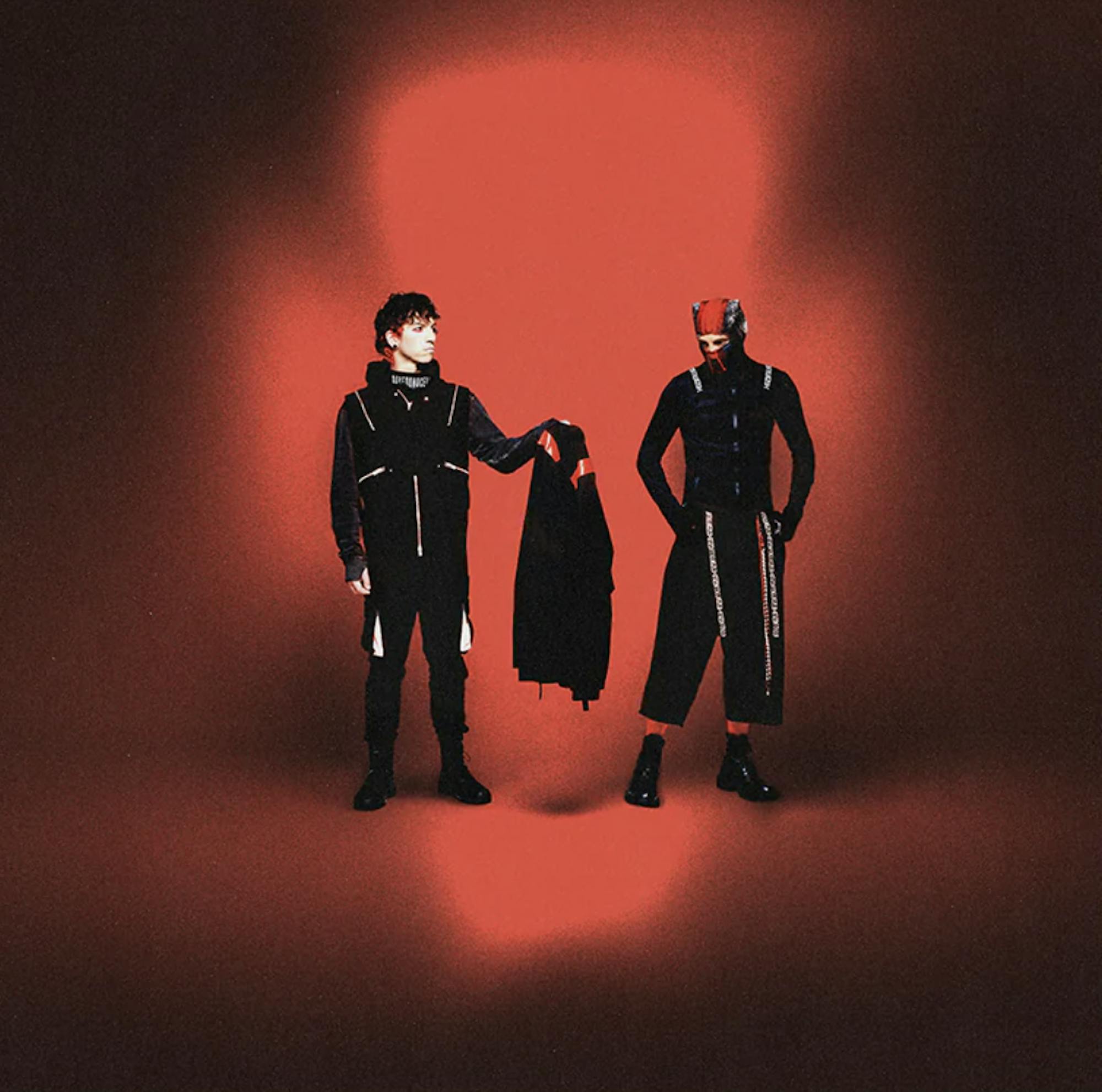
After a decade of lore-building, Twenty One Pilots’ fictional world, Dema, seems to be closing its doors. Breach, the collective’s new album, is out, and looming uncertainty has swallowed the fanbase whole.Tyler Joseph posted an open letter concerning the band’s plans and describing the general sense of exhaustion following the release, leaving fans uncertain about what the future holds. While the shivers rattling the skeleton clique’s collective body calmed down with the announcement of a couple of summer festival dates in 2026, it is not yet clear when and if listeners can anticipate a new record. It is also uncertain if audiences outside the US will get to hear Breach in its entirety; the album’s release is marked by only a handful of North American shows serving as an extension of the band’s Clancy World Tour. This combination places unusual weight on Breach, it arrives as a capstone –– or a farewell of sorts.
The record itself follows a familiar 13-track-long formula bookended with a distinct opening and closing that intertwine in the music video for “City Walls,” bringing a decade-long story of Tyler Joseph’s alter-ego, Clancy, to a conclusion. The finale, however, is far from heroic: even without delving into the lore, it is clear that Clancy’s narrative is not one of overcoming, but rather succumbing to a cycle. “Intentions,” the final track, echoes the sentiment: “I am starting it all over once again, did I learn a thing?” It is, as such, a rather fatalistic record –– perhaps more so than some of the collective’s previous albums. The central questions remain unchanged throughout the course of the decade: from 2015’s “I’m a pro at imperfections and I’m best friends with my doubt” to 2025’s “Oh, what have I become? Dirty and wretched one, am I unholy land.” Twenty One Pilots has positioned themselves as a band firmly remaining for the same struggling audience, if only further weathered by life’s many storms along the way. Old anxieties get wrapped in new melodic variations, but ultimately, cradle an all-too-familiar claustrophobic core.
Despite thematic permanence, the duo still has an array of new tricks to offer: Josh Dun debuts his own vocals, Tyler Joseph’s scream makes one briefly forget that this is not an early Bring Me The Horizon record, ballads abruptly collapse into hyperpop just to rise back up through a simple piano tune. As a whole, Breach stands as an impressive exercise in range –– and the band’s most versatile work to date.
“The Contract” and “Drum Show” were the only two tracks released as singles –– and both shine as brilliant compositions. “The Contract,” electronic, guitar-heavy and rich in texture, stands out as the album’s undeniable highlight. Along with “City Walls,” the two feel like stylistic markers, showcasing the band’s ability to play with a variety of registers within the span of a singular track –– as well as continuously explore new directions, even years down the road. “Drum Show,” perhaps the most punk composition on the record, is a spiritual twin to the band’s essential “Car Radio.”
Nearly every Breach track could hold up as a standalone; the composition for each song is segmented into clear sections that slow down and speed up to bleed into one another –– or, on occasion, sometimes nearly stop altogether just to pick back up. The result is fascinating, yet fragmented — and the overall plot ends up being easy to lose. Breach attempts to be a career step forward, a memorial and an emotional outlet all at once. It succeeds in parts — but in trying to be everything, it strains against itself and loses cohesion. Listening to Breach is like tearing open an advent calendar in one sitting: the surprises, taken in all at once, seem to blur, combining into an experience less than the sum of its parts. One could almost imagine Breach unfolding as a year of singles rather than a single drop — an unrealistic model, but one that would have amplified its strongest qualities.
In the end, Breach feels less like a conclusion than a question mark. As a listening experience, it’s sprawling, inventive and emotionally raw, but as a chapter in the band’s history and the final line of a story as long and lore-heavy as that of Dema, it reads as unfinished business — an ellipsis rather than a true sentence end. For the fanbase, this ambiguity may be frustrating, but admittedly fitting. Twenty One Pilots have always thrived on tension, casually balancing intimacy with spectacle, and despair with defiance. If Breach is indeed a farewell, it’s a restless one, refusing to offer resolution; if it’s a prelude, then it’s a daring one, leaving fans with high expectations and an unsatiated hunger.
Arina Zadvornaya is a graduate student in the College of Engineering. She can be reached at az499@cornell.edu.

Arina Zadvornaya is a graduate student in the Duffield College of Engineering. She is a columnist for the Arts & Culture department and can be reached at az499@cornell.edu.