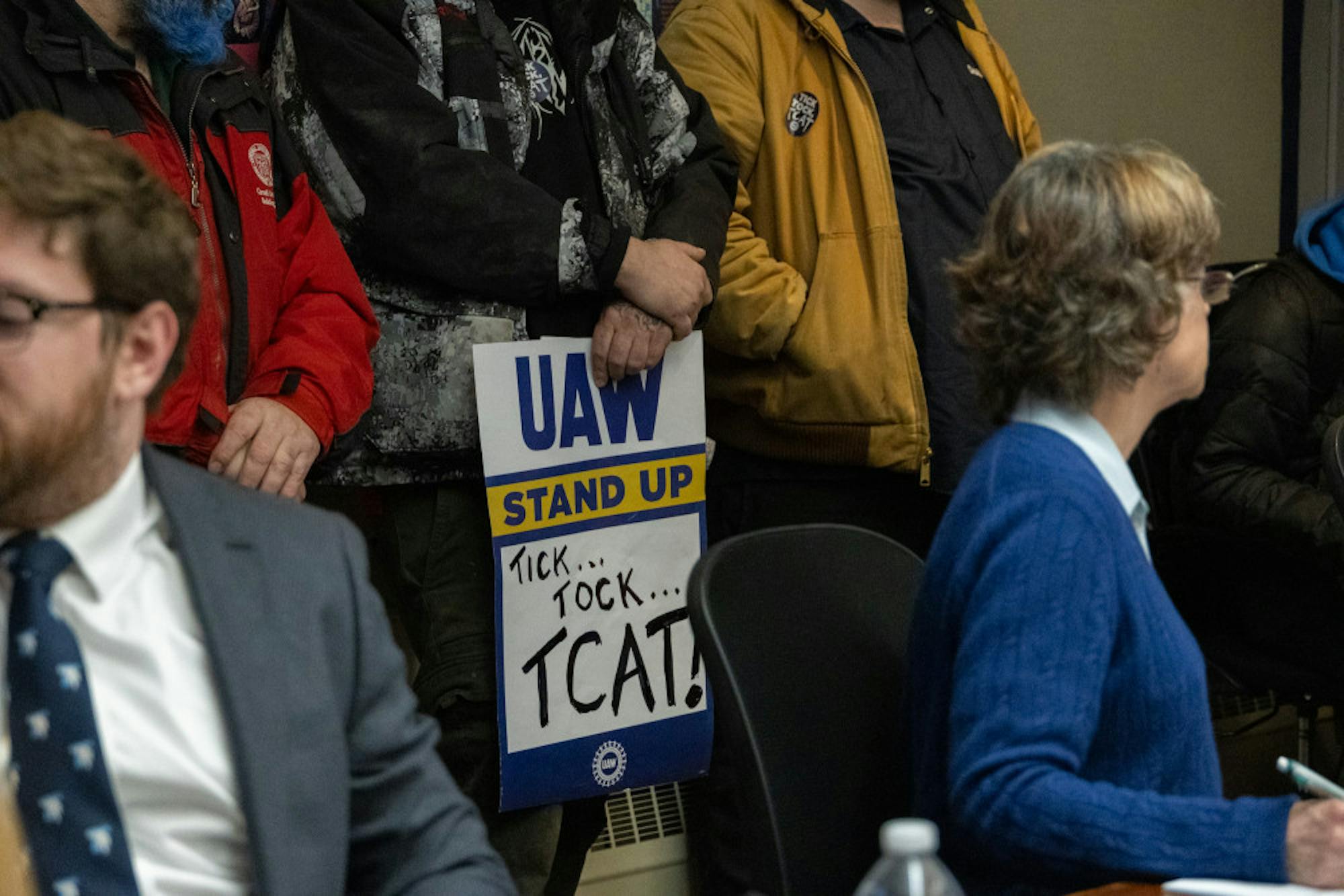
Employees represented by the United Auto Workers Local 2300 union rallied outside the Tompkins Consolidated Area Transit office on Thursday to generate support and awareness about their ongoing negotiations for a new contract.
The TCAT oversees all bus lines that service Ithaca and Cornell. In December, the workers’s contracts expired, launching a series of negotiations between the union and TCAT management.
According to a statement released on its website, the UAW Local 2300 “continues to focus on our priorities of fair wages for all members, equal pay for equal work, and ensuring staffing levels meet the needs of our community without forcing our members to work 6 days a week, enduring exhaustion and facing burnout.”
Will Wright, a bus operator for TCAT, vice chair for the TCAT unit of the UAW Local 2300 union and member of the bargaining team, addressed fellow workers and bus riders outside the downtown office where the monthly board of directors meetings take place. The rally occurred directly before a monthly meeting.
For Wright, one part of a fair contract means an increase in wages, which he said are not keeping up with the cost of living, and are worth less after adjusting for inflation than the wages drivers earned in 2019. He also wants to see an increase in overall staffing and more consideration in the contracts for work-life balance.
“The drivers of the membership have been sacrificing and sacrificing and sacrificing to make sure that public transit in this area is still functional to whatever degree we can,” Wright said. “We've been working for wages that haven't kept up with inflation, and we see that by the fact that we have such high turnover as well.”
In an interview with The Sun, TCAT General Manager Matthew Rosenbloom-Jones said that TCAT has proposed a new contract which they hope will satisfy the UAW’s requests. Rosenbloom-Jones expressed his interest in getting a new contract approved soon, recognizing the importance of investing in the workforce.
“We need to invest in our workforce to remain competitive and to provide the best quality of transit service we can to our community,” Rosenbloom-Jones said.
According to Rosenbloom-Jones, the contract the TCAT is now offering, including wages and additional premiums, “would make [their] employees some of the highest compensated bus operators and mechanics in the United States.”
“Our latest proposal that we sent to the UAW would put the starting wage for a TCAT bus operator at $26.94 an hour, which is the highest in upstate New York, and the mechanic starting wage would be the second highest in upstate New York,” Rosenbloom-Jones said.
In 2024, new TCAT drivers were paid $25.66 per hour. New York bus mechanics make an average of $27.34 per hour, the highest average rate in the U.S. except for Washington and Washington D.C. Bus operators in New York make an average of $27.07 per hour.
Wright explained that he, along with the other TCAT employees, are invested in the work they are doing while fighting for a new contract.
“We want to make sure that TCAT maintains its operations, and expands its operations even,” Wright said. “But we need a fair contract in order to do that.”
Wright recognized that the wages were among the highest in this region, but expressed frustration with the overall pay scale for transit employees in Upstate New York.
“I think part of our work here is not just around TCAT,” Wright said. “If they're offering some of the highest wages, that means upstate New York in general is not recognizing the value of the work that we do — [the work] of transit employees. So part of what we're doing is standing up and pushing for that value to be recognized overall.”
UAW members also objected to the “mandates” policy — a TCAT policy that requires employees to come to work on their scheduled days off when needed by management. Wright explained that with regularly scheduled work days, employees can choose their hours or have more flexibility over their assignments, but with mandates that choice goes away, causing uncertainty for operators.
“If you don't come to work [when mandated], you will be disciplined, just as if you've missed a scheduled day,” Wright said. “On top of that, we cannot take vacation for that mandated day. We cannot stop it in any way.”
While official “mandates” are handed out infrequently — under 20 times across the organization last year — Wright said that was due to pressure for employees to volunteer their time instead. According to Wright, employees will sometimes be asked if they will voluntarily come to work on their days off. However, he says that if employees don’t voluntarily come in on their off days when asked, there is the risk of being mandated anyway.
As a result, employees will often volunteer their time to avoid the risk of being mandated. “They don't really have a choice, but it makes it look like they just took extra work,” Wright said. He describes this situation as “shadow mandating.”
“We don't have numbers on exactly how frequent [mandates are], because the numbers are hidden in that process,” Wright said. “But we do know that, on average, our drivers have worked an additional 25 days in 2024. If you're looking at your usual business week, that is over a month of extra work.”
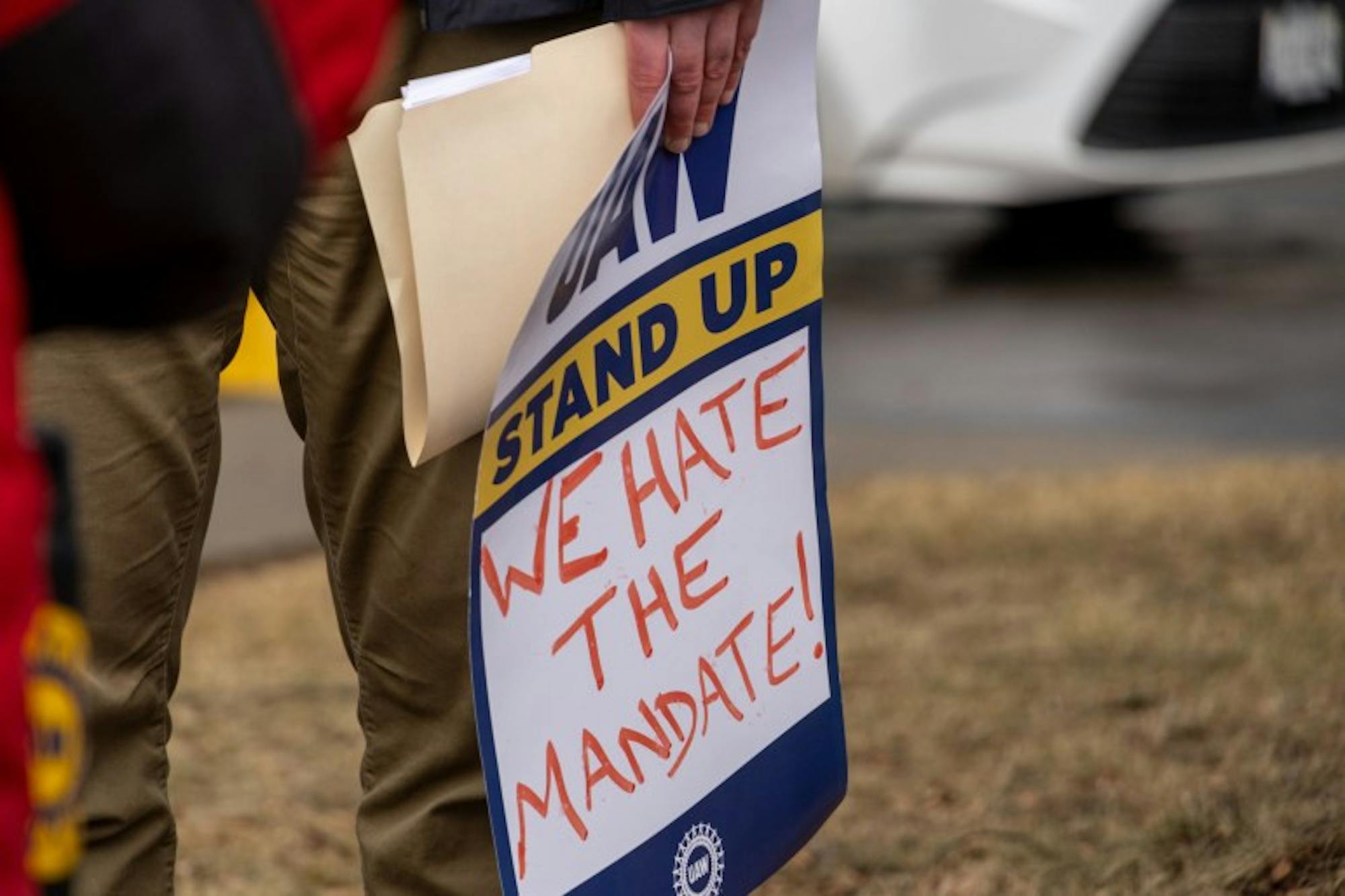
However, the policy is not one that management is open to reversing. Rosenbloom-Jones noted that mandating employees to come in on days off is a common practice across the transportation industry.
“The thought process on mandating is very simple,” Rosenbloom-Jones said. “We’re a public service, and there [are] times of day where we need to provide transit service. We need people to be behind the wheel at all those times so that no one is left standing on the side of the road.”
As a result, Rosenbloom-Jones explained they always need adequate staffing to keep routes running. “When we have a high amount of call-offs or absenteeism, sometimes we are forced to mandate to ensure that service is covered,” he said.
Aside from bus operators, members of the community — including riders and fellow UAW members — attended the rally in solidarity with the TCAT workers. John Monkovic, a union member who is a cook and building representative for Morrison Dining, was enthusiastic about supporting his fellow union members in their efforts.
“We're here to support our brothers and sisters at TCAT who are bargaining for a fair contract, and to make our presence felt at this Board of Trustees meeting,” Monkovic said. “All the TCAT drivers and workers really showed out for us during our strike. So we're trying to repay the favor.”
Monkovic additionally recognized the importance of the bus operators in keeping the city connected.
“We know that they make this whole city and county run, so we're trying to send a strong message to TCAT management — that these workers need a fair contract,” Monkovic said.
The unionized TCAT workers and TCAT leaders are both hopeful that a new contract can be agreed and voted on soon.
“We are anxious to get a new contract ratified and out to the membership for a vote, so that we can focus on retention and recruitment,” Rosenbloom-Jones said. “We look forward to continuing to negotiate with the UAW and finish up this set of contract discussions and get the final contract out to the membership for a vote.”