

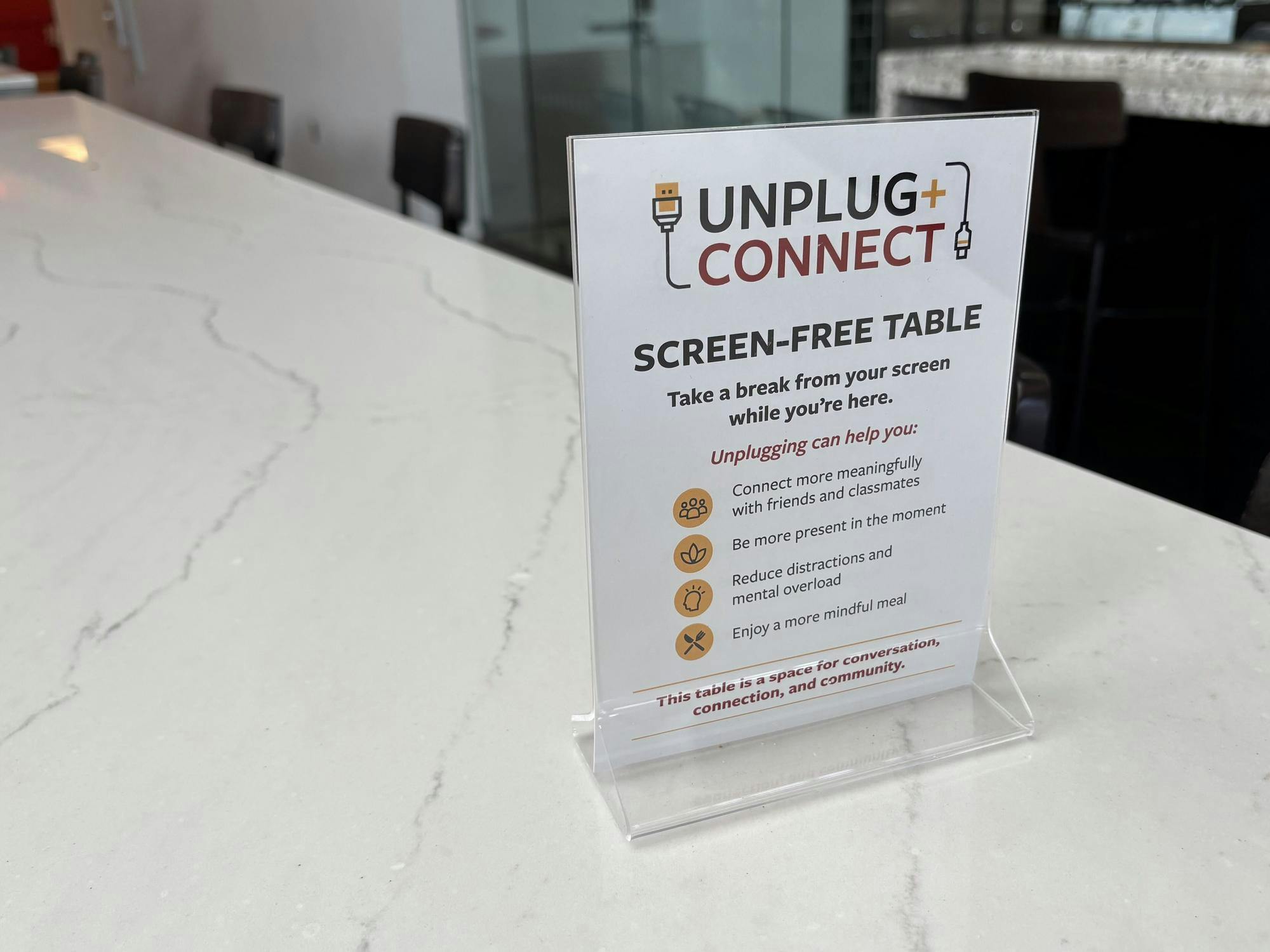
Cornell examined different ways in which students can limit their own screentime use through their weeklong event Cornell Unplugged, which urged students, faculty and staff to “go off-line, off-screen, and off-tech.”
Cornell Unplugged, which took place from Sept. 14 to Sept. 20, explored how mindful technology use supports personal well-being and meaningful face-to-face connections. Participants were encouraged to put down their devices during meal times or while engaging with other students. Cornell faculty also considered tech-free and tech-light classroom strategies during this time.
The initiative was run by Prof. Steven Jackson, science and technology studies, vice provost for academic innovation and chair of the Sustainable Computing Working Group, and his graduate student Paul Vermette.
According to Jackson, the event came in response to campus concerns surrounding technology use.
“Faculty were expressing some concerns around technology use and sometimes AI use in their personal lives,” Jackson said. “Students also express[ed] concerns about whether they were using screens too much and whether it was detracting from their ability to be present with others at the University.”
The Cornell Unplugged website offered a list of tips on how to limit screen time, along with a list of events to attend as alternatives to using technology. The weeklong series of events included activities at the Herbert F. Johnson museum and daily “Golden Hour” gatherings at sunset on Libe Slope.
One of the student organizers of Cornell Unplugged, Mikael Murphy ’28, expressed concern that technology overuse leads to phone addiction, which negatively impacts students.
Excessive screentime “impacts interpersonal relationships, such as decreased time spent with other people, neglecting responsibilities, and shorter attention spans and focus, affecting student success,” Murphy said, pointing to research from the National Institutes of Health.
Jackson explained that members of the community were encouraged to participate in whatever capacity they could.
“We are open to whatever people want to try. If people want to step back for an evening, day or weekend, all of that is fine,” Jackson said.
Pari Patel ’28, another student organizer of Cornell Unplugged, noted that taking breaks from technology while studying improved her wellbeing.
“I feel really grounded and refreshed in a way I don’t get from scrolling to decompress, and I come back being able to do better work,” she said.
Community members signed the “Unplugged Pledge,” an anonymous form when they could set a personal goal for the amount of hours they would attempt to go without a device.
With a sample size of 56 individuals, the form reports that participants committed to reducing screen time and overall technology use by 35%.
On average, students pledged to unplug for 17 hours a week, staff for 19 hours and faculty for 21.
The form revealed that 84% of participants’ motivation to unplug was for mental health, connection, taking a break, feeling that it’s a waste of time and to avoid becoming screen-dependent.
Boubakar Diallo ’28 admitted that social media and other forms of technology make it difficult for him to engage with his peers.
“There are days where I read a lot of the news [for up to] five to six hours and that affects my involvement with my friends and the community.”
Additionally, 12% of participants expressed environmental concerns and 10% wanted to try new ways of teaching or see if paying attention in class was easier.
Jackson pointed out that students were having difficulty paying attention in his classes. “Students were on screens in ways that were distracting to their colleagues who were trying to pay attention in class, but were sometimes drawn into whatever was on the laptop next to them.” Jackson said.
Finally, 28% of participants planned to unplug by prioritizing human connection, 24% wanted to restrict technology use and spend time outside, 18% reported reading books and 16% reported finding alternatives for teaching and learning.
Students found unplugging from the digital world to be beneficial for their mental health.
“The biggest difference is not having to engage with a barrage of notifications [from social media],” Patel said. “A few hours without that and I feel noticeably less overwhelmed.”
This aligned with graduate student Vermette’s stance on why Cornell Unplugged was needed.
“There are increasingly more and more issues with how much people are using social media and how that intertwines with their mental health,” Vermette said.
Additionally, using less technology meant more time for other things.
“I had the screen time limit on my phone, so I couldn’t use Instagram for more than an hour,” Murphy said. “I found myself spending time with my family and going outdoors more often, and generally felt content about how I was enjoying my time every single day.”
Jackson and Vermette continue to encourage students to be mindful of technology, even after unplugging, and hope that this event taught participants how to be sustainable and intentional with screen time use going forward.
“The world would be better if we were mindful and intentional about technology use,” Jackson said. “[It’s important] to use and lean into [technology] for a lot of the great things it can bring to us but also avoiding it when it’s affecting the relation to our own wellbeing, relationships with others, and the teaching and learning efforts at the university.”
Chloe Yu is a member of the Class of 2027 in the College of Arts and Sciences. She is a staff writer for the science department and can be reached at cyu@cornellsun.com.


