“I always say it took me 12 years to get into Cornell.”
When Katherine Houpt applied to Cornell’s College of Veterinary Medicine in the 1950s, she was rejected. Later, she returned to Cornell as the first woman appointed to a full professorship at the vet school.
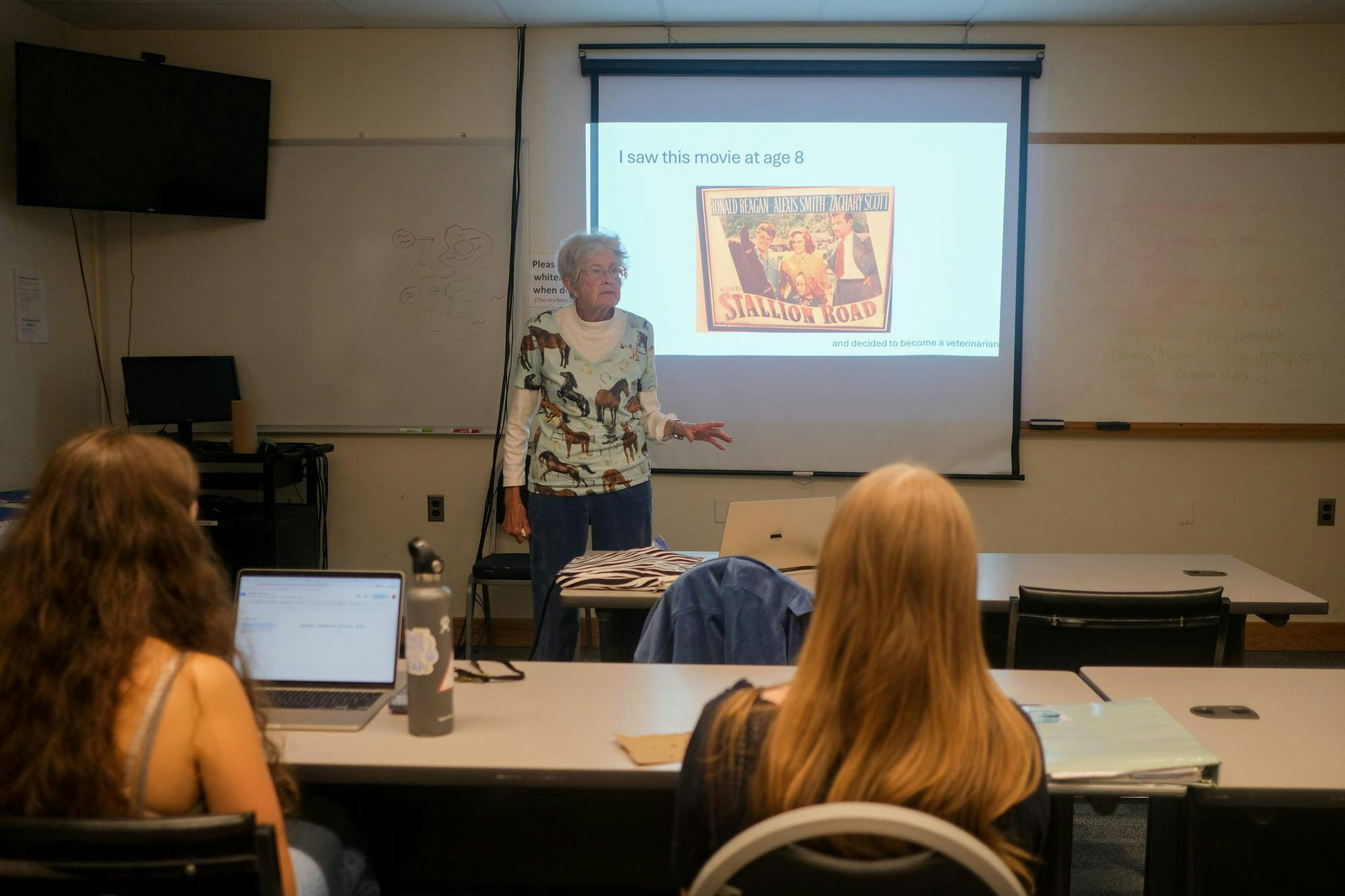
The undergraduate Animal Behavior Club at Cornell hosted an interactive talk with Katherine Houpt, the James Law Professor of Behavior Medicine, Emeritus, on Sept. 30.
In her talk, Houpt discussed her motivations for pursuing behavioral veterinary medicine, her research on horses and her experience navigating a then male-dominated field.
She described how her early experiences with animals and interest in research influenced her decision to become a veterinary behaviorist — someone who treats medical, neurological and behavioral disorders in animals.
“I have loved horses all my life,” Houpt began, explaining that her early experiences with horseback riding were connected to her father’s military service. When the Japanese cavalry surrendered its horses to the American army after World War II, horseback riding became an important part of her childhood and contributed to her interest in veterinary medicine, she said.
In addition to her love of horses, Houpt explained that she first became interested in behavioral research in her early 20s when she stumbled across an article that explored how certain stimuli could influence sexual behavior in domestic turkeys.
Houpt was an undergraduate at Penn State University at the time, and the author of the paper was coincidentally a professor there. She went to see him.
“I said, ‘I think this is the most interesting thing I have ever heard of. I’d like to be in this field,’” she recalled. “And he said, ‘Well, before you had this epiphany, what did you want to do? And I said I wanted to be a vet, and he said, ‘Be a vet, then you can be anything you want to be.’”
Because Houpt was interested in both veterinary medicine and animal behavior, she decided to follow the professor’s advice and apply to veterinary school, which was challenging for women at the time.
“Eventually I got into veterinary school, which was very hard for women in those days,” she said. “Cornell turned me down.”
However, the University of Pennsylvania was beginning to admit more women into its veterinary school.
“The University of Pennsylvania decided to take five women that year,” Houpt said. “Veterinary medicine was in decline because everyone was driving cars. They didn’t need to keep their horses sound, so they decided that instead of letting in five guys, they would let in five women.”
Houpt was one of those five women. She graduated from the University of Pennsylvania School of Veterinary Medicine in 1963 and entered into a profession in which women were still underrepresented, becoming the 250th woman veterinarian in the U.S., she said.
Since then, the gender composition of veterinarians has changed drastically. “Now, of course there are more women in the profession than men,” Houpt commented, attributing the change to Title IX, which was enacted in 1972 and prohibited sex-based discrimination in education.
In addition to receiving her VMD, Houpt went on to get her Ph.D. in behavioral psychology at the University of Pennsylvania in 1972. She studied feeding behavior in newborn rats in order to further explore her interests in animal behavior.
After practicing as a veterinarian, Houpt became the first woman appointed to a full professorship at Cornell’s College of Veterinary Medicine, though she encountered gender-based disparities in pay.
Houpt initially taught a course in the Department of Women’s Studies called “The Biological Basis of Sex Differences.”
Later in her career, she was asked to teach an animal behavior class to veterinary students without pay. Eventually, she was paid part-time before receiving a full-time salary.
With this position, Houpt acquired an office and research space, which she described as “a big stall that I could divide in half.”
“My first question was, ‘Do horses like bedding?’,” Houpt said.
To answer this question, she performed preference tests that looked at whether horses preferred only concrete or bedding composed of wood shavings in their stalls.
Using a video camera to observe their behavior, she noticed that the horses in the concrete stall did not lie down at all but ate more, while the horses in the stall with bedding would lie down more frequently. She ultimately determined that they preferred stalls with wood shavings and deeper bedding.
In another study of equine behavior, Houpt discovered that horses preferred to be outside in the paddock for longer periods of time, about 40 to 50 minutes, but only if they were with other horses.
Through her research, Houpt observed how animal behavior changed in response to different environments. In the classroom, she found that veterinary students were also interested in understanding behavior beyond its biological mechanisms.
“The vet students did not only want to know about the parts of the brain, or about neurotransmitters,” she said. “They wanted to know about the behaviors and the behavioral problems that they would see in their clinics.”
This growing interest helped to expand the field of veterinary medicine to include behavioral problems as an aspect of clinical care.
Houpt concluded her talk with an interactive component where the event attendees presented their pets’ behavioral issues and she provided guidance.
Some students mentioned that their cats would sometimes urinate outside of the litter box.
“Most cats like two litter boxes,” Houpt responded. “The reason is that they like to urinate in one and defecate in another, and you can also do preference tests, so you can try crystal litter in one box and Tidy Cats in the other.”
Houpt encouraged students to approach each behavioral question systematically: First, rule out any medical issues, and then use observation and preference tests to determine what might be contributing to their pet’s unusual behavior.
Houpt’s talk was part of a series of interactive discussions hosted by the Animal Behavior Club.
Co-president Allix Byars ’28 emphasized that the club helped her find an interdisciplinary animal behavior community at Cornell.
“I like having meetings like this to explore the cross section between behavior and other topics,” she said.
The club will continue to invite faculty, postdocs and graduate students “at all different levels of their career to talk about their research and how they got into their career,” co-president Leo Navarro ’28 said.
Elsa Huelsbergen is a member of the Class of 2028 studying biological sciences in the College of Agriculture and Life Science. She is a staff writer for the science and technology department and can be reached at eh586@cornell.edu.