As students settle into the new academic year, some Cornell seniors are exploring the rigorous world of research through a unique milestone: the senior honors thesis.
To learn more about what an honors thesis is, The Sun spoke with two seniors, Sophia DeSisti ’27 and Shawn Wallace ’27, who gave a glimpse into the work they have put in so far and what they hope to accomplish before graduation. Additionally, Jeff Huether ’26, a recent animal science graduate, reflected upon his experience defending his thesis.
What is a Senior Honors Thesis?
At Cornell, a senior honors thesis offers students the opportunity to deeply research a topic they care about through an individual, faculty-guided research project. The thesis is designed to explore a question that researchers haven’t fully answered yet, which prepares students for graduate work and research-driven careers.
The process of completing a senior thesis varies across colleges and departments at Cornell. Students are typically required to apply during their junior year of college and submit a written thesis by the spring of their senior year.
After the written thesis is submitted, students are sometimes required to give an oral defense of their findings to classmates and professors. Once this is complete, it may be published in an online archive for unpublished research papers called bioRxiv.
In fields like animal science, biology and society, psychology or other STEM areas, defending a senior thesis is more common than in non-STEM departments, such as English.
Students across departments can choose to conduct a senior thesis by approaching their advisor and discussing potential research interests and eligibility requirements. Interested students must write an application and a thesis proposal to the department that aligns with their research idea. Deadlines for these applications among all senior theses are due no later than the first semester of senior year.
Bad Bones and Dog Genes: Jeff Huether ’26’s Panosteitis Study
For Huether, his honors thesis topic became not only a research question, but a line of inquiry he hopes to continue beyond college.
Huether’s thesis, which he defended in May, focused on panosteitis, a painful bone disease that primarily affects young, large-breed dogs, causing lameness and impairing mobility. However, scientists are uncertain about the cause of the disease, he explained.
Huether’s senior thesis provides a preliminary diagnosis method and recommends ways for scientists to move forward in discovering the origin of panosteitis.
“You have this giant, whole project you have to do at some point or whatever that big task may be, it's kind of like you have to figure out when you're getting that done and how you're getting that done. Obviously you try to set goals and deadlines, sometimes you fall behind those or get ahead of those, it's a time commitment but I think it’s worth it.”
Unlike most coursework, Huether’s senior thesis had few checkpoints, with the majority of his work being managed independently. With his principal investigator Prof. Heather Huson, animal science, he set goals and deadlines that helped to evenly distribute the work over time.
Huether aimed to understand some of the root causes of panosteitis, and if there are differences in how the disease affects different breeds of dogs. In particular, he focused on identifying genetic regions among dogs with panosteitis that are susceptible to the disease. He used a Genome-Wide Association Study, a research method that scans the entire genome — or all of an organism’s genetic material — to find genetic associations.
Huether analyzed genetic data from an organization in New Jersey called The Seeing Eye, which breeds and trains guide dogs for people who are visually impaired. The organization raises several breeds, including German shepherds, labrador retrievers and golden retrievers.
This data was sent to Cornell’s Odyssey Lab, where Huether analyzed it using specialized computer software.
“[I] looked at all the dogs to see where those associations lie, and then I’ve also looked within specific breeds to see if there’s differences in their relationships to the disease,” Huether said.
Huether joined the lab in the spring of his sophomore year, but didn’t start working on the project until his junior year. As he states, “it's definitely a really cool experience being involved in research, definitely learn a lot.”
Huether’s research could help improve canine medicine. By searching for factors that are associated with the development of panosteitis, scientists and veterinarians will be able to have a better understanding of ways to treat this disease and predict which dogs are at risk, he said. Although Huether's study can’t identify the specific causes of the disease, it can help guide future research toward a better understanding of panosteitis.
For Huether, the hardest, yet most rewarding, part of his senior thesis was learning how to conduct research, perform lab techniques and use different software to analyze data.
“When you figure out how to do a bunch of stuff that you couldn’t even comprehend, and now you’re forming an analysis and presenting on things that you didn’t even have any idea about one year ago, it’s pretty cool,” Huether said.
To him, a senior thesis at Cornell serves as a way for students to apply what they learned in the classroom to real-world situations. Students are able to explore different topics, and contribute meaningfully to research areas they are interested in, just like Huether was able to focus on something that he feels is impactful.
Meteorology Meets Migration with Shawn Wallace ’27
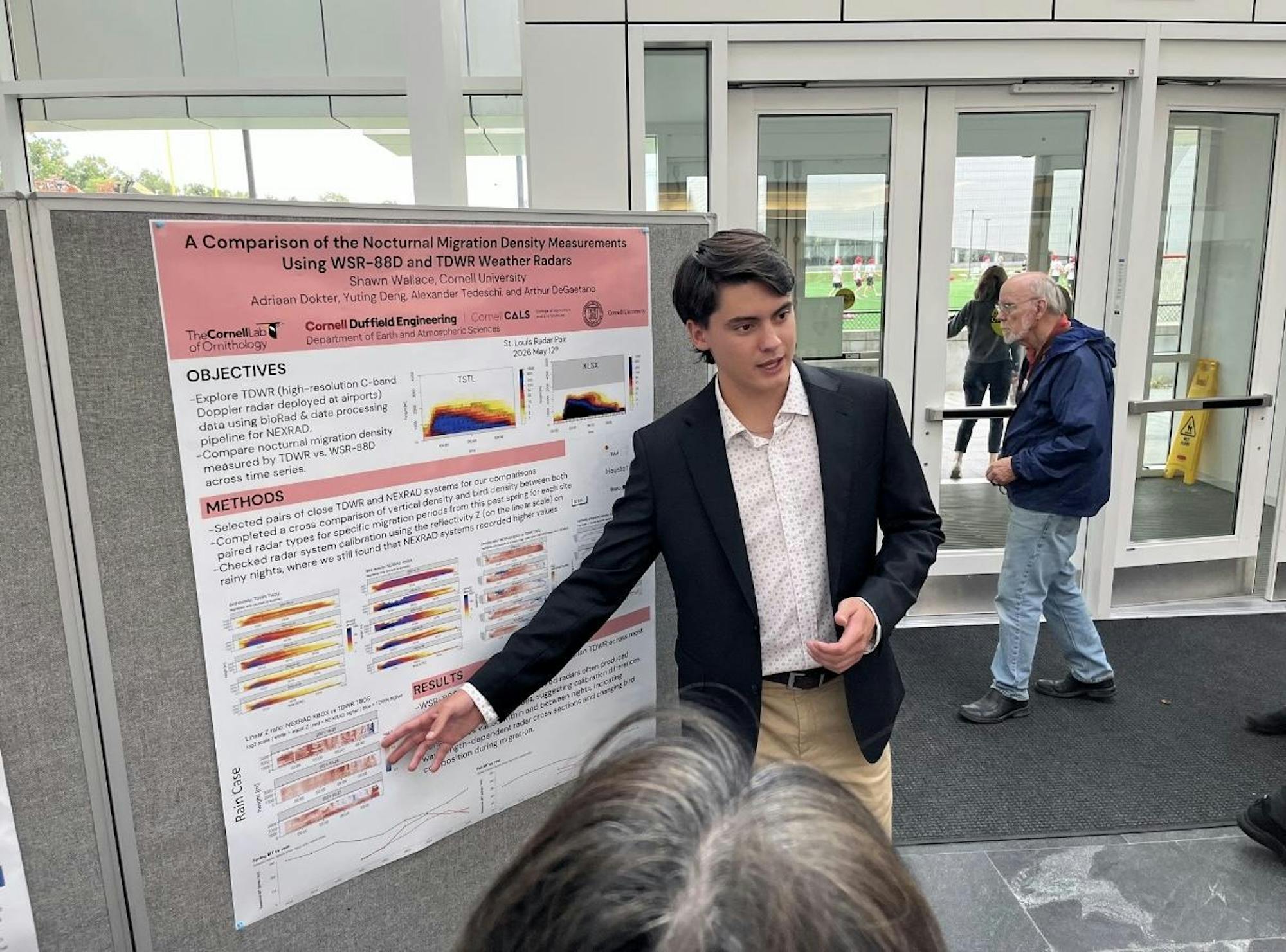
As an earth and atmospheric sciences student, Wallace has a passion for weather — but also for birds. He decided to take a unique route with his thesis by investigating the capabilities of two different weather radars to capture bird migration.
Wallace plans to study bird migration during a particular night during the fall or spring and compare that to other nights, or even throughout history, to evaluate the two radars — the Terminal Doppler Weather Radar from the Federal Aviation Administration and Weather Surveillance Radar-88D from the National Weather Service.
“Bird strikes cost airlines every year around the world over a billion dollars in losses. Especially for your major airlines, they are getting millions of dollars worth of damage to aircraft,” Wallace said. His thesis has the potential to make a major impact on the aviation and meteorology industry.
Wallace works at BirdCast, a project at the Cornell Lab of Ornithology that uses weather radar to detect and predict the numbers and routes of migrating birds.
By studying the migration of birds using these two weather radars, this can help BirdCast determine whether one radar is better, if only one is needed or whether the two can corroborate and give comparisons, he said.
Wallace hopes to use the results from his honors thesis to compare whether it’s worth incorporating the TDWRs into the current system at BirdCast and make a real difference for both aviation and birds.
“If I was able to be an expert in this subject area and make something or provide insight that helps reduce the chance for these collisions for the aircraft,” Wallace said, “not only would it be helpful to the birds that are flying into them and not making it, but it would be helpful to the aviation companies.”
The biggest challenge for Wallace has been understanding the intricate details of weather radars, as well as code in R and work with the datasets. Additionally, Wallace states “I have a great support team.”
The goal of Wallace and the atmospheric science department for this thesis is to get it published. According to Wallace, the project was predicted to be finalized at the end of the summer of 2026, and continuing to advance it throughout the fall. The goal is to present the project at the American Meteorological Society in the winter of 2027. He hopes to have it written in February of 2027 to get it peer reviewed. Publishing the article “is an optional step, but one that the lab really likes to be able to publish research.”
Sophia DeSisti ’27 Studies Infant Curiosity
Coming to Cornell, DeSisti had no research experience, and neither did anyone in her family.
“I didn’t expect that this would be my own little project,” she said. “I really get to pull it anyway I want. It’s fun, but it’s also challenging.”
DeSisti’s thesis is under the psychology department and explores what makes seven to 10-month-old infants pay attention to certain stimuli, or events in the world around them.
Her thesis is based on a previous study published in 2012 by psychologists at the University of Rochester, which showed human infants patterns of shapes. They found that babies learned these patterns best when they were not too simple and predictable, but not too difficult and unpredictable, either. They dubbed this the “Goldilocks Effect.”
Whereas the previous study only looked at patterns of shapes — stimuli that are not social in nature — DeSisti is attempting to extend these findings to more social stimuli. Instead of patterns of shapes, infants in DeSisti’s study will watch a sequence of videos of human faces while simultaneously hearing short, consonant-vowel sequences of language.
Infants and their parents are recruited to participate through the Cayuga Medical Center in Ithaca, where new parents can register their infants for a database of developmental psychology labs at Cornell. For DeSisti’s study, once the infants turn seven months old, they are invited for a play session at the lab which she is currently working on.
The first part of the study is to present the infants with a video of human faces popping out of a box while babbling. The next step of this study is to see if this translates into real life interactions. She is finding the sweet spot between too challenging and too easy that will keep the infant engaged in the interactions.
DeSisti then brings the infants into a playroom, and has their mom “match that intermediately level of predictability or be above or below it.” She wants to see where this pattern becomes learnable for the infant. The ultimate goal of the study is to test infant curiosity, which is “the booming field in developmental psychology right now,” DeSisti said.
While challenging, the process of working on a senior honors thesis has been a positive experience for DeSisti and many other students who pursue one.
“If you show someone that you’re curious and driven, the rest will fall into place,” she said.
Desisti has been working on her senior thesis since the fall of her Junior year. She submitted her honors application by submitting a proposal about what she planned to accomplish along with her faculty advisor filling out a form, which opened in January of her junior year. This fall, she is taking a one-credit methods class about research.
DeSisti emphasized how important it is to be self motivated, curious and have an open mind throughout the research process. “It’s not like anything else I've ever done before,” she said.
Farrah Scott is a member of the Class of 2028 studying communications in the College of Agriculture and Life Science. She is a contributor for the science and technology department and can be reached at fas84@cornell.edu.