

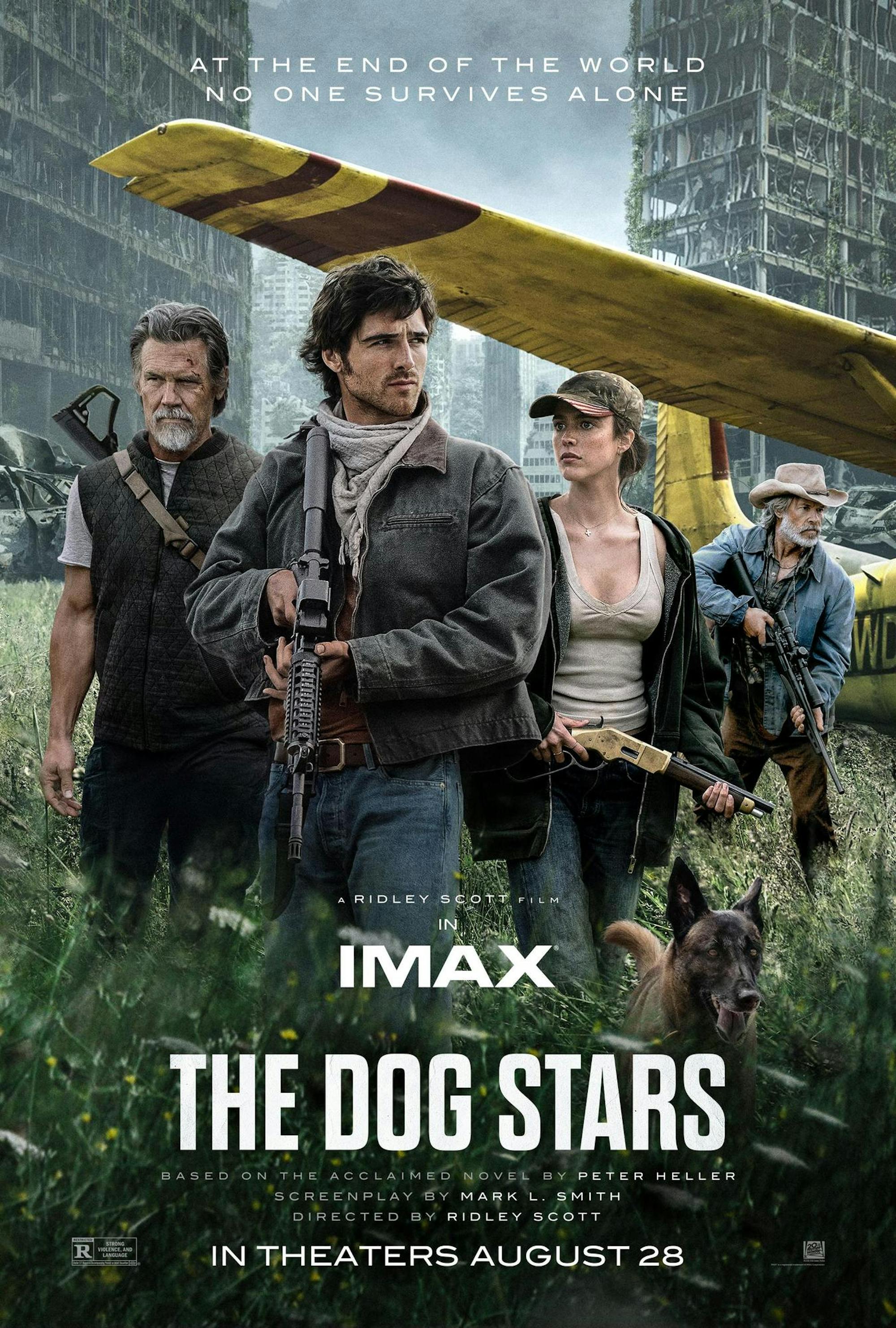
For most of us, imagining a world where a pandemic wipes out the majority of humanity unfortunately does not seem so foreign. In Peter Heller’s novel, The Dog Stars (2012), Heller paints a picture of this post-apocalyptic world, riddled with abandoned roads, dilapidated buildings and immeasurable grief. Although Heller’s novel predates the COVID-19 pandemic, the dystopian world designed in The Dog Stars resonates now more than ever. In Ridley Scott’s adaptation of Heller’s story in his film The Dog Stars, released on August 28, Scott reintroduces this fictional dystopia into a post-COVID society.
The Dog Stars follows Hig, an ex-mechanic grappling with the death of
his wife and unborn child in the aftermath of a fatal, flu-like virus. Jacob Elordi plays the role of Hig, yet another brooding man (this time with more lines than The Creature in Frankenstein and slightly more hillbilly than Nate Jacobs). Amid overwhelming grief, Hig traverses a desolate version of Denver in 2035. Hearing a faint voice on a radio, he sets out for Grand Central Junction on his search for greater human connection and life. Hig meets Cima (Margaret Qualley) along the way and finds unexpected love. While the skeleton of The Dog Stars seemingly illustrates an uplifting story of hope and connection, the body of the film feels empty. With a poorly paced plot structure, The Dog Stars fades into a nebulous tale — mirroring the vacant world it describes.
Although Hig’s driving motivation for much of the film is landing at Grand Central Junction, his actual arrival at the aircraft hangar only serves as a small blip in the story. Scott depicts Grand Central Junction in a Hunger Games-esque fashion, with an artificial vibrancy that juxtaposes the grayness of the surrounding world. Flamboyant outfits populate the hangar, concealing the vapidity of the people wearing them. Just as audiences grow curious about what sinister truths underlie Grand Central Junction, Hig escapes and the plot point is abandoned. What is supposed to be the climactic peak of the plot lasts on screen for mere moments.
The unexplored territory of Grand Central Junction is not the storyline’s only shortcoming. Scott also fails to address crucial expository questions such as the nature of the virus destroying almost all of the human race. Furthermore, the relationship between Hig and Cima falls flat. The couple experiences almost no real conflict throughout their relationship. Whenever a problem arises between the pair, Scott resolves it in the following scene, never fleshing out a relationship that feels organic or subject to change. Instead of gradually developing a love story with imperfection and depth, Scott again opts for a surface-level portrayal.
Aside from the film's questionable pacing and its glossing over of the story's most compelling elements, I also found the overt product placement distracting. As Hig sipped on a bottle of Coca-Cola and ostentatiously presented several Mennonite children with a 10-pack of Sprite, I couldn’t help but get taken out of the story. Instead of focusing on pivotal moments between characters, my eyes drifted toward the anachronistic soda carefully placed on screen. In moments like these, this post-apocalyptic movie felt more like an AMC advertisement.
Despite these setbacks, Elordi and Qualley’s performances salvaged much of the film. Both actors brought charm to their characters, and I enjoyed watching the pair share the screen. Elordi, in particular, delivered a convincing representation of loss in a series of repeated flashback scenes.
In addition to Elordi and Qualley’s strong performances, the relationships between survivors stood out as a captivating aspect of the adaptation. Even after the enormous scale of fatalities from the unknown virus, humans continue to commit gruesome acts upon each other within their dystopian state. Hig attacks unfamiliar tribes with his partner, Bangley, and survivors in opposing groups steal from and murder one another. Once the virus ceases, destruction persists through the hands of men.
While I found Scott’s storytelling shallow and vacant in The Dog Stars, his exploration into grief and violence was undeniably compelling. The awe-inspiring landscapes and scenery also greatly enhanced the film. Although The Dog Stars missed the mark on execution, the movie’s relevancy today is valuable. It allows us to revisit the original novel through a post-pandemic lens, so we can appreciate the resilience of our real world.

Michelle Bookbinder is a member of the Class of 2029 in the College of Arts and Sciences. She is a staff writer
for the Arts & Culture department and can be reached at msb394@cornell.edu.


