

Where do I begin with Chantal Akerman? I fell in love with her after watching Je Tu Il Elle at the beginning of 2026. Then, Jeanne Dielman, 23, Quai du Commerce, 1080 Bruxelles was assigned for a class I took; News From Home was recommended to me by a professor, and I discovered articles mentioning her films and the podcast The Akerman Year.
These days, I have felt drawn more than ever to Akerman’s works, as if being physically pulled. Some of her films make me feel a compulsive need to make something (usually gouache renditions of her films). Is there sense in the overwhelming space she has come to take up in my life?
I kept feeling the need to rewatch this; and so I did. “And so I left,” Akerman opens. This is perhaps my favorite film ever; I feel like I could disappear into the immense silence and loneliness. Akerman’s descent to emptiness is so delicate and comforting — she removes all the furniture from the room, save a mattress on the floor, then strips and the camera too is largely unmoving. Here’s a bit I adore: while lying on the mattress, she spills the sugar she is eating out of a bag with a spoon on the floor. Still sideways, she tries to scoop the sugar back into the bag. There’s also the misalignment of narration and image, the portrayal of lesbian sexuality, the camerawork and Akerman’s willingness to manipulate herself on screen.
Portrait d'une jeune fille de la fin des années 60 à Bruxelles (1994)
In this semi-autobiographical coming-of-age TV film set in April 1968, high schooler Michèle (Circé Lethem) abandons school and explores the city with an army deserter she runs into (Julien Rassam). Michéle is so endearing and magnetically expressive, especially in the party scene towards the end of the film. The shot of her face bathed in the warm yellow light as she watches from the side haunts me. What a beautiful and devastating depiction of queer loneliness and longing — the way it intersects with the struggle to understand yourself and your relation to the world. I see reflected in Michèle’s face that feeling of something you can’t articulate yet, that you will maybe spend the rest of your life trying to articulate.
D’est is a documentary about Eastern Europe after the fall of the Soviet Union. Long takes and slow, horizontal camera movement layer Akerman’s personal experiences as a child of Holocaust survivors (who did not tell her much about their histories) upon images of lines of people waiting in train stations or food lines as their way of life disappears. Some shots are so still they seem like photographs, as if in the process of becoming unmoving documents of history. In other scenes, the camera overtakes people, literally leaving them behind, articulating the position of the camera (the viewer) and its incompleteness even as it ‘documents.’ D’est also really struck me as painterly in the way Akerman’s camera moves like a paintbrush, clarifying shapes and leaving things outside its path unrendered.
Hotel Monterey (1973) and La Chambre (1972)
In Hotel Monterey, the camera starts on the bottom floor of a welfare hotel in New York City and ends on the roof. We oscillate between representation and abstraction; Akerman in particular describes seeing a corridor and “after a while you forget it’s a corridor, you just see that it’s yellow, red, lines: and then it comes back as a corridor.” And the repetition in this film makes things recognizable yet obsolete (what can this never-ending series of nearly-identical hotel floors, for example, do or mean?).
La Chambre consists of a 360-degree camera spin in Akerman’s New York City apartment. I’ve taped a gouache painting I did of a still from this film to the wall of my room. Her address of the camera transfixes me; there’s something so hypnotic about her and the space she occupies in the room, and the composition as the camera moves.
Akerman’s adaptation of the fifth part of Proust’s À la recherche du temps perdu follows a sort of love triangle between Simon (Stanislas Merhar), his girlfriend Ariane (Sylvie Testud) and Andrée (Olivia Bonamy). The film opens with Simon watching a video of Ariane and Andrée, a projected image he desperately desires but can’t quite get into, left just with himself when the projection ends. Again, bits cling to me: the three main persons blurring together, the name “Ariane” sounding like “à rien” (which can mean “of nothing” or “for nothing/no purpose” in French), Akerman’s representation of lesbian subjectivity as something there and yet ineffable and the consequences of Simon’s incapability of seeing past his image of Ariane.
Chantal Akerman par Chantal Akerman (1996)
“But as I make this film about myself, I’m not scared. I’m up against a black hole,” Akerman says about this profile of herself as part of a French television series on cinema. She had wanted to re-edit sections of her old films as an autobiography (which is ultimately included). However, the producers told her she had to appear on screen and talk about herself.
So, what is the relationship between her and the images she makes? What, why do I need to know? Is there something I’ve been looking for in those gouache sketches, trying to understand how she makes things or something I don’t fully know in myself that I find in these images? Maybe I am terrified to show myself to the world and so I find inspiration in the obliqueness yet often-explicit personal insertions of her mode of autobiographical art. Maybe this is all a self-centered desire to understand myself against the world — to see a blur of me and her looking right back at me.
Ultimately, I’ve found solace and an unbearable need to make something through her, and so I pull myself in.
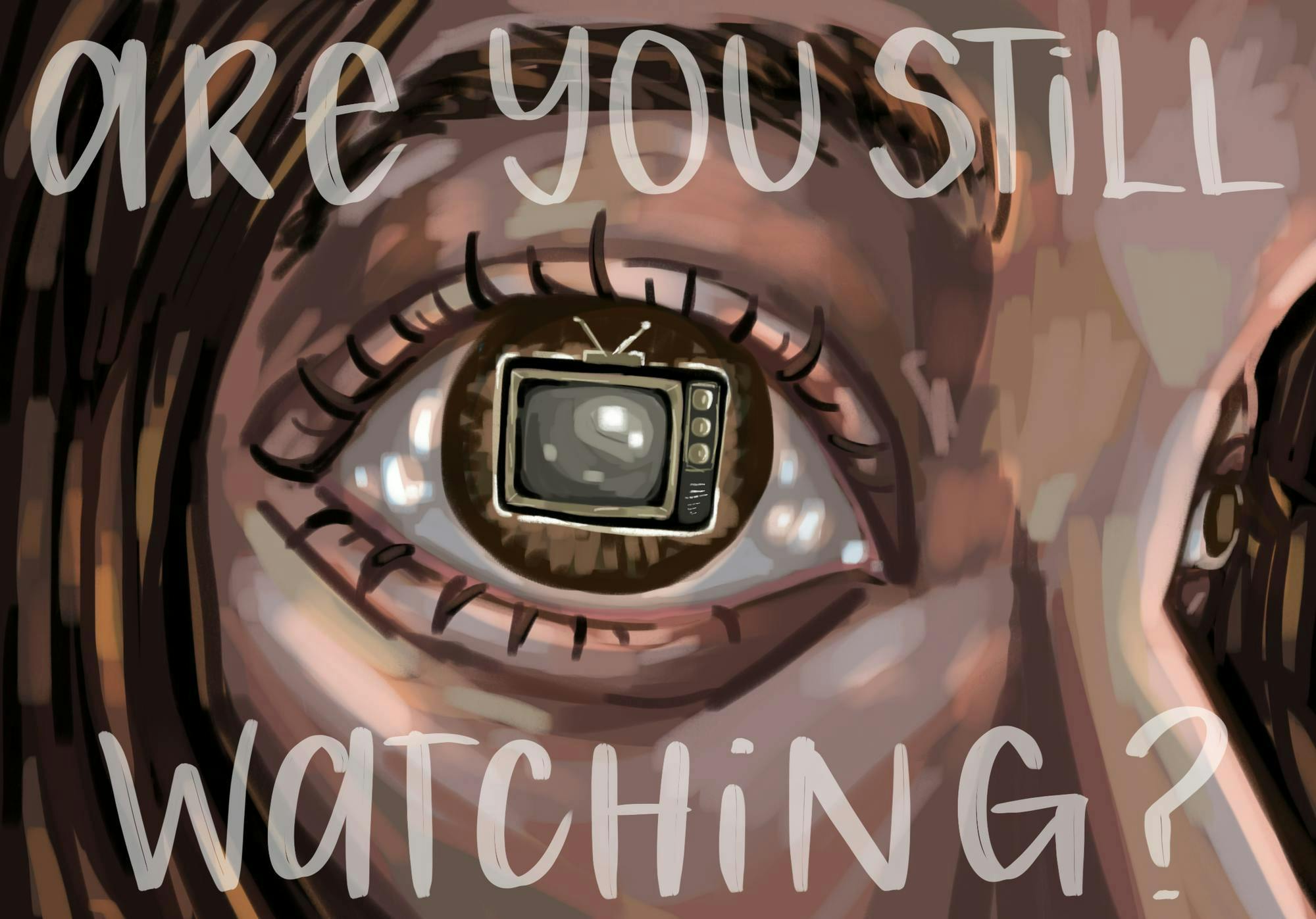
‘Are You Still Watching?’ is a column spotlighting what the Cornell community has been streaming. It runs every Wednesday.
Pen Fang is a member of the Class of 2028 in the College of Arts and Sciences. They are a staff writer for the Arts & Culture department and can be reached at pfang@cornellsun.com.


