

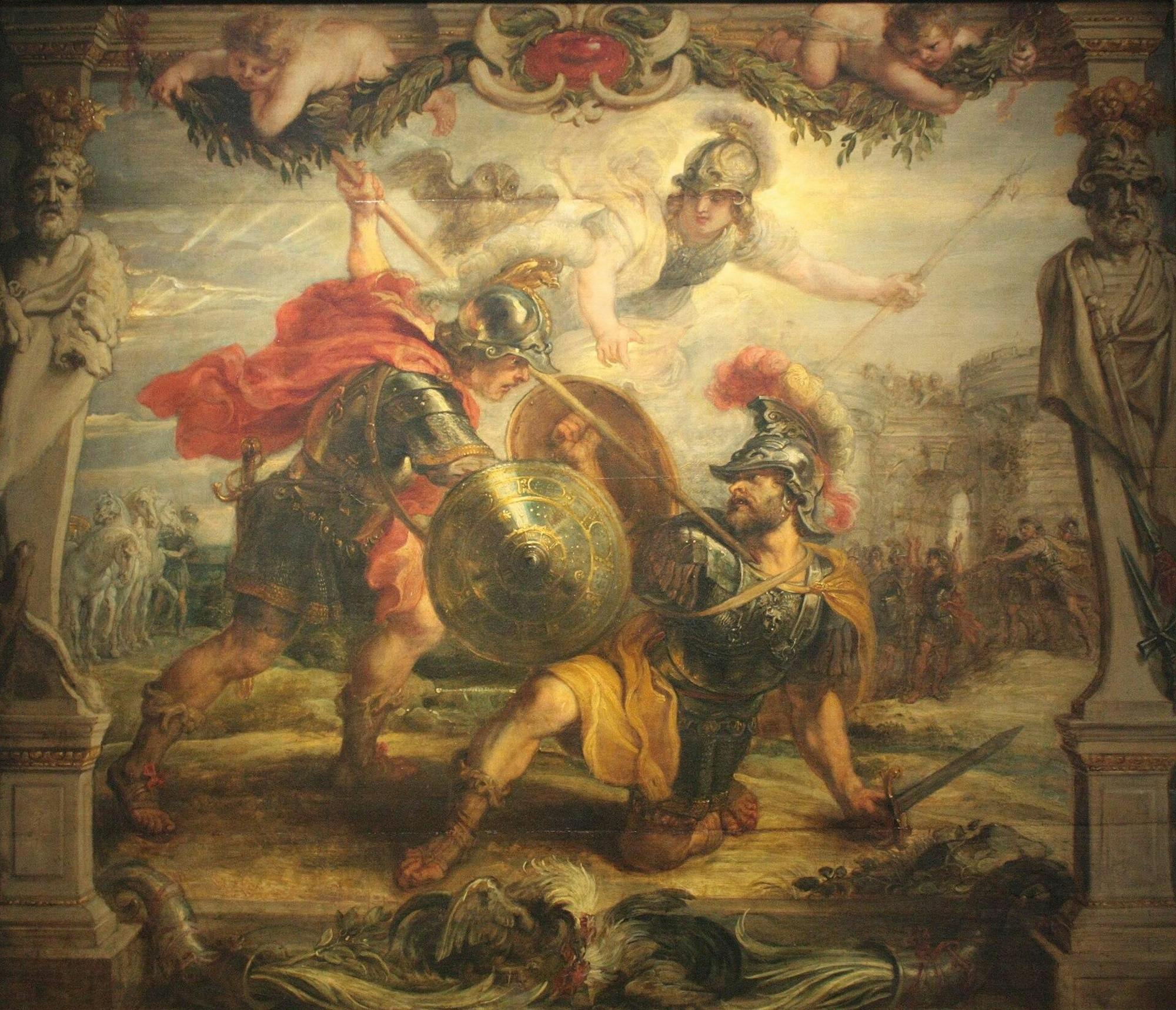
Whenever I want to quantify the modern readership’s relationship with classical antiquity, a quick look at Goodreads proves highly instructive. On the platform, Homer’s Iliad possesses only half the number of reviews found on its chronological successor, the Odyssey. One epic is universally prevalent, effortlessly contemporary and adapted endlessly; the other remains critically revered but generally avoided.
What accounts for this disparity? Why have we largely forgotten Achilles, the civilization-ending tantrum thrower, in favor of Odysseus, the man that can thankfully blame a two-decade-long hiatus on unfavorable weather and some pretty distasteful upper management by the gods?
Ultimately, before we can afford to bleed over honor and war, we have to make sure we live to see tomorrow. The idea of survival — the primal, symbolically resonant drive of coming home — is a universally legible imperative. An odyssey is something we can all relate to: the commute back to your dorm from Collegetown or the numbing trek from your bed to the bathroom at 4 a.m. On the other hand, the abstract, suffocating theater of pride, legacy and ego that defines the Iliad is a less immediate, less universally accessible condition.
But beyond its inaccessibility, do the symphonies of ancient conflict even exist anymore? In an era defined by the grim, mechanized realities of asymmetric warfare, there is a pervasive cultural enchantment regarding the glory of last stands in front of foreign invaders. Modern warfare lacks physical allure; you will not have your final stand against your age-old rival, instead, you will probably be shot down by artificial intelligence-powered drones. The mythic promise of heroism that drove the entire plot of the Iliad is a concept that fades with each passing age, and, today, hardly exists. Consequently, as Professor Hall of Durham University puts it, the Iliad simply does not let you off “the hook of war.”
Disillusioned by the reality of combat, we eagerly retreat to the comforting biological imperatives of the Odyssey. As Hall observes, the poem offers an “astonishing array of sensory experience.” It trades on our interaction with the land, the universally resonant pangs of nostalgia and wanderlust and the pleasures of food and drink. Emily Wilson, in the prologue to her translation of the poem, notes that the Odyssey deals far more harshly with subjects of biological need. In Odysseus’ narrative, the physical body is the ultimate driver of the plot. This achieves a highly comforting notion; it makes Odysseus, and by extension, the reader, feel helpless. The obstacles are highly external: hunger, physical aches, the weather, divine beasts and abducting witches. This dynamic perfectly mirrors the self-justifying narratives we constantly construct for our own problems, including: What can I do? It’s not my fault! I can’t control the weather!
Even Aristotle recognized this self-exonerating architecture. In Poetics, he notes that while the Iliad is simple in plot and passion, the Odyssey is full of twists and turns not easily pinpointed, with an ending aligning far more with the structural pleasure of comedy rather than the unyielding weight of pure tragedy. In other words, more akin to our unpredictable lives or, rather, what we would like our lives to be.
What if our cultural retreat to the Odyssey masks a far deeper, and explicitly more critical, anxiety? We can stomach violence and tell ourselves that our problems are not of our own making. Yet, what may be harder to confront, particularly for male readers, is the Iliad’s unflinching exposé of misogyny, objectification and the fragility of the male ego.
The Iliad does not open with a grand battle or a mythical siege on Troy; it begins with two bickering men trying to one-up each other over a woman. Agamemnon’s decision to take Briseis from Achilles is motivated purely by his insecurity and desire to project his power over the physically more powerful Achilles. The inciting incident establishes a raw dichotomy between institutional and physical power.
As is commonly and tragically mirrored in real life, this fragility of the male psyche demands a horrific collateral cost. While the Odyssey is definitely no paragon of progressive gender politics, the Iliad is distinct in how it presents gendered dehumanization as the direct product of male exceptionalism. Briseis is reduced to a literal prize with absolutely no autonomy, not due to any fault of her own, but because of chance and Agamemnon’s need to seem powerful. Helen of Troy, despite being the central catalyst of a decade-long rampage, is granted vanishingly little agency.
This dynamic of objectification is so culturally entrenched within the text that it fundamentally warps how audiences perceive passivity and action. Take Patroclus, the beloved male companion (or lover?) whose death induces Achilles’ immense and terrifying carnage (tantrum?). Because Patroclus functions as a passive subject of emotion rather than an active belligerent in the overarching narrative, many portrayals of the tale heavily feminize him. The text’s reception continuously reinforces a misogynistic framework where femininity is intrinsically linked to passive provocation. Women, or feminized figures, are strictly objects of exchange, rather than agents of change: designed to be fought over. Well, unless they are literal gods.
This is profoundly uncomfortable. It requires a level of deep mental confrontation, one that a narrative driven by mythical monsters, biological necessities and the relatable pangs of nostalgia, bypasses.
When we read the Odyssey, we can allow ourselves to project our anxieties onto angry gods, treacherous seas and a foolish crew. The Iliad turns the mirror inward, especially if you are a man. Achilles, Agamemnon, Menelaus, Priam — beacons of honor in antiquity, yet in conduct, a bunch of crying idiots.
Faced with such an agonizing catharsis, no wonder most would rather set sail for Ithaca.
Ali AlSaif is a member of the Class of 2029 in the College of Industrial & Labor Relations. He is a contributor for the Arts & Culture department and can be reached at aea252@cornell.edu.


