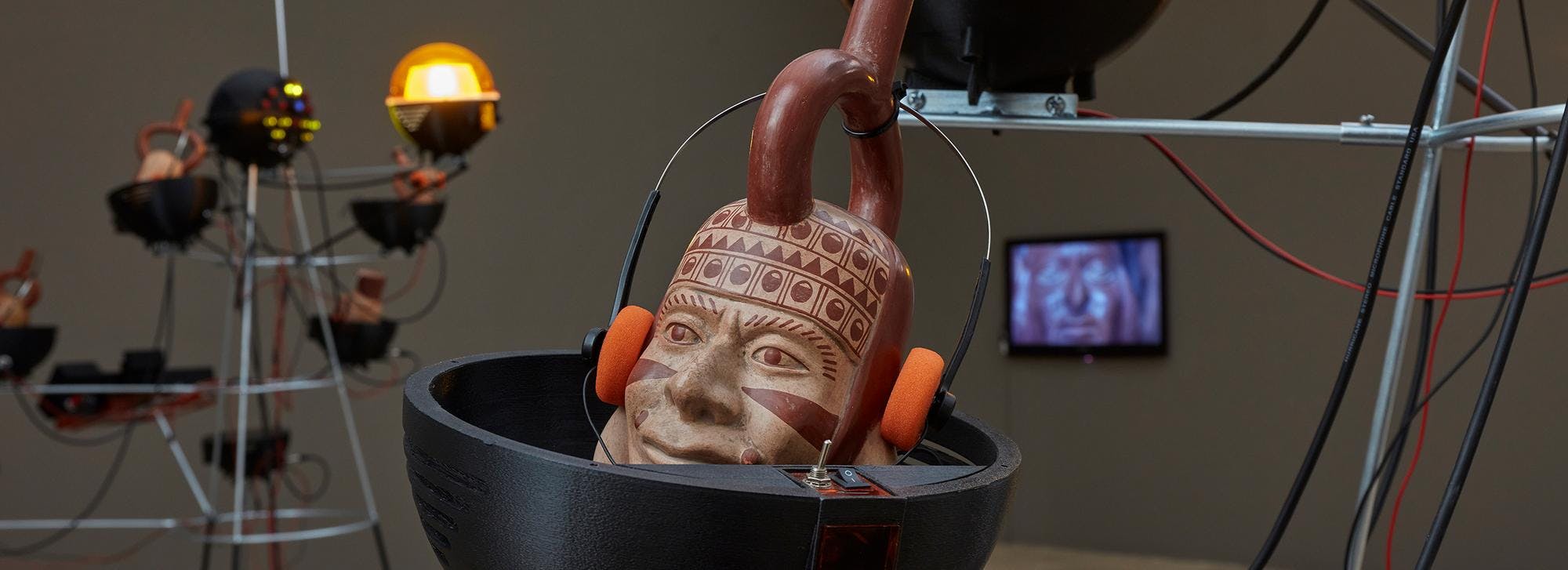
The first thing I noticed when I entered the lower level wing gallery of the Herbert. F Johnson Museum of Art was a large machine sitting in the middle of the room.
Black, satellite-like forms stand in a circle with a DJ-like panel at the center, controlling the words the machine plays. Each of the forms is fitted with a glowing yellow bulb which holds a replica Moche ceramic head wearing headphones. Together, they trace what contemporary Peruvian artist Fernando “Huanchaco” Gutierrez describes as the sun’s descent into the underworld.
The machines are strange, futuristic and difficult to look away from. Yet, in the exhibition “Checán Stereo,” they're not really the point. What matters is what the machine is actually doing and what Gutierrez has plugged into them.
A few feet away, inside a glass case, sit several Moche ceramic heads from the Johnson Museum’s own collection. Unlike the ones inside the machines, these are not replicas, but originals sculpted on Peru’s North Coast sometime between 400 and 850 C.E. One of them wears headphones, listening to the same recording that plays throughout the gallery.
This visual of an ancient artifact wearing a pair of headphones truly encapsulates the way the exhibition is meant to be seen, experienced and understood. The Huaco (an ancient Andean ceramic object, often created for ceremonial or burial purposes) is no longer displayed as archeological evidence of an ancient civilization. Now, for the duration of the exhibition, the ceramic head becomes a listener, undergoing a transformation.
The voice coming through the headphones and heard throughout the whole space speaks Muchik, a language once spoken along Peru’s northern coast by communities including the Moche and later the Chimú. Although spoken Muchik has long gone extinct, its sound survives through a 1974 recording of Simon Quesquen, one of the language’s last speakers. Gutierrez was able to acquire this recording through a relative in Trujillo, Peru, his hometown. As Quesquen’s voice plays on a loop, the Moche head appears to listen to a language that may have once surrounded objects like it.
This moment felt deeply personal to me: my mother was born and raised in Lima, Peru, where much of my family still lives. Peruvian culture was and has always been present in my life and how I was raised. Therefore, I could not look at the ceramic heads as distant archaeological specimens. They felt closer to me and my family than what a museum or archeological text might encapsulate, contributing to the overall liveliness and vividness of the exhibition’s framing.
During the artist talk on Friday, Gutierrez explained that moving the Huacos (referring to the ceramic heads in the exhibition) removes them from the relationship that once gave it meaning: its position within a burial, its alignment with the stars and its connection to the seasonal cycles. Once the Huaco is placed inside a museum, it is classified, dated and studied. It becomes an object. Gutierrez wants visitors to consider what is lost in that transformation, rather than treating the ceramics simply as research material, engaging in a hierarchical relationship with academics. The artist asks the public to engage with them as living entities, how they were treated by the Moche and Chimú people centuries ago.
“Checán Stereo” attempts to restore one of these lost relationships through sound. Though the installation cannot return the ceramic heads to their original burials or recover everything that once surrounded them, what it can do is place them in contact with a surviving voice from the region they were created in,
Curator Hugo. C Ikehera-Tsukayama told me that the exhibition also created an opportunity to put objects already in the museum collection into collaboration with contemporary artists from the same country and cultural background. Instead of remaining separated by categories like “ancient” and “contemporary,” the Moche ceramics and Gutierreze’s machines now work together on the same show. All of this is unfolding in Ithaca, New York, far from both the artist’s home and the Huaco’s own. That distance, unusually so, feels intentional. Looking towards the future and working within the present, rather than treating the past as fixed, is close to Gutierrez’s central idea for the exhibition: building new ecosystems and ever-changing stories where nothing is strictly labeled or fixed.
This conversation continues throughout the rest of the gallery. A brightly oil-painted panel depicts the ceramic heads becoming living beings wearing the same headphones, becoming alive again through the power of their maternal language. There is also a video showing Gutierrez carrying his machines into archeological museums in Peru, performing a similar ritual with their own collections. On the back wall, small oil paintings function as instructions on how the machine operates. All the while, a Muchik recording keeps playing in the background.
The exhibition is visually beautiful yet quietly powerful. A 1,500 year old ceramic object sits behind glass, wearing headphones and listening to a human voice speak its extinct language from its place of origin. The exhibition does not pretend to undo the violence of the excavation. Rather, it asks what magic can happen when a museum object is treated as something capable of having relationships rather than just observing it.
The machinery draws us into “Checán Stereo.” The act of listening is what gives it life.
“Checán Stereo” is on view at the Johnson Museum through Feb. 7, 2027. The exhibition is curated by Hugo C. Ikehara-Tsukayama and co-sponsored by the Consulate General of Peru in New York.

Allegra Gonzalez Barbieri is a member of the Class of 2028 in the College of Arts and Sciences. She is a contributor for the Arts & Culture department and can be reached at ag2745@cornell.edu.