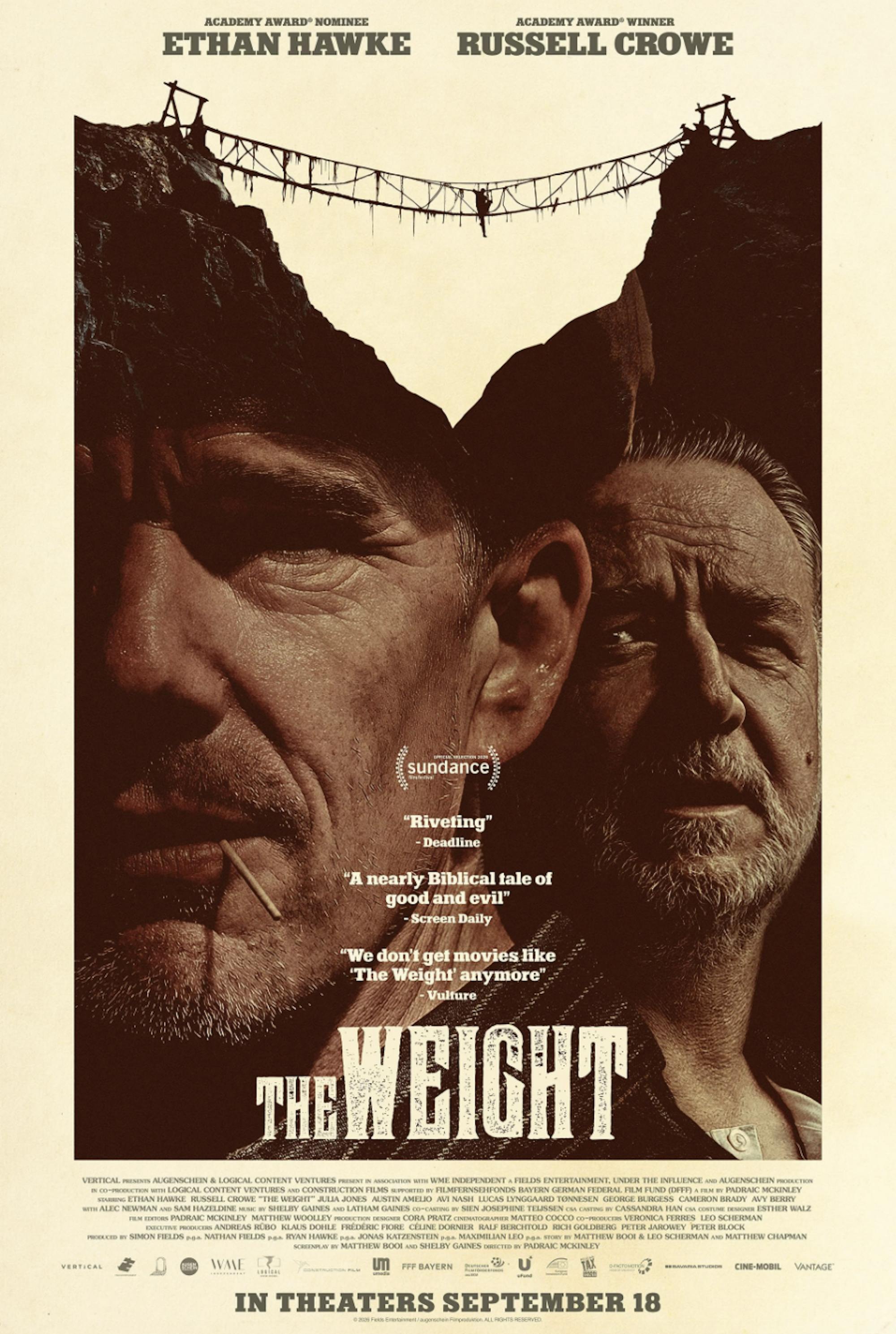
The Weight (2026) is a Great Depression-era drama that follows down-on-his-luck widower and World War I veteran Samuel Murphy (Ethan Hawke) as he tries to secure an early release from prison and reunite with his daughter, Penny (Avy Berry). After facing eviction while at church, Murphy checks out a listing for a new apartment only to face accusations of trespassing from three men, a situation that soon escalates into violence once Murphy throws punches at the men he believes are threatening his daughter. After revealing themselves as cops, the men send Murphy to a prison labor camp while his daughter is placed in a foster home, where she will be put up for adoption if he is not released in a month. Recognizing Murphy’s ingenuity after discovering his dilemma, Warden Clancy (Russel Crowe) offers him a chance at early release. To secure his freedom, Murphy must complete a dangerous mission to smuggle gold out of a mine before it can be seized by the federal government under President Roosevelt’s Executive Order 6102. Clancy lets Murphy choose three fellow convicts to join him, and together they embark on a harrowing journey. Along the way, they encounter betrayal and an unexpected ally in Anna (Julia Jones), a Native American woman who fled a federal boarding school that tried to forcibly assimilate her.
The acting in the film is beyond superb. Overall, the cast convincingly portrays the anxiety and desperation emblematic of the time period. I was particularly impressed with Hawke and Berry’s performance. Hawke stands out for depicting a rough edge to his character that exemplifies the grit required to withstand the toils of the Great Depression. This grit is subtle rather than in-your-face, which keeps Murphy from becoming the standard archetype of the hardened veteran who takes extreme measures to protect his family in times of trouble. Berry has great on-screen chemistry with Hawke, creating a convincing father-daughter relationship. Additionally, the young actress impressively balances awareness of the severity of her situation with a child’s innocence. Avy Berry avoids the all-too-common trope of children on screen possessing an adult-like consciousness of their circumstances to the extent of shattering the illusion of realism.
Additionally, I found that including the character Singh (Avi Nash), one of the convicts chosen to join Murphy, adds an important dimension to the film. Despite its generally positive features, the film’s central expedition occasionally drags on as a never-ending saga of far-fetched obstacles, undercutting authenticity and leaving me feeling detached from the story. Although separation from everyday life is central to the story, it makes it harder to stay engaged. That’s why I found Singh, a socialist who criticizes American capitalism, so impactful. Singh’s focus on politics brings the story back into the context of its time, rather than keeping it confined to the treachery of the Oregon wilderness.
Another one of the film’s most compelling features is its vivid imagery of the Great Depression era and Oregon landscape. From the run-down apartment complex where Murphy gets into a scuffle to the vast, terrifying Oregon wilderness where he undertakes his gold-retrieval expedition, the film balances scenes of destitution with natural splendor. This visual juxtaposition embodies one of the film’s core tenets: Life often sucks, but it has inherent beauty despite the suffering.
An unexpectedly striking aspect of the film is the symbolism of Murphy’s daughter’s teddy bear. At the beginning of the film, right after Murphy and his daughter face eviction, she offers her teddy bear up for sale to another child, in response to her father selling her late mother’s radio to bring in some extra cash. The teddy bear represents both a connection to her happier past and the misery that comes with the sacrifices required during difficult times. The teddy bear’s significance is underscored by its reappearance later in the film, making it a badge of sacrifice and perseverance. Effective object symbolism is often difficult, either failing to convey what it’s meant to represent or coming across as forced. The teddy bear falls into neither trap and instead serves as a natural, easily identifiable reminder of hardship and better times.
The film’s ending continues its impressive ability to connect underlying themes in a succinct, memorable way. The story has a feel-good ending that makes you smile without slipping into a hackneyed wish-fulfillment narrative. I walked out of the theater with a strong sense of hope and a comfort, as cliché as it sounds, that everything would be okay. Overall, The Weight is a heartfelt tale that brings the Great Depression to life while offering a message of hope that feels resonant to everyday life.
Caroline Kelly is a member of the Class of 2028 in the College of Arts and Sciences. She is a staff writer for the Arts & Culture department and can be reached at ckelly@cornellsun.com.