


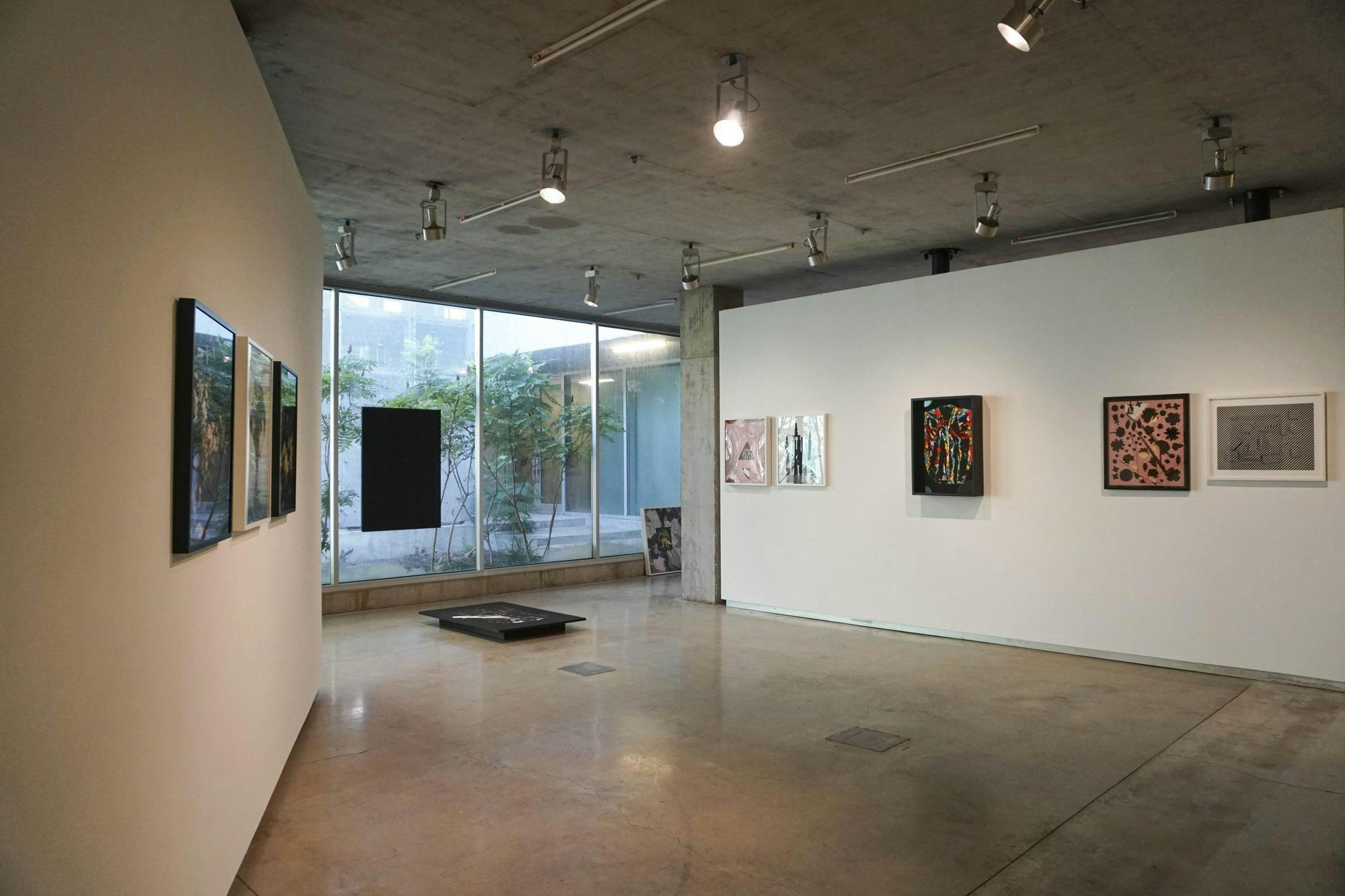
“I wonder if we can ever clearly see the people we love,” muses artist Kathleen Hawkes ’07 in her artist statement printed on an inconspicuous orange pamphlet in the Bibliowicz Family Gallery. This question lies at the heart of her exhibition as a whole, a series of hazy yet bittersweet snippets of a close friend of Hawkes, who died after struggling with addiction and an eating disorder.
Displayed in an array of wall and floor installations, the exhibition, which Hawkes began working on in 2021, is a collection of works titled “The Cherry Blossoms You Missed,” previously on display in the Winona History Centre and the Rochester Art Centre. This series is fleshed out in Hawkes’ signature style of layering multi-media compositions, including photography, digital construction and drawings to produce poignant reflections on themes such as loss and grief.
I thought this exhibition was no exception, with pale floral motifs overlaid on darker images peeking out behind the expansive glass wall facing the gallery. Beyond the heavy usage of flowers, Hawkes shifts her focus towards everyday items her friend left behind with their passing, including clothes and stationery.
I found Hawkes’ still life photography at the forefront of the installation to be its most visually compelling facet. She obscures the flowers depicted in the photos with either layers of material or light to create a vague distance between them and the viewer. My favorite among them was an untitled piece consisting of damp tulips stifled under a plastic bag. The shadow cast on the material almost resembled an outstretched hand buried under the bag and unable to escape its confines.
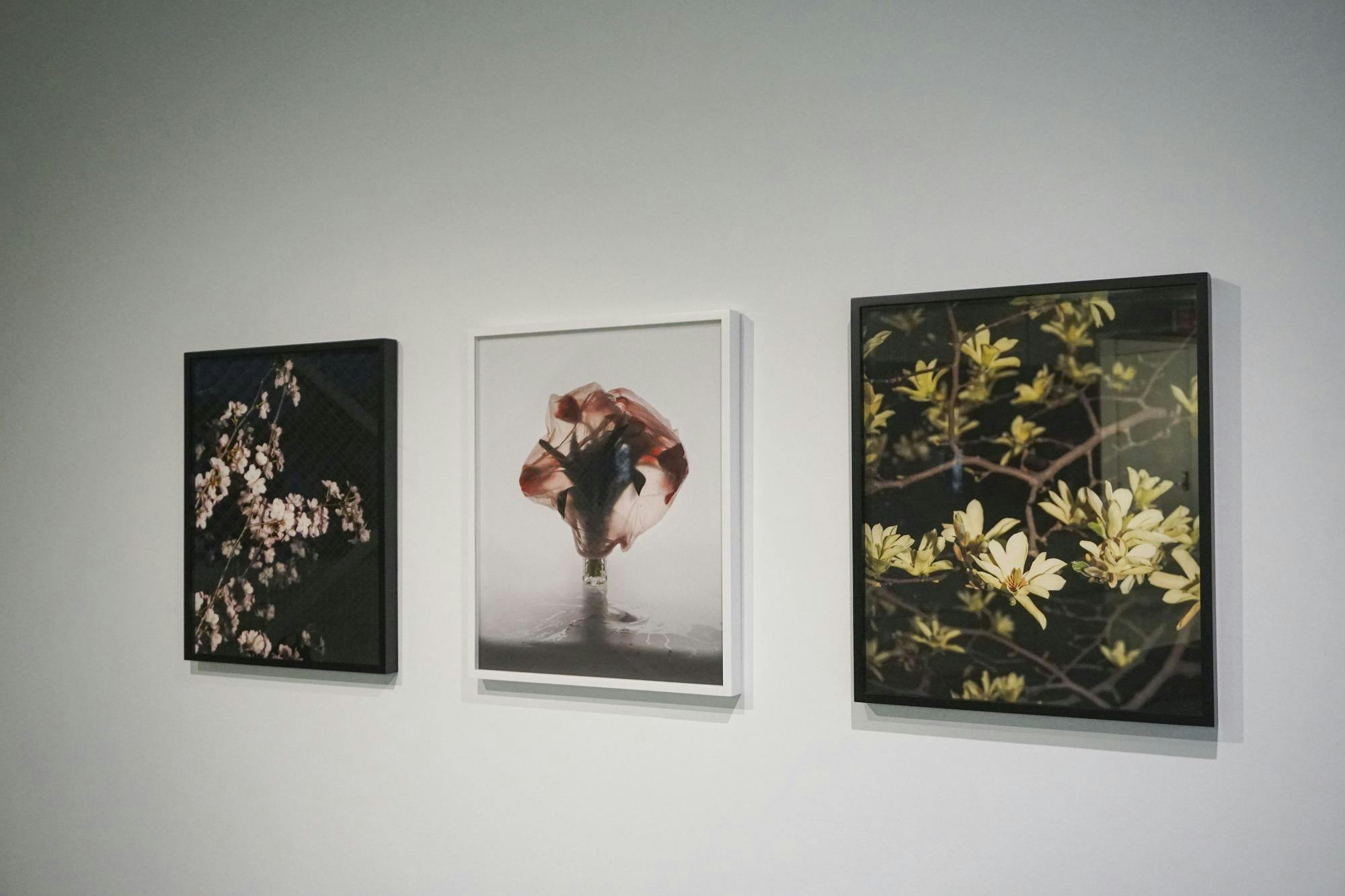
This rather unnerving imagery encompasses Hawkes’ artistic vision with the exhibits, as she mentions her friend’s suffering was silent, and that her struggle had been “hiding in plain sight.” The still life mirrors this concept, with the flowers always shrouded from view, alluding to how our personal relationships are always cloaked in mystery, leaving us in the dark regarding the struggles our loved ones truly face.
In an interview with 365 Artists/365 Days, Hawkes illustrates the significance of flowers to her, terming their fleeting existence something beautiful. In this sense, the exhibition operates as a celebration of her friend’s life and their impact on Hawkes, with an undertone of melancholy given the tragedy of their passing. The title itself is another acknowledgement of the depth of the bond they shared, as the two experienced the cherry blossoms growing near Lake Winona together.
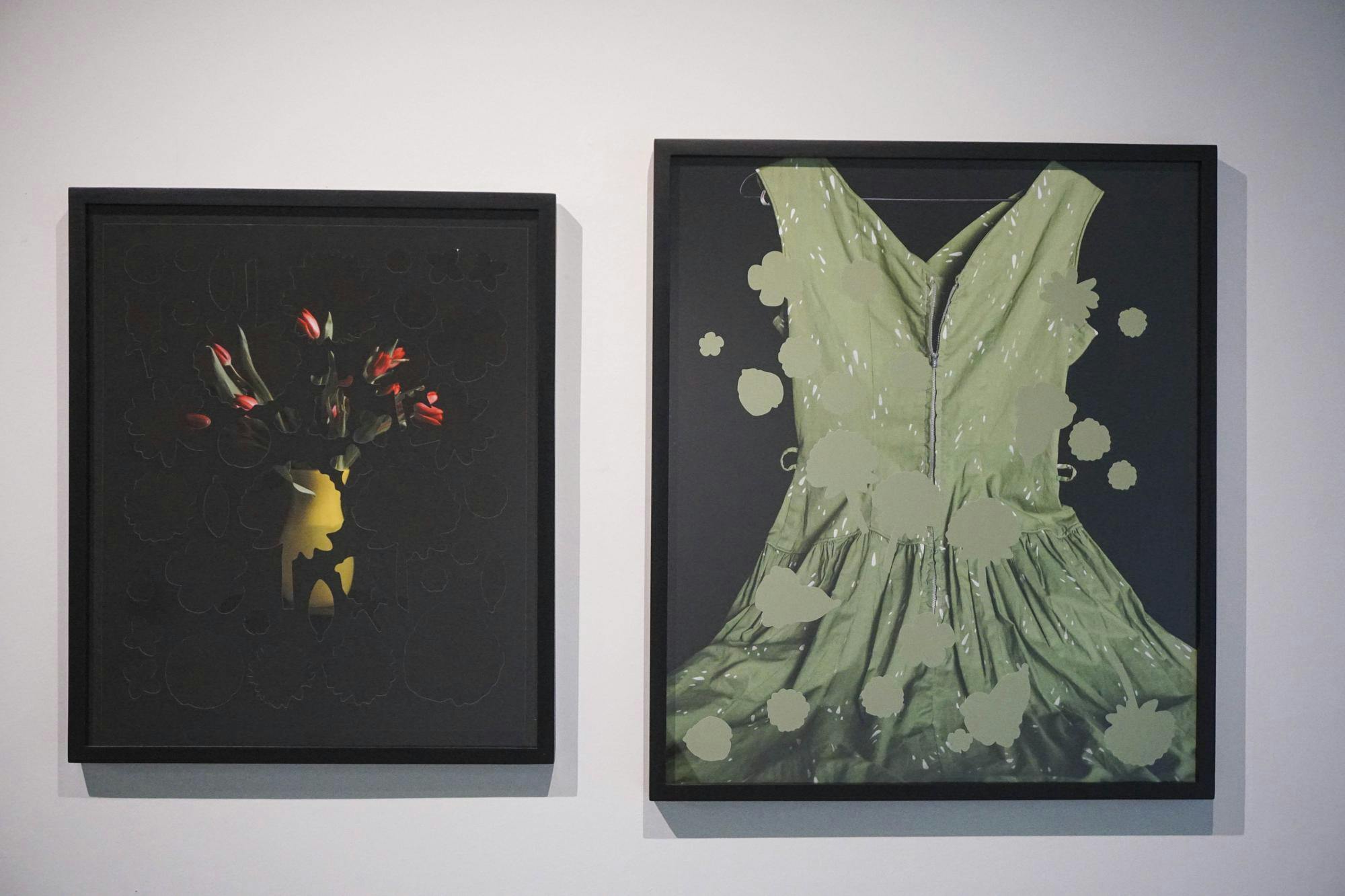
The sentiment of grief extends to Hawkes’ fixation on a particular dress her friend wore, its various portrayals ranging from a photo of it unzipped in vibrant green overlaid with a paint-splotch stencil to a simple, solid white silhouette on a backdrop of black, all positioned at various points throughout the gallery.
I was really drawn to the untitled work within this thematic cluster at the entrance of the gallery, which consisted of an illusion of the dress formed by concentrated white dots scattered around the canvas. The way Hawkes reinterprets this personal article of clothing as gradually disintegrating towards the edges of the frame is a profound reflection on how grief distorts our memory, with Hawkes no longer being able to unlink loss from her friend's memory.
Hawkes has also previously stated that these miscellaneous objects form the “backbone” of the exhibition, as her loved one still resides in pieces of them. I find that there is something so true about this sentiment; clothes really do embody a person’s spirit and individuality. I was struck by an image of a solitary piece of clothing hanging from a rack enveloped in shadow, except for a few isolated pools of light that illuminated the left side of the dress. The morbid implication that the dress would have to remain cast in shadow, never to be worn again, framed such an ordinary moment as something tragically haunting.
Moreover, the visual continuity between the pieces — not just thematically but with the repetition of specific materials — was fascinating to observe. One such example was the same floral-patterned overlay on both the strikingly bright green dress and the stencil of these shapes, which are a negative space left on another still life of tulips. The connection drawn by Hawkes between the tulips and the dress piece together fragments of her friend’s life, drawing from the ephemerality of the flower and the physical remnants of the garment.
I find it interesting that Hawkes left me, as a viewer, mourning the loss of her subject despite not being made aware of a single detail pertaining to this person’s life, save their fondness for floral clothing. Instead, my grief for the situation stems solely from the empathy I feel for Hawkes’ mourning for the relationship, elucidating the exhibition’s main point of reconciling the acceptance of grief with the knowledge that we never know someone completely.
The installation is open from Sept. 26 to Oct. 8 in the Bibliowicz Family Gallery in Milstein Hall.


