


What do Las Vegas, Nevada and Memphis, Tennessee, have in common? Elvis impersonators! Lots of them. Grown men and women — donning rhinestone-studded polyester jumpsuits, jet-black wigs sculpted into pompadours and oversized gold-rimmed aviators that overwhelm their faces — fill the streets, casinos and, in the case of Memphis, barbeque joints. Some are professional performers; others simply enjoy dressing up like the King and walking around, occasionally, and sometimes without warning, dropping to one knee and belting out: “We can’t go on together, with suspicious minds … ”
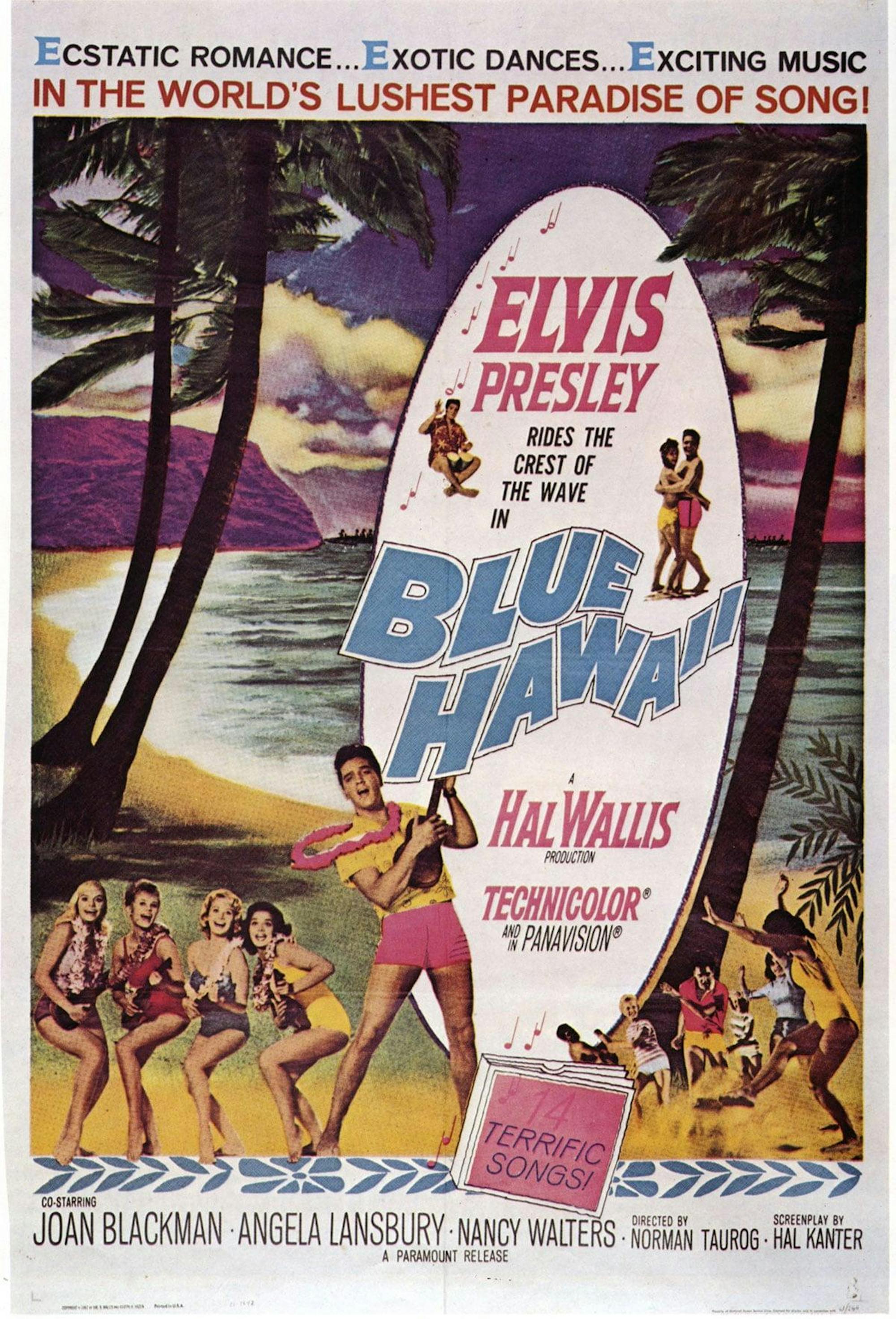
Impersonators are one of the more unusual parts of Elvis Presley’s cultural legacy. Yet this cartoonish image obscures the Elvis who existed before his extravagant Las Vegas spectacles: The handsome young performer whose warm, velvety baritone captivated audiences over both the radio airwaves and on movie screens. That’s right, Elvis made movies — lots of them. During the 1950s and 1960s, he appeared in more than 30 feature films as Hollywood became the focus of his career. The movies let Elvis conquer two mediums at once, turning each film into a big-screen showcase and a cinematic means of promoting his music. One of the best examples of this symbiotic relationship is the Hawaiian-themed and visually stunning Blue Hawaii.
Shot and released in 1961, the combination of Technicolor and widescreen Panavision gave Blue Hawaii an appeal like the one IMAX carries today. Audiences were not simply watching Elvis; they were watching him shake, rattle and roll surrounded by Hawaii’s lush foliage, mountains, white beaches and impossibly blue water. Yet, as visually impressive as the movie was, let’s be honest: no one was winning an Academy Award for it. Elvis was a mid actor at best, and the plots of his movies were formulaic and predictable. Although I personally find the film to be entertaining and enjoyable, the true value of Blue Hawaii is its soundtrack.
During my recent cross-country odyssey, I listened to this album numerous times. Why? Good question. In my spare time between the endless hours studying in Mann Library and writing Arts & Culture pieces for The Cornell Daily Sun, I collect vinyl records. One of the first records I ever bought, over four years ago, was the Blue Hawaii soundtrack. The main reason I bought it at the time was simple: Elvis’ hit “Can’t Help Falling in Love” was on it. So, I figured, why not?
After forgetting about the record for a few years, I found it on my shelf again, brushed off the dust and brought it home for the summer. I listened to it, watched the movie, listened to it again and then watched the movie again. I found both light, silly and fun — which, frankly, was exactly what I needed after interning with the San Diego County Public Defender’s Multiple Conflicts Office, where the work could be deeply emotional and intense.
The most famous song from Blue Hawaii is, as I mentioned, the love ballad “Can’t Help Falling in Love.” It was a massive hit for Elvis, becoming one of his signature songs and peaking at No. 2 on the Billboard Hot 100 on Feb. 3, 1962, behind Joey Dee and the Starliters’ “Peppermint Twist.” Now, “Peppermint Twist” is a good song — you would probably recognize it if you heard it — but be honest: How many of you know it by name? My point is that history ultimately vindicated Elvis. “Peppermint Twist” may have won that week, but “Can’t Help Falling in Love” won over time.
More upbeat was “Rock-A-Hula Baby,” a fast-paced blend of rock-and-roll and Hawaiian sounds. Listening to it makes you want to kick off your shoes, grab a flowery shirt, throw on a plastic lei and dance on the beach. The steel guitar especially gives the song its distinctly Hawaiian flair. The best part comes at the end, when Elvis showcases his classic deep, resonant baritone as he belts out: “Oh well, that rockin’ a-hula baby of mine.”
One of my favorite songs occurs early in the film when Chad Gates, played by Elvis, returns to Hawaii after serving in the Army and is picked by the girlfriend he left behind. She asks him if he was true to her while away, and he responds by bursting into a short playful song called “Almost Always True” in which he sings that while he was faithful, he was tempted.
Now, if you have ever thought about serenading someone you love, grab your ukulele and steel guitar and sing “Ku-U-I-Po.” Personally, I think it is the most beautiful song on the album. The lyrics speak for themselves: “I love you more today / More today than yesterday / But I love you less today / Less than I will tomorrow.” So, next Valentine’s Day, you’ve got something to work with!
Some other great songs are the title track, “Blue Hawaii,” “Moonlight Swim” (while that sounds like a romantic idea, I strongly recommend not swimming in the ocean at night, especially in Hawaii) and “Slicin’ Sand,” which is apparently a fun term for dancing on the beach, although in the movie they do, quite literally, slice sand with their bare feet.
There are a couple tracks that might seem curious if you have not seen the movie, including “Ito Eats” — which is literally about a guy who eats just about anything — and “Beach Boy Blues,” a song Chad sings while in jail after getting into a fight — or, as he puts it: “‘cause someone shoved his face against my hand.” The song is filled with comic wordplay, including: “Now I’m a kissing cousin to a ripe pineapple, I’m in the can.” (I had to look that one up.)
Hawaii made a lasting impression on Elvis, who converted a large den into his Jungle Room, complete with tiki furniture, green shag carpeting and a waterfall wall. While Blue Hawaii and its soundtrack also made an impression on me, don’t worry, you won’t see me walking around impersonating Elvis like the beloved Cornell Batman. I’ll stick to the record.
Aiden Gaddis is a member of the Class of 2027 in the College of Arts and Sciences. He is a staff writer for the Arts & Culture department and can be reached at ajg335@cornell.edu.


