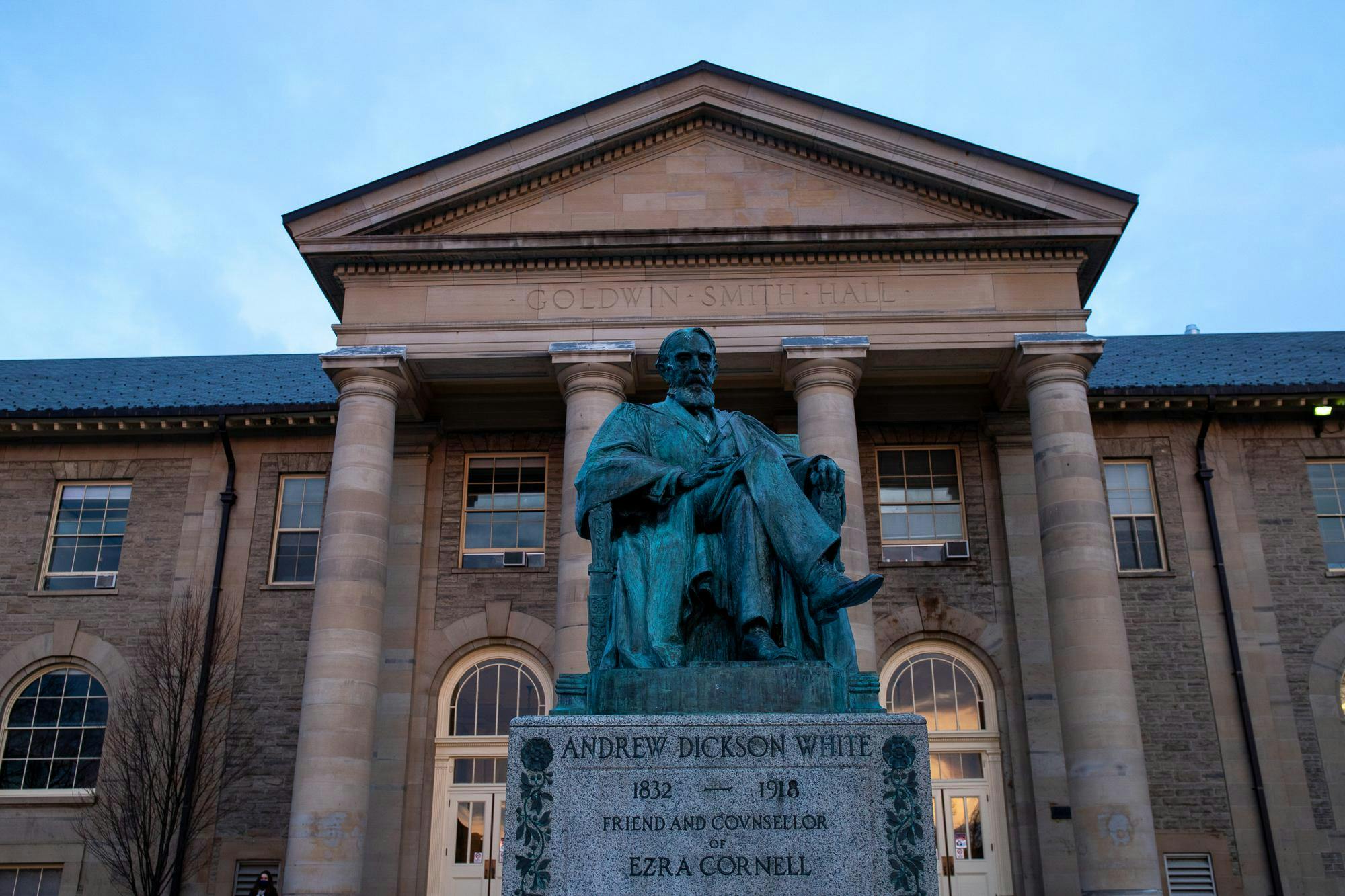
Every single Cornellian has stood at the center of the Arts Quad at least once during their four years here. Little do they all know that their surroundings are the result of a years-long disagreement between Ezra Cornell and Andrew Dickson White as to how the University’s campus should be arranged.
Ezra Cornell wanted the buildings at the University to be basic and solely utilitarian, nothing too decorative and nothing too flashy. Andrew Dickson White, both a co-founder and the first president of Cornell, on the other hand, was a lover of more classical and symbolic architecture, inspired by his time at Yale. The funny part of that disagreement is most apparent at the center of the Arts Quad. On one side is the statue of A.D. White sitting there facing the “Old Stone Row” of Morril, McGraw and White Halls. These buildings were labeled as “ugly” by critics. On the other side, in front of said Old Stone Row, is a statue of Cornell facing Goldwin Smith Hall, a building that perfectly mirrors the Neoclassical style that A.D. White so loved. The irony of the whole situation is that the two founders face the style of architecture they disliked and that the other had lobbied for.
These two founders then proceeded to build their own residences around campus, White commissioning the A.D. White House and Ezra Cornell requesting the construction of Llenroc (from where I currently write this article). Ironically, despite having very different architectural styles, the two buildings employed the same stone carver. A.D. White House was completed in 1874, in a high Victorian Gothic style. It was designed close to the Old Stone Row and served as the greatest contrast to those gray and gloomy buildings. Llenroc, on the other hand, was designed in a Gothic Revival style. Still more beautiful than Old Stone Row but, at the same time, much less ornamented and colorful than the A.D. White House both inside and outside. Despite this, Llenroc boasts a beautiful dining hall and incredible wooden carvings and paneling that do not seem to reflect the bland utilitarianism that its owner inflicted upon other buildings on campus.
What is the most famous architectural wonder at Cornell? Well that would have to be the West Campus Gothics. But did you know Risley Hall is just as old as the Gothics? White was deeply opposed to the idea of having dormitories. He was of the belief that fraternities and boarding houses would be better environments for the students of Cornell. As a result, for nearly 50 years, the University had no actual dormitories for its male students to live in. While men may have had housing issues, it was a much more dire issue for women. Girls could not live in men’s housing so attracting female students would’ve been impossible because of how limited the housing in Sage Hall, the original women’s dorm, was, and the boarding houses and fraternities not being an option. Risley Hall was opened in 1913 as yet another women’s residence hall. In that same year Cornell finally opened a complex of men’s residence halls on West Campus, mirroring the English Collegiate Gothic style. The first building built there was Baker Tower in 1913. As a West Campus resident for two years, I find the most beautiful parts of the area to be the Gothic architecture. It was especially wonderful to have to run through the old Gothic arches on the way to class. I whole-heartedly believe that art is a cure to a bad mood and beautiful architecture is a large part of that. So I genuinely wish that many of the newer dorms retained this older style.
Unfortunately for us Gothic architecture fans, the plans to construct all of West Campus in that fashion was scrapped. The Gothics that are there now are supplemented by the new modern West Campus Houses, which are for me a personal eyesore. This is a result of the fact that the student body almost doubled between 1950 and 1970. As a result, it was more important to build housing quickly than it was to make it aesthetically pleasing. Teagle Hall, completed in the early 1950s, is often considered the last campus building built in the Gothic tradition. Though students might not think too much about the place where they go to fulfill their physical education requirements, it is one of the last reminders of an architectural era that ended too soon.
Among other famous places at Cornell impacted by various events of their time is Uris Library, whose construction was only completed in 1891, despite having been planned for years before then. This was because of a legal battle over Jennie McGraw’s estate which was meant to fund the Romanesque style library at Cornell. Jennie McGraw, daughter of Cornell benefactor John McGraw, was a young heiress slowly dying of tuberculosis, her enormous inheritance partly set aside to fund a campus library at Cornell. However, these plans all became entangled in litigation due to her short marriage to Willard Fiske, who happened to be Cornell’s first librarian. It became a legal battle for years after her passing, as Fiske thought he was owed more than her will promised. Eventually, the very same Henry Williams Sage that was responsible for the building of both Sage Chapel and Sage Hall donated the money to have the then “University Library” and now Uris Library be built.
Another much forgotten aspect of Cornell history is Sage Hall. It was built in the same Victorian Gothic architecture as the Oxford’s University Museum, on which it was modeled. It was also completed in 1875 to house the Sage College for Women. That same year, Sage Chapel was completed in a high Victorian Gothic style. It was constructed as a monumental response to criticism of Cornell’s nonsectarian students. The University itself had been labeled as “Infidel Cornell,” and its students were called “the heathens on the hill.” Both Ezra Cornell and Andrew Dickson White are buried there. And though this is unconfirmed, there has often been speculation of catacombs below this very chapel.
Cornell is home to many architectural wonders, much of which are formed by the personalities and preferences of its two founders and first president — Ezra Cornell and A.D. White. We cannot separate the place from the people who built it and whose mark on our 161-year-old campus cannot be ignored.

Lusine Boyadzhyan is a member of the Class of 2027 in the College of Arts and Sciences. She is a staff writer for the Arts & Culture department and can be reached at lboyadzhyan@cornellsun.com.