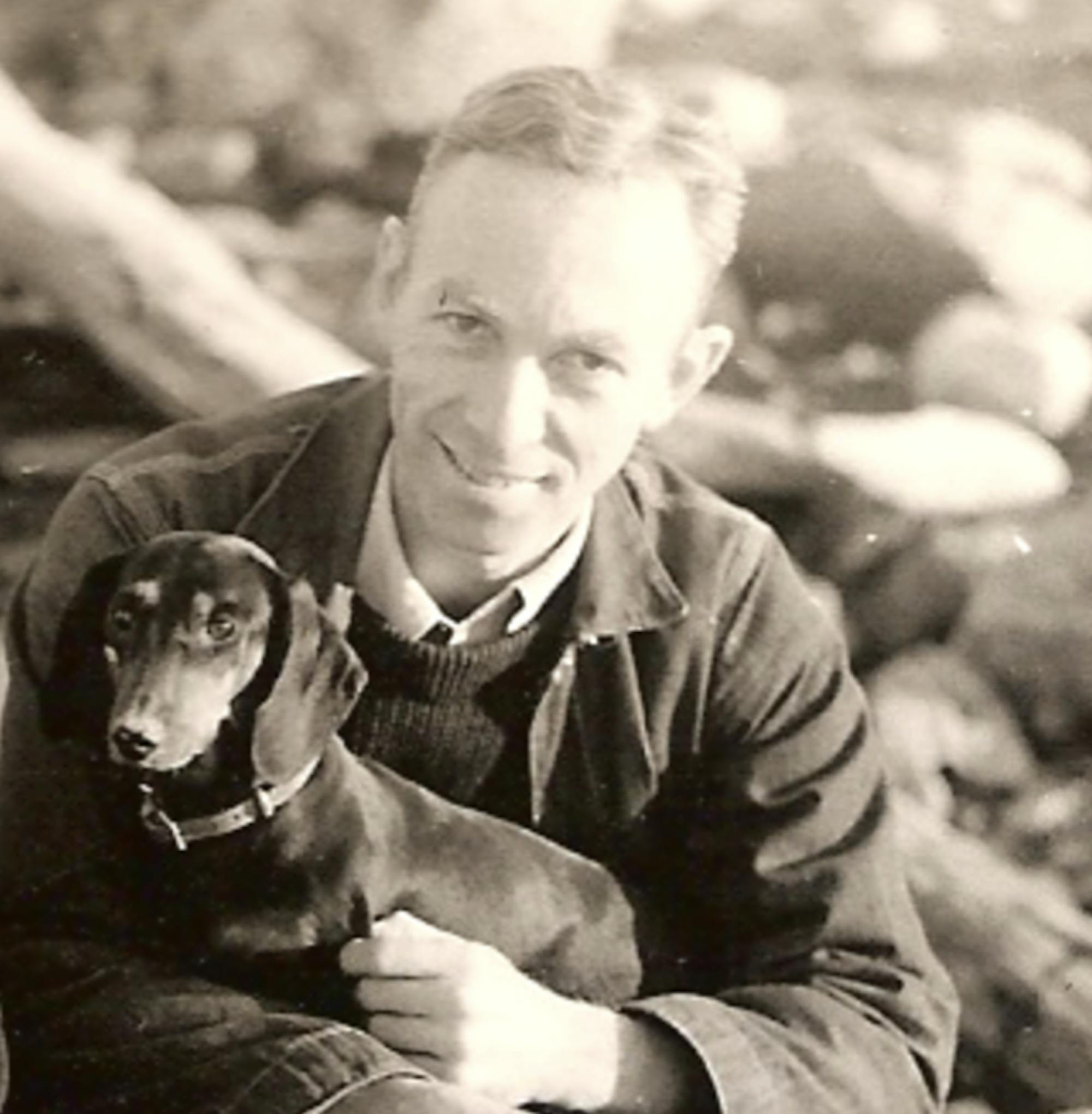
Elwyn Brooks White was the dog lover to outdo all dog lovers; when his childhood dog, Daisy, died after being hit by a taxi, he asked The New Yorker to run an obituary for her, and in it he wrote, “She died sniffing life, and enjoying it.” Beyond his love for animals, he was, like me, a horrid procrastinator when it came to writing; he admitted he would often walk around his house searching for things to clean to avoid sitting down and writing (proof that procrastination has always been a trait definitive of writers). I would argue that he was the best writer to exist because he preferred himself and his words above all else, a fact that is especially evident in his social avoidance. Whenever an unexpected visitor showed up to his door to talk with him, White would attempt to escape his office through the fire escape. His tendencies to procrastinate and flee are perhaps indicative of just how human, how normal he was, despite the attempts from the media to sensationalize him.
I know by now that you have been asking yourself, “Who the hell is Elwyn Brooks White?” My apologies, for I should have led with this: Elwyn Brooks White, or more famously Cornell’s E.B. White, is the author of beloved children's books Stuart Little and Charlotte's Web.
In a way, it can be argued that White’s destiny was always to be a writer. During his time at Cornell University, White served as editor-in-chief of our very own student-run newspaper, The Cornell Daily Sun. And even when White chose to take a year-long sabbatical from his studies to serve in World War I, he would arguably return with an even stronger passion for his work, spending a year following his graduation in 1921 writing for The Seattle Times as a cub reporter. From there, White became an editor at The New Yorker, where he often wrote about his childhood in rural Maine alongside his new life in the city. It was at The New Yorker where he met his wife, Katharine Angell, a fellow editor.
White was coming off years as a columnist for Harper's Magazine in 1945 when he wrote and published the famous children's book, Stuart Little, which follows a young mouse born into a human family. With this, White perhaps found his calling, shortly after publishing an equally famous children's book, Charlotte's Web, in 1952, which tells the story of a livestock pig, Wilbur, and his unlikely friendship with a spider named Charlotte.
White was arguably one of the best-known authors and essayists at the time; he was awarded the National Medal of Literature in 1971, the American Academy of Arts and Letters in 1973, a Special Pulitzer Prize citation in 1978, and the Laura Ingalls Wilder Medal (the greatest acclaim in the field of children's literature) in 1970 for Charlotte's Web and then again for Stuart Little. His work is a cornerstone of childhood for generations of children; since its publication, Charlotte's Web has sold more than 45 million copies since its publication over 70 years ago. The book is also the New York Public Library's 6th most borrowed book in its history; Stuart Little has seen 4 video game adaptations, two television show adaptations and a movie trilogy. E.B. White's name will live on for another 100 years as a generational writer. He is a legend. But he was also a father, a brother, a husband and a son.
In his rise to fame, E.B. White — like so many authors and writers — has come to be known as only a writer. The public tends to alienate artists from their humanity; from painters to singers to writers like White, their lives’ worth is reduced to the work they produced. Society often fixates on the lives of artists, dissecting their experience for clues that speak to the origins of their work, while overlooking the actual complex people they are outside of their work. This is not only a shame but a disservice. The beauty of writing, of art, is the life that led to it: the humanity and the person behind it. I loved Charlotte's Web and Stuart Little, and a part of me always will; I will, like many of you probably, ensure my children know the stories of Wilbur the pig, who only dreamt of a friend, and similarly, Stuart Little, who longed for a family. However, our love, if it is true love, should encompass all. It should honor the entire human that E.B. White was.
White was more than his writing. He was the youngest of six siblings, born to artists: his father, Samuel Tilly White, was a pianist, and his mother, Jessie Hart White, was a painter. A victim of his times, White served as a private in the Student Army Training Corps during WWI. At Cornell, he was a member of the Quill and Dagger Society and was often called “Andy,” due to a Cornell tradition of nicknaming any male student with the last name “White” after the first president, A.D. White. In between his postings at The Seattle Times and The New Yorker, he found himself in a side quest serving on an Alaskan fireboat. He had a lesser-known and lesser-praised career as a tagline writer for newspaper cartoons, and he had a tendency to ramble in his writings about the evils of totalitarianism, peculiarities of Maine speech and hatching goslings when given the chance.
White was a powerhouse in literature. And he was also just a human; his life was messy, complicated, full of laughs and frustration and shaking angry fists in the air, and most importantly, complete.

Leslie Monter-Casio is a member of the Class of 2028 in the Brooks School of Public Policy. They are a staff writer for the Arts & Culture department and can be reached at lmontercasio@cornellsun.com.