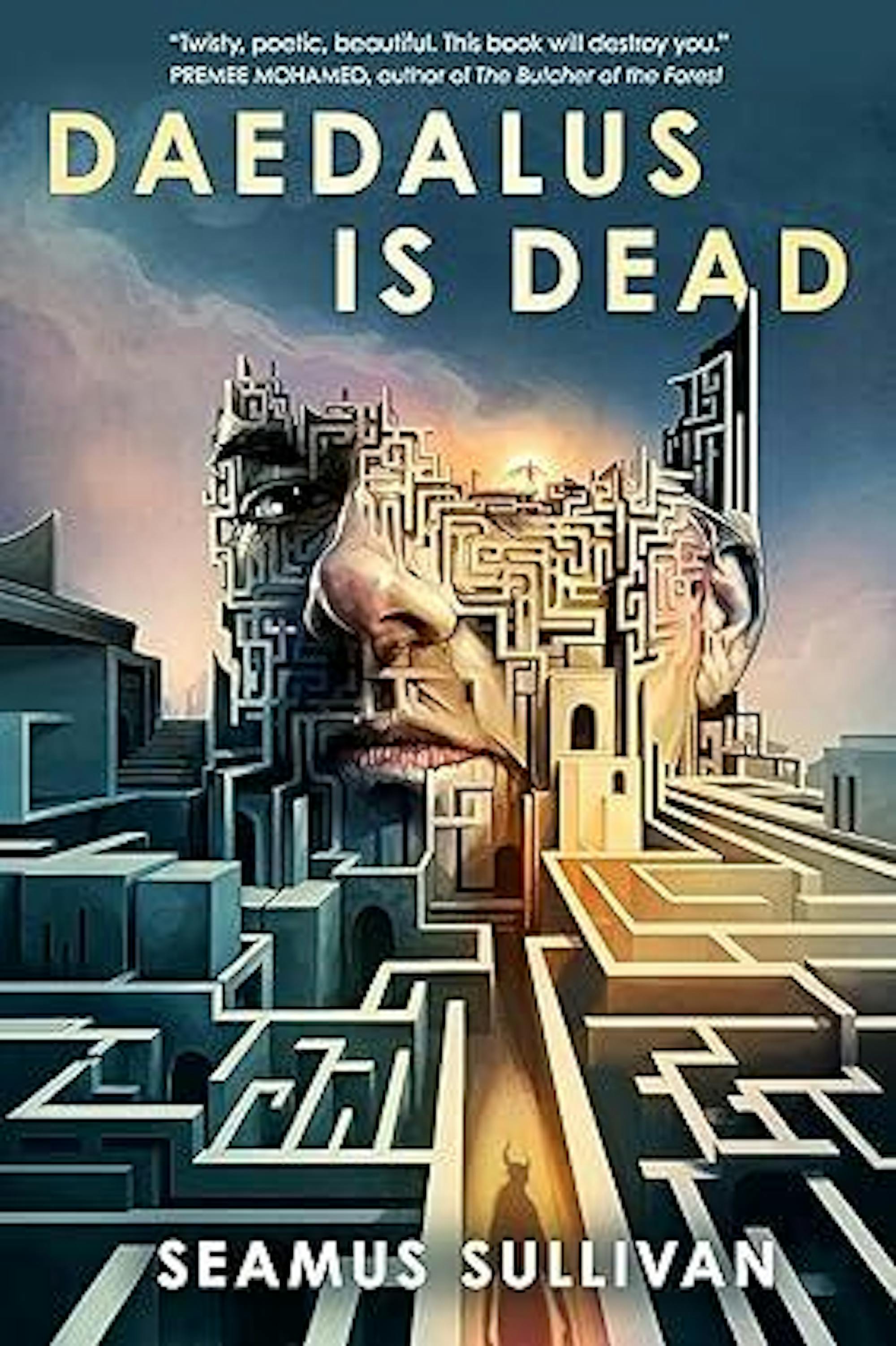
In the fading wake of Christopher Nolan’s star-studded IMAX giant of an odyssey, debut author Seamus Sullivan has stirred the surface of Greek mythological canon with little more than 150 pages. Sullivan’s reframing of the myths of Daedalus is by no measure the storm of Nolan’s film; but, refreshingly, neither is it a retelling. Instead, Sullivan ventures into the hazier corridors of speculation, exploring the conflict that could create the heroes we know and the struggle that might follow triumph or tragedy. Daedalus is Dead is a haunting specter of the myth we expect to see; a haunting recollection of a past that doesn’t die.
Everything begins at the end. Daedalus has already served King Minos for a lifetime and turned the isle of Crete into the center of a technological empire. The legendary architect has completed the Labyrinth, his masterpiece and a sprawling reminder of his greatest shame. The Minotaur is dead and Ariadne is long gone. There is only one tragic tale left to tell: Daedalus and Icarus take their flight, Icarus falls and the visionary who constructed the whims of his imagination discovers a desire that he cannot bring to life. Alone, Daedalus ages and dies, all the while dreaming of the day that he will finally be reunited with his son. But in the underworld — realm of gods, monsters and, worst of all, his own mind — the father of inventions finds himself way out of his depth. Daedalus’ enemies, made at the height of his creative brilliance, now have an eternity to exact their revenge.
The plot switches between Daedalus’ tortured present and his recollections of an equally brutal past. Again and again, Daedalus returns his mind to times when the Labyrinth grew alongside Icarus, Ariadne and Asterion, the child that would become its monster. Warped partly by magic and partly by Daedalus’ perception, certain parts of the book seem almost like a feverish hallucination. This further blurs the already tenuous border between Daedalus’ imagination and reality, as the inventor’s constant commentary and questioning intertwine with both past and present. Though Sullivan, for the most part, avoids depicting direct scenes from the related legends, there seems to be no escape from the familiar figures who taunt Daedalus in his death. Like branches twisting from the heart of an impossible maze, everything is beholden to these stories that Sullivan book-ends, but does not tell.
Most striking about Sullivan’s creation is his choice to have Daedalus, the “I” of the story's first -person narrative, address Icarus as “you.” The effect is profoundly intimate and intense in a way that a normal first person narration is not. We, the reader, have no choice: we are Icarus. In life we burned up, burned out and, inevitably, fell. In death, we hear our father’s pleas whispering for one last chance from within the paper pages. However, our responses to the man in our minds fall on deaf ears because Daedalus can never hear the words we, as his son, might speak. We can only hope that we are not Icarus and that someone else is listening. With this brilliant device, Sullivan invokes equal measures of despair and terror all too appropriate for exploring the complexity of a mastermind.
It must be noted that for all its strengths, Daedalus is Dead possesses a tedious enthusiasm for similes and metaphors. There are often comparisons embedded within descriptions that add little in the way of imagery and that appear irrelevant to the Daedalus’ unique perception of the world. Instead, they forward a more general picture of Greece as a whole and reference natural and cultural elements with little specificity to the story. This is done the most exhaustingly with Persephone, whose expressions are compared to events in nature at seemingly every opportunity. With an absent Hades, the book’s sovereign of the underworld cannot so much as deepen her frown without plants withering and crops rotting and frost forming among other things. The comparisons were all accurate, simply overused.
Despite this grievance, the ~150 pages of Daedalus is Dead are well worth the time. Within his short debut, Sullivan has bestowed a greater humanity upon a stagnant myth, revitalizing Daedalus into someone flawed and real. Daedalus will likely never escape his Labyrinth, the legend that is an eternal part of his legacy. If you step into Sullivan’s twisting passages, the maze of the inventor’s mind will wind its way into your memory as well. Do you dare to explore the Labyrinth?
Thank you to Tor for an ARC of Daedalus is Dead!
Wyatt Tamamoto is a member of the Class of 2029 in the College of Arts and Sciences. He is a staff writer for the Arts & Culture department and can be reached at wkt22@cornell.edu.