

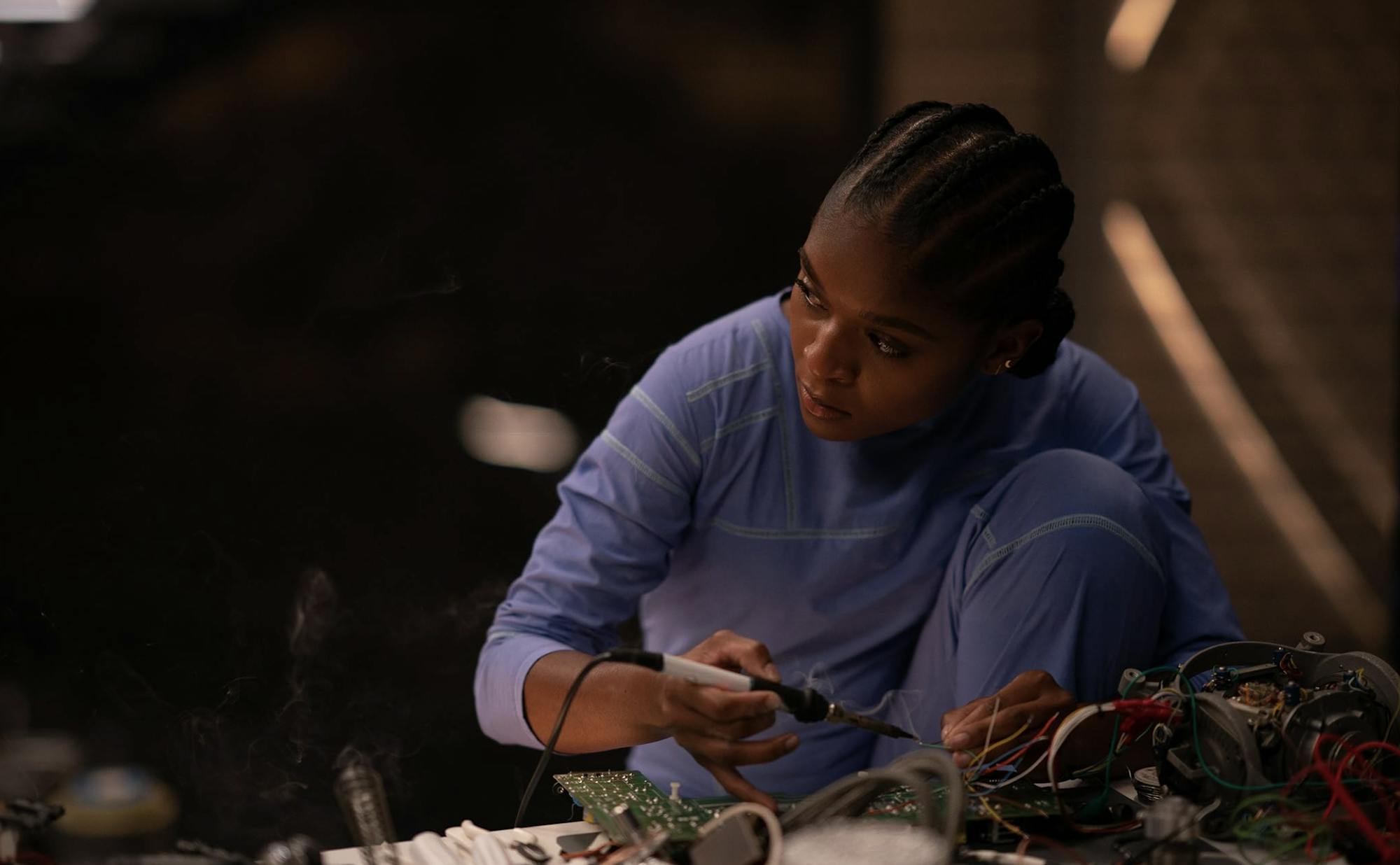
On the big screen, Dominique Thorne ’19 is a hero: Riri Williams, a young, Black and incredibly intelligent female inventor in the Marvel Cinematic Universe. (Check out Black Panther: Wakanda Forever and Riri's spin-off, Ironheart.) Behind the scenes, too, Thorne remains a hero: the picture of poise, elegance and grace as she spoke at her Alma mater, Cornell, on the night of Sept. 10. Seated across from Performing and Media Arts Director Samantha N. Sheppard, Thorne reflected on her journey as a young Black woman navigating both Cornell student life and, later, her blossoming career as an actress.
"I will never forget sitting in an audience, feeling invited to grow and change," Thorne told us, her conviction palpable as she spoke. Her audience, myself included, hung on to her every word. Though she was referring to theatre performances, her wisdom did just that — invited us to grow. Now, as I offer some of my favorite tidbits of her story, I invite you to grow too.
"I will forever be a student."
Thorne attended a performing arts high school, and she loved it. However, she chose Cornell because she wanted to put her focus into a global education. When she enrolled in the College of Human Ecology, Thorne reports that she learned to "honor herself holistically," putting energy into both her academic career and the relationships around her. Thus, Thorne put her head down and learned to study policy and human development. Here, she also learned the power of community. She holds a particular love for her sisters at Wari Cooperative, Cornell's all-Black, female residential co-op. She recalls meeting the Wari upperclassmen at a first-generation college student meeting, describing them as a "blast of culture and sound" which opened her door to the Black community at Cornell. She eventually went on to join Wari’s executive board, serving as their president in her junior and senior years. Thorne repeatedly emphasized the power of community, adding that a large part of Cornell that she missed after graduation was the critical conversations and attitude of curiosity that she found both with her Wari sisters and among the Cornell community at large.
"I've done all I can do."
Thorne also talked about the audition process for Marvel, starting with her audition for the role of Shuri in Black Panther. She recalls countless audition tapes, flights to L.A. and chemistry reads with Chadwick Boseman. She even called on her international friends to help her nail an accent that she felt was appropriate to Wakanda; though the nation was fictional, its language is based in various real African dialects. By the end, she just had to accept that she had done her best and hope for a win. And then? Rejection. "It was devastating," she said. Yet as she was leaving the hotel to fly back to Cornell, she heard a voice in her head:
"You'll never get the things you want if you don't tend to the things inside of you."
Thorne believes the voice she heard that day was God speaking to her, giving her a sign to reconnect with herself. Arriving back to Cornell, where she had remarkably never before missed a class, she looked within. What needed to change? She subsequently switched majors, made time to call her parents and threw herself into what was in front of her. Looking back, Thorne says she is glad that she had the space to complete her education and build a life marked by joy and mental security. When Marvel called her back a year later, offering her the role of Riri Williams, she felt much more prepared to accept. To connect with her character, she did everything from listening to Chicago street music to researching every little detail of Riri's background. She even suggested the addition of a scene which explored Riri's trauma-induced fear of water.
“A gift and not a burden.”
When asked about the pressure of playing a character who represented the epitome of young Black female power, Thorne replied that she saw it as a gift and not a burden. The gift was trying to represent her community. The real burden was the way cinema typically "pigeonholed Black women," reducing them to a stereotype or a caricature. Riri Williams, on the other hand, breaks precedent, a character who is both vulnerable and real as well as powerful and intelligent. Sometimes, Thorne adds, she just wanted to be viewed as an actress and not a Black actress, measured by her talent rather than her skin.
"Live up to your own expectations."
Above all, the real emphasis in Thorne's words fell on staying true to yourself. As she explained to us, after Cornell, she had to seek out things that "fed [her] soul," such as volunteer work or visits to a nearby library of free books by Black authors. Even as she became Riri Williams on the screen, she stayed utterly true to herself and her passions in real life. Thorne mentioned multiple times the importance of knowing and understanding yourself and caring for your basic needs in order to find balance and fulfillment in anything you do. Plus, with the discipline she found at Cornell, Thorne is always working hard to live up to her own expectations.
Her strong sense of self was evident in every aspect of her presence; from her strong posture to her words, you could feel a settled spirit in her soul. I cannot pretend to capture her magnetism in text. I do, however, hope we can all find the same purpose, passion and power that Thorne embodies, whether as Riri Williams or as a Cornell alumna and incredible human.
Emily Federovitch is a member of the Class of 2029 in the College of Arts and Sciences. She is a staff writer for the Arts & Culture department and can be reached at eaf258@cornell.edu.


