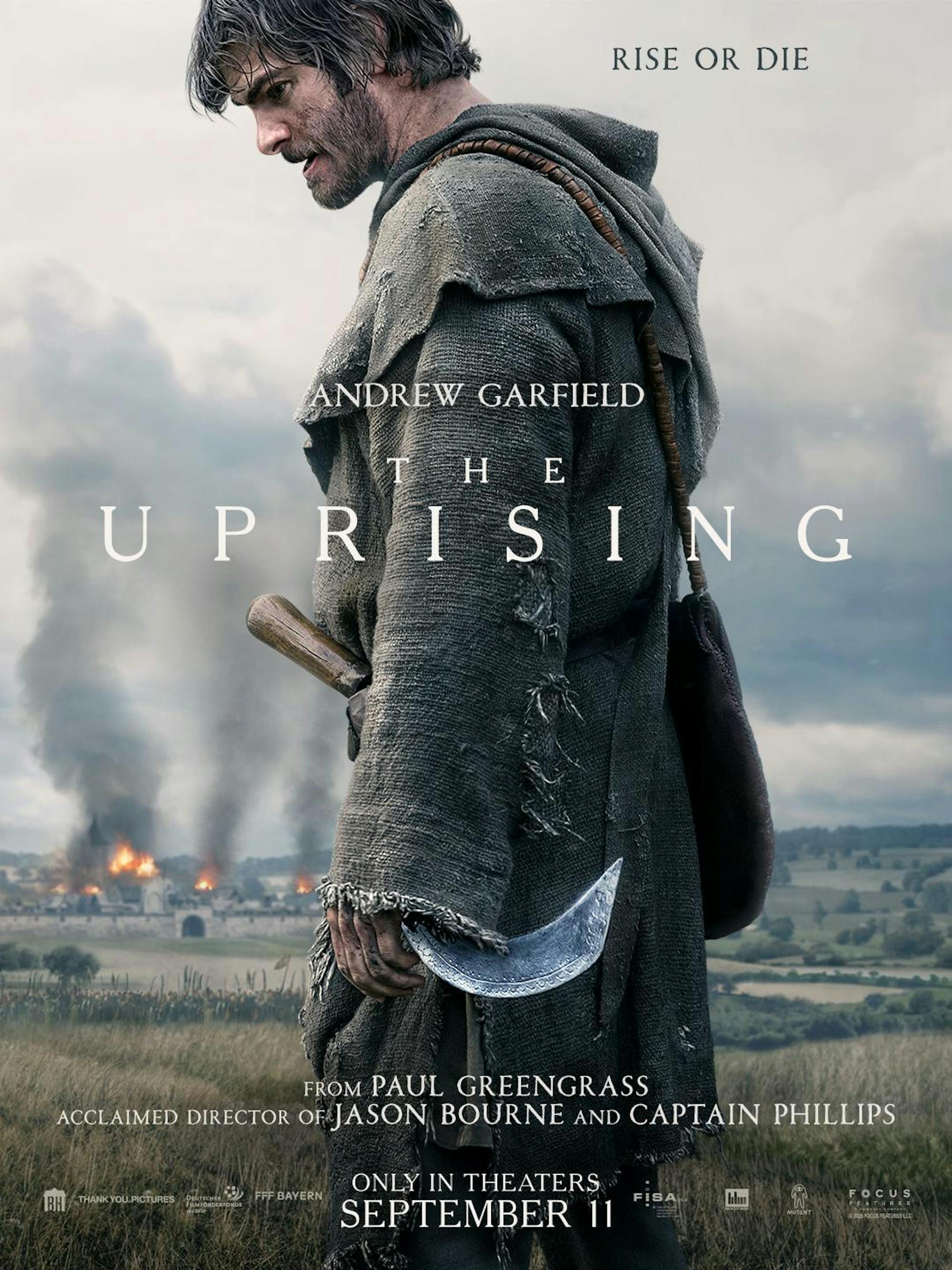
The Uprising immerses you in medieval England while simultaneously keeping you at arm’s length from its affairs. The story covers the Peasants' Revolt, set in the aftermath of the Black Death. Following the advice of his council, a young King Richard II levies a poll tax, a fixed tax on everyone over a certain age, disproportionately affecting the peasantry, to fund war with France. An exasperated farmer, known only as Ploughman (Andrew Garfield), who lost his entire family to the plague, violently rebuffs the tax collectors’ demands and stirs outrage over the crown’s treatment of his community. As this unrest spreads across villages, Ploughman joins forces with John Ball (Jamie Bell), a rebel preacher, and Wat Tyler (Cosmo Jarvis) to lead the rebellion to London and petition the king for fairer treatment. Although they eventually reach London and face the king, the movement ultimately descends into chaos amid betrayal and unrest.
The film’s visual aesthetics are one of its strongest features. The grayish weather and desolate open fields felt quintessentially English and successfully conveyed the misery and haunting undertones entrenching post-plague Europe. Additionally, the medieval townscape balanced emphasizing its historical character without becoming a caricature of the medieval period. From the moment the film began, I felt the emotions of the 14th century and completely centered in the character’s world. The power of the visual setting took some pressure off the screenplay by reducing what was needed to stay engaged.
On the other hand, I found the pervasiveness of violence tiring. I am not opposed to violence in film, in fact I believe some violence is necessary to represent the Peasant’s Revolt properly. However, the film’s emphasis on, and severity of, the revolt’s terror diminished the story’s emotional force. For example, Ploughman's violent outbreak at the beginning felt like a medieval caricature, making the story harder to relate to. I would have preferred more everyday manifestations of his grievances that a general audience could more easily map their own lives onto.
Alongside the overuse of violence, I noticed an underemphasis on character relationships; it seemed as though each main character was experiencing the revolt alone rather than as a unit. I wanted to see more personal plotlines between individuals, as the disjointed nature between characters made the film feel more like a sequence of events than a cohesive story.
The two exceptions to this flaw were the dynamics between the king and his council, and between the king and his mother (Katherine Waterson). The former eerily demonstrated the council’s extreme control and manipulative power over a vulnerable monarch; I felt genuine anger at the council members’ exploitation of the young king. Additionally, I enjoyed the parental relationship between King Richard and his mom, as her protective tendencies added personal depth the film otherwise lacked.
Despite weak bonds among the characters, the acting itself was strong. Garfield, as Ploughman, portrayed the sincerity of an ordinary farmer turned rebel leader and effectively conveyed the anger of the English peasantry. Jarvis, as Wat Tyler, delivered an emotionally weighted performance emphasizing the passion behind the peasant’s cause. Bell, as John Ball, brought the eccentricity of a radical to a figure fighting for broader social change rather than simply policy change. I was most impressed by Woody Norman’s portrayal of King Richard II, who perfectly embodied a young, frightened king caught between wanting to establish himself as leader in his own right and remaining under the heavy influence of his council. As with the film’s visual allure, the acting kept me invested beyond the storyline and engaged with its broader themes.
One of the film’s biggest selling points is how its themes of structural inequality and the erosion of trust in authority apply to modern times. The oppression that the English peasantry faced in 1381 is not unlike the sentiment among many Americans today that our current economic system unfairly favors the elite. A 2020 Pew Research Center study found that 70% of Americans believe their country’s economic system unjustly benefits those with greater wealth and influence. Additionally, the ultimate betrayal those who took part in the Peasant's Revolt felt at the hands of their king somewhat resembles the lack of trust many Americans feel towards their government. Additionally, a 2025 study by Pew Research Center showed that only 17% of Americans trust their government to make the right choices either “just about always” or “most of the time.” However, despite the relevance of the topics raised in the Peasant's Revolt, the film’s lack of developed personal relationships between characters keeps it from reaching its full potential.
I enjoyed the film, but afterward I didn’t feel that after-movie effect where you are left with lingering emotions after leaving the theater. Overall, The Uprising delivers a believable historical backdrop with high-level acting and resonant themes but fails to deliver significant emotional impact.
Caroline Kelly is a member of the Class of 2028 in the College of Arts and Sciences. She is a writer for the Arts & Culture department and can be reached at ckelly@cornellsun.com.