Not politically. Not legally. Not even nationally. He was, unmistakably, India’s superstar. But for a Pakistani child growing up after partition, that distinction could feel strangely irrelevant.
I knew India as the country on the other side of a border. I knew it as Pakistan’s rival, as the place from which my country’s political history had separated us. But I also knew India through the screen: through Shah Rukh Khan’s outstretched arms, extravagant weddings, embroidered lehengas, Urdu poetry, elaborate choreography and songs that seemed to make South Asian life itself impossibly colorful.
What I did not understand as a child was why these images felt so strangely familiar. I was watching Indian movies, but I was also seeing pieces of a cultural inheritance that existed long before the borders of India and Pakistan did. My own family history, like that of millions across the subcontinent, was shaped by the centuries of movement, conversion, migration and cultural exchange that preceded partition. My ancestors became Muslim generations ago, but becoming Muslim could not erase the South Asian worlds from which they came. Watching Bollywood, I could feel the remnants of that larger inheritance in the music, clothing, languages, family rituals and aesthetics that had survived religious and political transformation. The irony was that the country I had been taught to see as separate from Pakistan was often the place where I most vividly encountered parts of the culture that made me feel connected to the subcontinent in the first place.
This is perhaps why I keep returning to the Bollywood films of Shah Rukh Khan’s heyday. Dilwale Dulhania Le Jayenge and Kuch Kuch Hota Hai remain some of my favorites, not simply because of their romances, but because of how completely they inhabit their worlds. Kabhi Khushi Khabie Gham turns family, wealth and tradition into a visual spectacle; Kal Ho Naa Ho places friendships, love and diaspora against the backdrop of New York City; Om Shanti Om is almost a love letter to Bollywood itself. Even Swades, with its quieter story of migration and returning home, asks questions about what it means to belong to the place you came from. These films are unmistakably products of India, but their emotional vocabulary never felt exclusively Indian to me. The families, the weddings, the music, the arguments over love and duty — all of it felt recognizably South Asian.
Perhaps no Shah Rukh Khan film captures the strange intimacy between India and Pakistan better than Veer-Zaara. Its central romance crosses the very border that had become so politically consequential in the lives of millions of South Asians. Watching it myself, I could not help but notice the strangeness of seeing my own country represented within an Indian film, particularly one centered on a Muslim woman and an Indian man whose lives are shaped by the border between them.
My relationship with Bollywood was also shaped by growing up in a religiously conservative Pakistani household. Some forms of music, dance, clothing and self expression could feel morally complicated in ways that they did not on the Bollywood screen. I do not think Bollywood represents some uncomplicated, liberated version of South Asia; Indian society, like every society, contains its own contradictions and restrictions. But Bollywood gave me an artistic vocabulary for parts of South Asian culture that I sometimes felt were difficult to access elsewhere.
Its women could be glamorous and expressive. Its men could be romantic and emotionally vulnerable.
Families could be deeply traditional while still making room for rebellion, desire and reinvention. For me, the extravagance of Bollywood was not merely escapism. It was a way of imagining what cultural expression could look like.
And perhaps that is why the Bollywood of the 1990s and early 2000s remains so culturally alive to me. Its aesthetics were unapologetically excessive — sweeping landscapes, elaborate costumes, enormous sets, orchestral scores, choreographed celebrations and romances that could stretch across years and continents. Yet those films have survived only because the worlds they depict are not confined to the country in which they are made. Their stories travel because South Asia itself has always been larger than its modern borders.
I have never been to India. As a Pakistani dual citizen, I don’t think I’ll ever be allowed to within this lifetime. Perhaps that is the peculiar gift of Bollywood — it made geography arrive before I did. Every Shah Rukh Khan film was a little act of trespassing, not across a checkpoint, but into a cultural world that history had told me belonged somewhere else.
A border kept me from India. A movie never did.
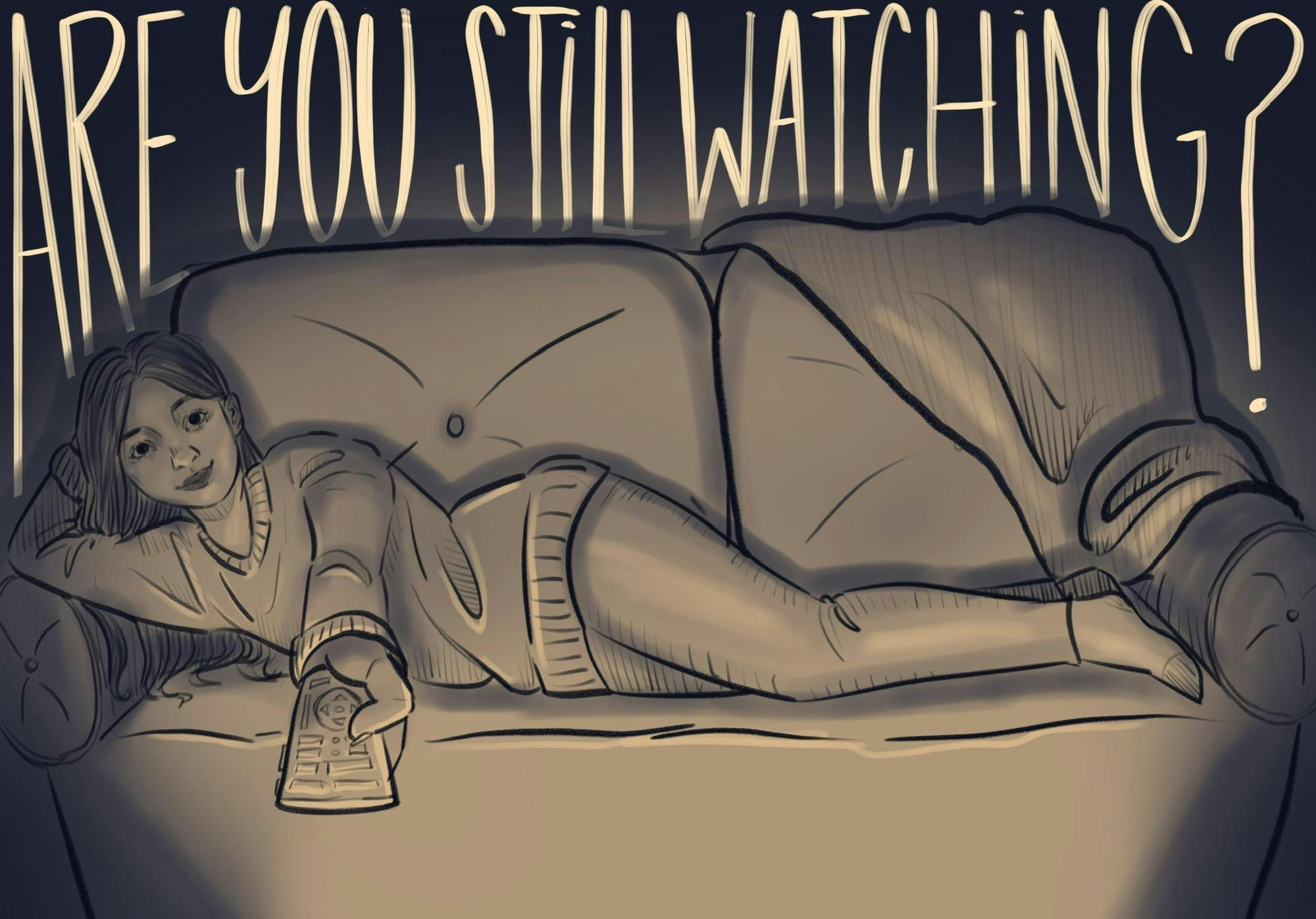
‘Are You Still Watching?’ is a column spotlighting what the Cornell community has been streaming. It runs every Wednesday.
Aima Raza is a member of the Class of 2027 in the School of Industrial and Labor Relations. She is a staff writer for the Arts & Culture department and can be reached at araza@cornellsun.com.