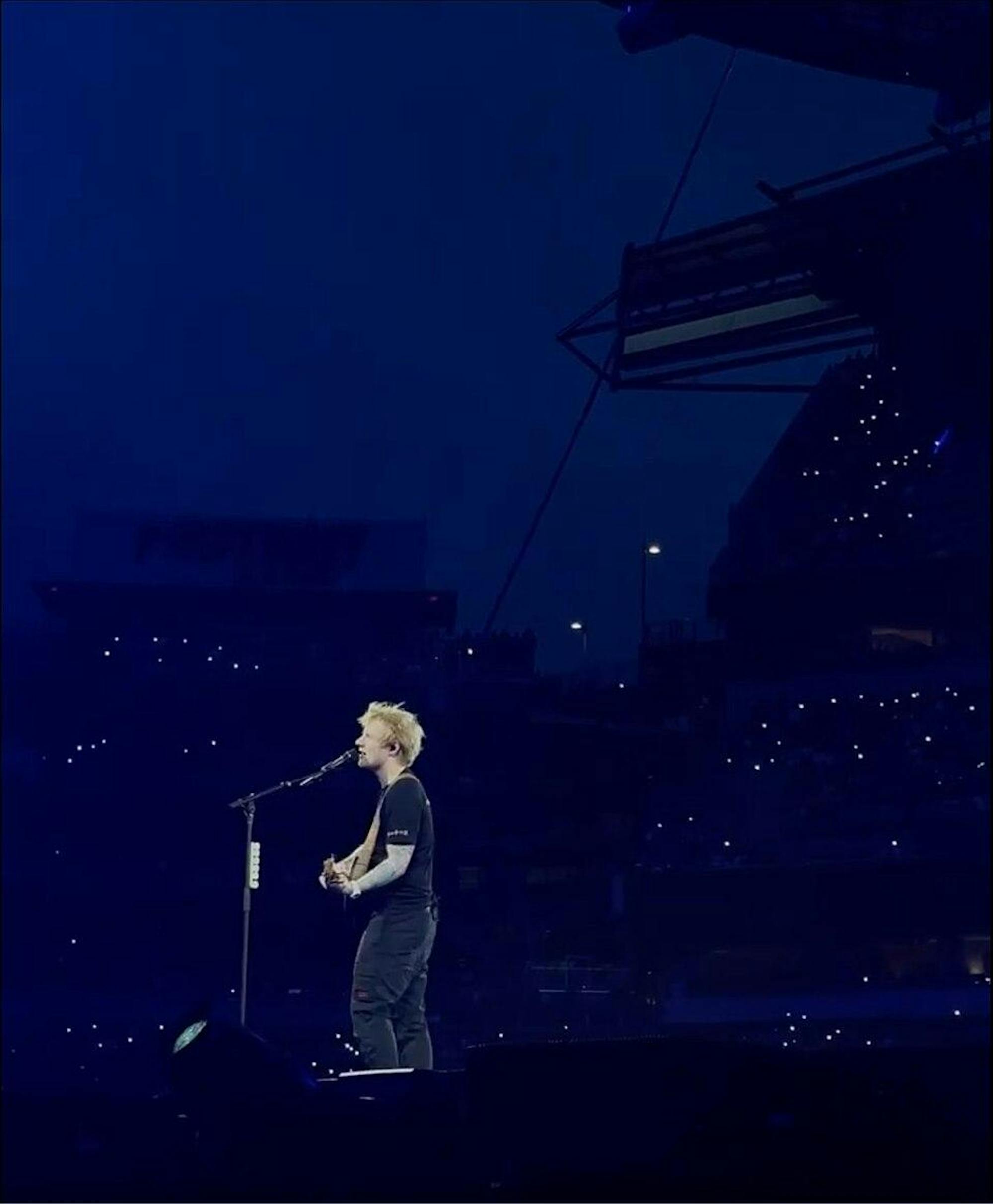
On Sept. 4 and 5, Macklemore opened for Ed Sheeran’s Loop Tour at MetLife Stadium. These were the first two of what was supposed to be 10 gigs with the pop star, yet they would be their last performances together.
On both nights, Macklemore expressed his support for the Palestinian people in the ongoing Israeli-Palestinian conflict: “Free Palestine. I want those words to be loud and clear, so the people from Gaza, all the way to the occupied West Bank know that we have not forgotten them.” On the second night, in response to Jewish organizations calling his statements antisemitic, he rebutted, “To all of my Jewish brothers and sisters: criticism of Israel, criticism of apartheid, being against genocide in no way is a criticism of you. … None of us will be free until we are all free.” He also praised Columbia University students for leading pro-Palestine protests and encampments in 2024, leading into his song “Hind’s Hall,” which was inspired by these students.
Just over a week after these shows, Macklemore posted on his Instagram that he had been removed as an opening act for the remainder of the tour. Robert Kraft, who owns Gillette Stadium, where Macklemore and Ed Sheeran were scheduled to play later in September, gave Sheeran the ultimatum of removing Macklemore or cancelling his shows, challenging Sheeran’s apolitical stance. Soon after, the remaining openers — Aaron Rowe, Finneas, Lukas Graham and Beoga — dropped out in solidarity. Each one posted a statement supporting Palestine and criticizing the silencing of Macklemore. Finneas said, “Artists must not be silenced when they speak up for the oppressed.”
In his statement on Instagram, Macklemore began, “People are being killed today, and people will be killed tomorrow. I want to make sure that as I tell this story, we don’t lose sight of that.” Despite being friends with Sheeran for over a decade, Macklemore criticized his apoliticism, citing a disconnect between their stances: “There is no neutral position between the oppressor and the oppressed. … At a certain level of exposure, ‘Free Palestine’ becomes too much of a risk. … Maybe that’s why this time it became so important to silence me.”
Macklemore ended his statement boldly, saying, “I didn’t need 10 shows from Ed. I needed 2. Two chances to stand in front of 90,000 people and say the words that somehow became too dangerous to say. Free Palestine.”
This situation is a striking example of how, as the war in Gaza has continued, people continue to associate criticism of the Israeli government with antisemitism. In a post criticizing Macklemore, Pink, a Jewish singer, muddled this line, saying, “Last weekend he stood in front of a stadium full of music-loving families, with violent images from a war on the screens, dedicated a song to the movement of his choice, and then took the mic to tell all of the Jews in the stadium that it wasn’t about them. You don't get to decide that for us.”
Standing against war does not mean opposing religion; it means denouncing a nation-state whose officials have openly said things like “They have no right to exist. … They need to be exterminated” (Israeli Minister of Education Yoav Kisch, 2023) and a terrorist organization that has vowed to attack “time and again until Israel is annihilated” (Ghazi Hamad, Hamas, 2023). It means acknowledging the horrors committed by Hamas in Israel on Oct. 7, 2023, and the deaths that have come on both sides in the resulting war. Macklemore reminded people, “When criticizing Israel, opposing Zionism or saying ‘Free Palestine’ gets conflated with hatred of Jewish people, it doesn’t protect Jewish people. It protects Israel from accountability.”
Though Sheeran claims to be outwardly apolitical, the past proves otherwise: in 2022, after Russia’s invasion of Ukraine, he posted a video in support of Ukrainians, donating the royalties from one of his songs to a humanitarian aid relief fund. Though the scale of devastation is so much larger in Gaza, I believe the difference between now and 2022 is that he thinks he will lose more public support from supporting Palestinians than Ukrainians.
Sheeran posted that he has his own personal views on the conflict but chooses not to share them publicly, keeping his shows as a sanctuary rather than a political forum. In his next show, he also spoke on the issue, calling the devastation in Israel and Gaza a “catastrophic and unjustifiable and disproportionate” humanitarian issue. I thought his response was smart; he expressed sympathy for the devastation in Israel, Gaza and the West Bank while seemingly remaining neutral. (He noticeably never referred to the victims as Palestinians.) He ended his statement by calling his concerts a place of love and unity where people can disagree with one another.
I honestly thought that Sheeran should have left the conversation at his post. He could have had his quiet personal views and his apolitical concerts, but bringing up unity and welcoming disagreement while the context of the issue was genocide and death felt tone deaf.
I often come back to a phrase that has been popularized on social media: “We can disagree on pizza toppings but not human rights.” Celebrities like Jennifer Lawrence, SZA and — on the other side of the American political spectrum — Aaron Lewis have openly shared their views on political conflicts, prioritizing raising awareness over profiting off a larger audience. Sheeran’s claim that his concerts are a place where “everyone here can stand beside people that they don’t agree with on everything” continues to play neutrality, but at what cost? Framing a concert around love and unity doesn’t matter anymore when the “unity” seems to be about protecting profit. It is time for Ed Sheeran to make a choice: what matters more, his beliefs or his money?

Katherine Winton is a member of the Class of 2029 in the College of Arts and Sciences. She is a staff writer for the Arts & Culture department and can be reached at kwinton@cornellsun.com.