


Although Cornell was the first Ivy to admit women, priding itself on the founding principle of “... any person … any study” and now boasting around 10% more women than men in the student body, the University has a rockier history with women than they might want you to believe.
Allegedly, that famous 1865 principle was, at conception, meant to be inclusive of women. It was not until 1867, however, that Ezra Cornell stated in a letter that he wanted to “have girls educated in the university as well as boys so that they may have the same opportunity [sic] to become wise and useful to society that the boys are [sic].”
A nice sentiment, to be certain, but one that was not followed through — even under the pressure of many prominent figures like Susan B. Anthony — until 1870, when Jennie Spencer enrolled in the University on a state scholarship. Unfortunately, due to a lack of housing provided for her — on account of there being no women’s dorms — Spencer was forced to withdraw. Women were officially accepted in 1872 on a vote from the Board of Trustees, and construction on Sage College for Women, now Sage Hall, was completed in 1875. Emma Sheffield Eastman, a transfer from Vassar, was the first woman to graduate from Cornell in 1873.
While the journey toward female enrollment at Cornell was turbulent, you might be asking: Shouldn’t we give Cornell credit for matriculating women so much sooner than other schools of its kind? A mere five-ish years after its founding? Sure, it’s better than Princeton, where women weren’t admitted until 1969, but there still, 160 years later, are glaring issues in how Cornell interacts with its female students.
It’s easy to pretend, as seems to be the favored strategy of the University, that all the big, founding names of the institution were in favor of women being educated here. Unfortunately, this wasn’t really the case.
Goldwin Smith (the man, not the building) was brought to Cornell University in 1868 to work in the Department of History. Smith, an already famous British professor, gave the young university some much-needed “instant credibility.” However, Smith only remained at Cornell for a short four years, leaving in 1872, a choice that is largely attributed to the University’s decision to admit women. Smith told A.D. White that in admitting women, Cornell would “sink at once from the rank of a University to that of an Oberlin or a high school” and that all “hopes of future greatness” would not be achieved.
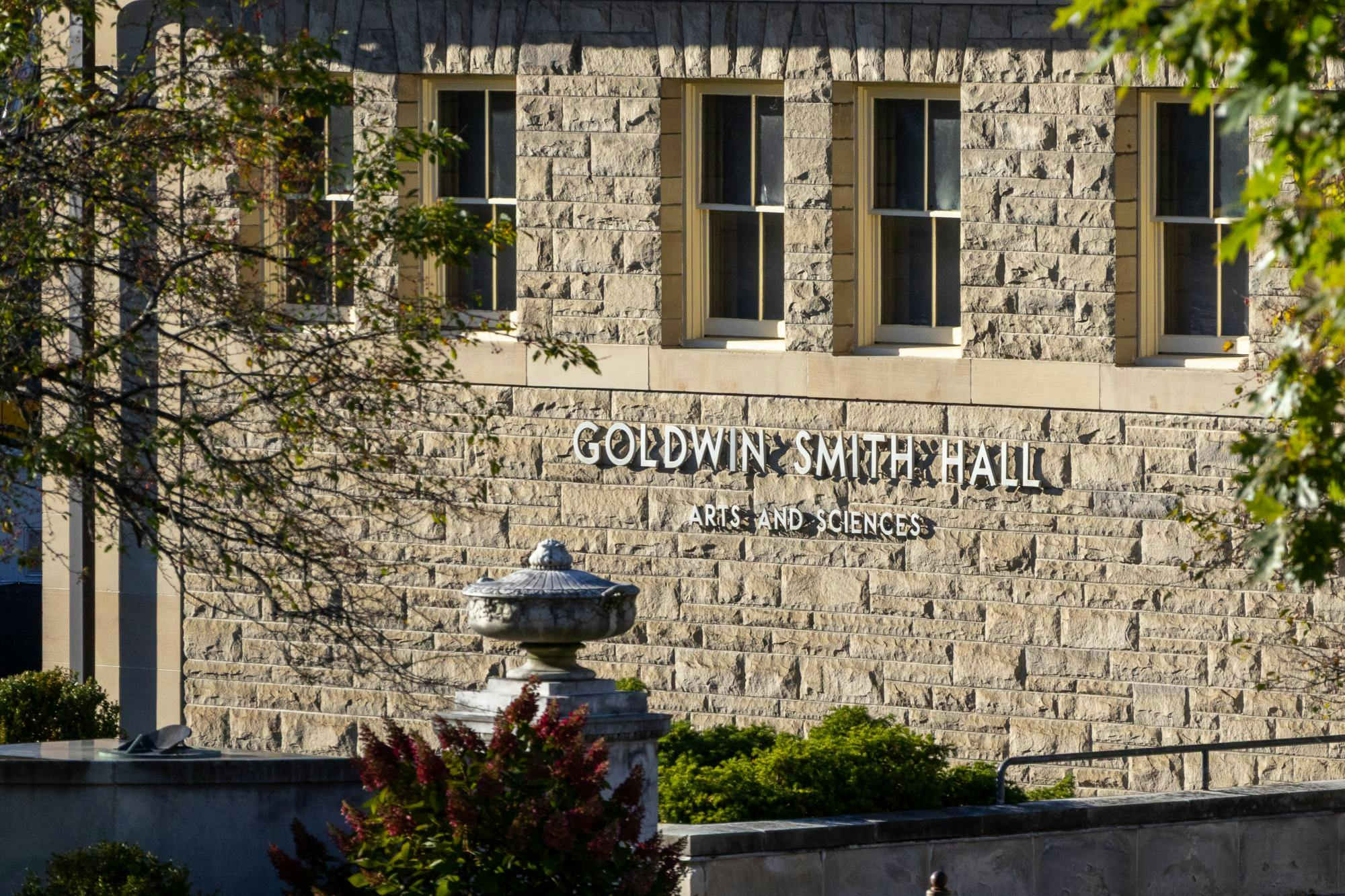
So, how am I, a woman, meant to feel when I spend nearly all of my time, as both a student in the College of Arts and Sciences studying English Literature, in Goldwin Smith Hall? Especially when the hall was dedicated in 1906, well after Smith made his misogynistic remarks.
I’m not the only one to feel disquieted by Smith’s legacy. There have been multiple pushes to remove Smith’s name from university happenings, over both his sexist comments and antisemitism. In 2020, his name was removed from professor titles, but the Board would not go so far as to remove his name from the building.
This begets the question: Why? Goldwin Smith was a professor here for only four years, a four years that happened long, long before any of us were even alive. I think many of us would be hard-pressed to even name a single achievement of Smith’s beyond having a building named after him.
Cornell has had a number of wildly impressive and certainly less controversial alumni who the building could take the name of. Why is it that the likes of Toni Morrison M.A. ’55 and Ruth Bader Ginsburg ’54 are relegated to having dorms named after them while Goldwin Smith continues to be honored with such a large and integral academic building?
While it is true that the University is not doing anything to actively celebrate Smith anymore, it is still a form of honor and remembrance to his hateful legacy every time I or any other student so much as says the name of his building. I might as well be saying, “Sorry, got to run! I have a class in the misogyny building.”
If the University was truly committed to its female students and their long and turbulent history at this institution, they would’ve long ago renamed the building or never had given it that name in the first place. Pull up a list of Cornell’s many influential alumnae and pick one. Genuinely any single one of them. Better yet, name it after one of the first women at this school who had to struggle so much and never even earned a degree. Jennie Spencer Hall has a much nicer ring to it.
Abigail Winsett is a member of the Class of 2029 in the College of Arts and Sciences. She is a staff writer for the Arts & Culture department and can be reached at agw66@cornell.edu.


