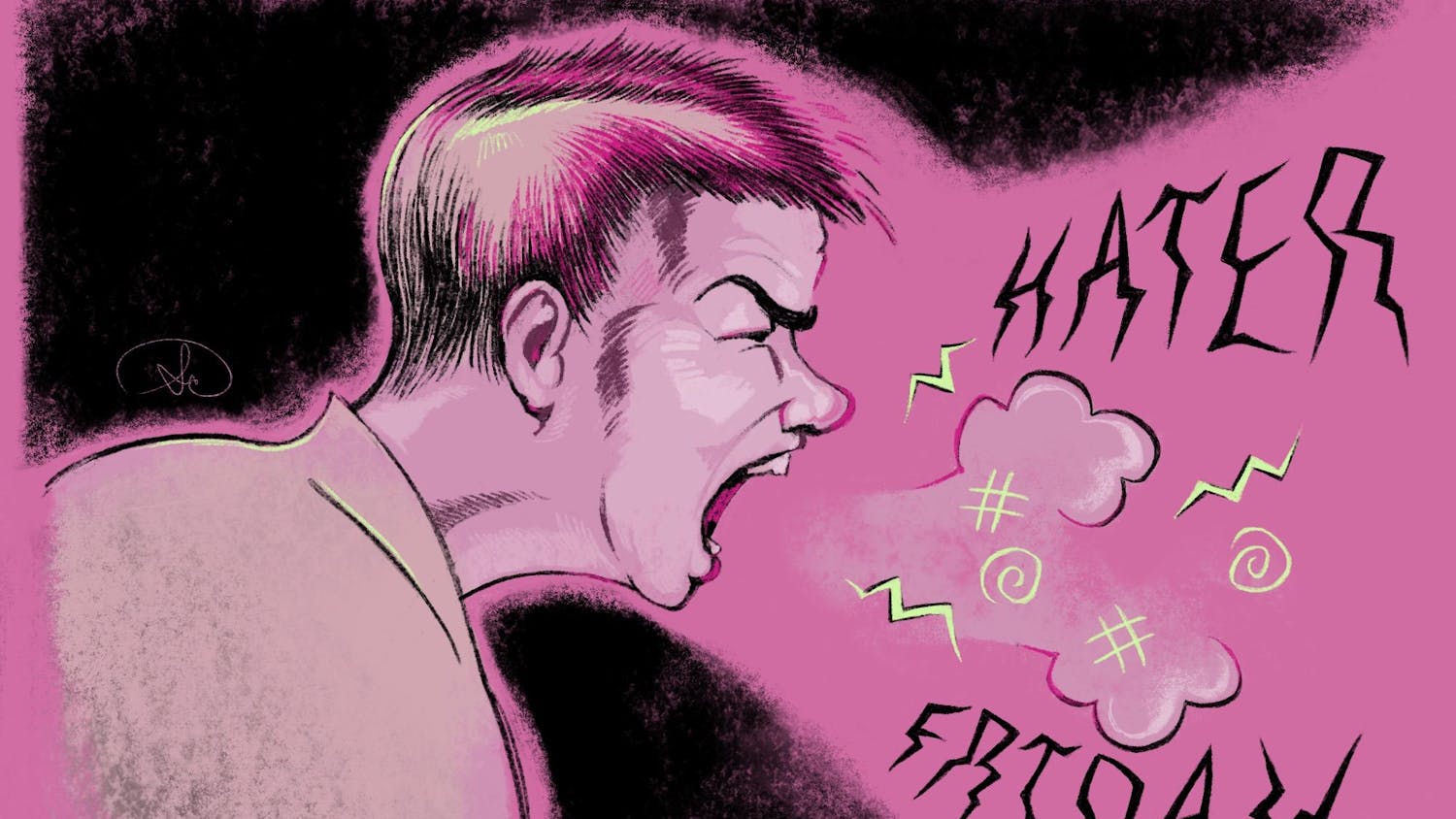
Epitome. Queue. Colonel. Buoy. Forte. Fuchsia. The one commonality between these four words is their inclusion on a list circulating on TikTok: “Words my bf can’t pronounce.” It has become a trend for users (mostly female) to film videos of their boyfriends or husbands, who are native English speakers, attempting to pronounce this long list of diverse words. When their significant others butcher the pronunciations, clearly struggling to read the list fully, the creators just laugh.
For something played off as a joke, it’s not very funny. The virality of the trend hinges primarily on how ludicrous some of these pronunciations are, delighting a barrage of TikTok users. Yet, the sheer volume of men who cannot pronounce two to four-syllable words has become concerning — especially considering most of these men are grown adults, ranging from their early 20s to mid-40s (and even beyond). Most have at least had some degree of high school education. Are you telling me they’ve never encountered the word “egregious”?
As with any video trend, the internet has jumped to point fingers, placing much of the blame on the men themselves. While this may be fair, societal aspects have been largely unconsidered, despite having definitely contributed. Literacy rates in the U.S. have been declining. In the 2023 Program for the International Assessment of Adult Competencies , 28% of American adults scored at the lowest level, showing poor literacy proficiency. Worse, the most recent rate is an almost 10 percentage point increase from 2017’s 19%, placing U.S. literacy capabilities below the international average.
Although these videos were made with a lighthearted intention, they reveal a serious literacy problem in our country. UNESCO defines literacy as the ability to understand text at a baseline level and make inferences. Counting skills are also considered an important aspect of literacy. Being proficient means interpreting what you have read and, in turn, retaining information that allows you to communicate understanding. Now more than ever, in the age of misinformation spreading through LLMs, AI and the internet, people must know how to absorb and apply information. Faced with a trend that highlights serious issues in adult literacy, the internet treats these problems as perfect humor. Literacy is a guiding protector against false narratives.
The skills that surround literacy are what make an English class indispensable to a child’s education. Novels such as F. Scott Fitzgerald’s The Great Gatsby are taught to showcase symbolism, underlying societal issues and subtext. Teachers assign essays not to torture students, but rather to boost how they personally decipher the author’s messaging. In the age of LLMs, students are easily able to bypass reading the book or writing the essay by relying on AI to do the work for them. While this saves time, using ChatGPT or Claude cheats students out of actually learning the skills.
Yet, AI alone does not explain our declining literacy rates. A large fault (perhaps the largest) is placed upon our education systems. As curriculum varies nationally, so do literacy rates. Massachusetts has the highest rate of childhood literacy, whereas New Mexico has the lowest. As education is decided on a state-by-state basis, the U.S. lacks a unified front in the face of illiteracy. Certainly, red state book banning is not helping matters by preventing teenagers from reading novels such as The Handmaid’s Tale, or The Bluest Eye. In 2023 Florida passed House Bill 1069, which banned classroom discussion on gender and sexuality for students through eighth grade. Thousands of books, such as The Hate U Give were pulled off shelves, paving the way for other red states to follow suit. These are books that typically write about serious matters such as racism and gender inequality, introducing complex themes and language usage.
The men participating in this trend are not children. They likely haven’t taken an English class for a couple of years to a decade. However, the education they received should have given them the tools to tackle new words. Part of reading and consuming literature is stumbling across unknown words. Skills taught in school should have equipped these men to read the word and take an educated guess at the pronunciation based on similar sounds. Even context — which, granted, the list lacks — can also help determine how a word is pronounced.
Many of the users making these videos see them as purely funny, showing no signs of alarm over their significant other’s poor literacy. Users will ignore the comments often expressing concern, albeit some more constructive than others, who opt for a more sarcastic approach: “Yay! My boyfriend can’t read woohoo!” There seems to be no sign of embarrassment or even a cognizant understanding of the backlash. Even the men themselves come across as indifferent to their own hindrance.
These videos, while portrayed as humorous, symbolize a declining grasp of literacy. As AI summaries become omnipotent, the skills needed to process and connect information become even more integral. Read a book. Look up a word you don’t know. Start using big words in your daily vocabulary.
Bolster your literacy skills. You need them now more than ever.

Kate LaGatta is a member of the Class of 2029 in the College of Arts and Sciences. She is a columnist for the Arts & Culture department and can be reached at klagatta@cornellsun.com.