

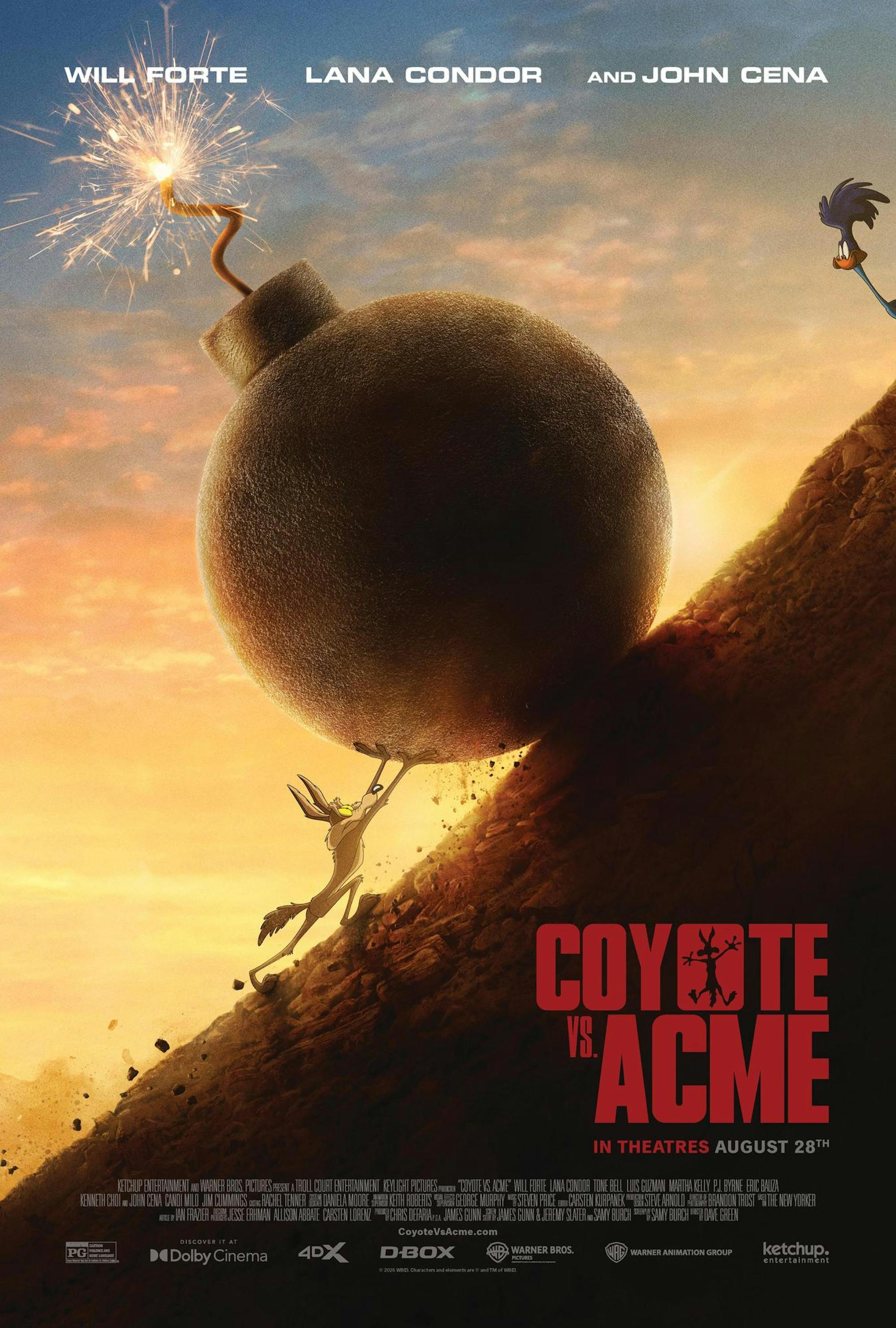
Coyote vs. Acme is a tale of unsuspecting heroines and classic villains. The audience is introduced to Wile E. Coyote (Eric Bauza) as an archetypal loser as he fails to catch his nemesis, a bird called Road Runner, with gadgets from the company ACME that continuously malfunction in embarrassing and seemingly impossible ways. However, after watching a commercial for a personal injury law firm named Avery, Jones & Maltese that claims his machines’ mishaps are not his fault, Coyote heads to Albuquerque, New Mexico to seek justice. Upon arrival, Coyote encounters the lazy and dejected attorney Kevin Avery (Will Forte) and his ambitious and bright-eyed niece/intern Paige (Lana Condor). When faced with Coyote and Paige’s desire to pursue a class action lawsuit against ACME, Kevin immediately dismisses the idea as impossible but is tricked into filing the suit by Coyote. The film then follows the trio’s efforts to fight ACME in court as they face internal rifts, the unyielding power of a monopoly and uncover clues that lead them towards uncovering the truth of why Coyote’s ACME gadgets perpetually fail.
Although the movie is a live-action/animated hybrid featuring numerous empirical impossibilities, the film felt more like reality than fantasy. The film’s central theme is how monopolies abuse their power to exploit consumers while corrupting the legal system to avoid responsibility. As someone who typically dislikes films that venture far beyond the scope of reality, the cartoonish elements of the movie blended seamlessly into the real-world plot rather than providing a distraction. Instead of relying on the absurdist humor often associated with cartoons, the film’s comedy centers on satirizing corporate power. This comedy is so effective because capitalist malfeasance resonates so deeply with the general public. It's often too difficult to separate satire from what is an accurate representation of real-world corporate corruption.
Furthermore, the film proves its relevance by tackling cultural issues, namely, whether big business is fundamentally American. In the courtroom, ACME’s defense attorney, Buddy Crane (John Cena), claims that the success of major corporations is intrinsically American by ascribing Coyote’s freedom to keep buying and subsequently failing with ACME products as symbolic of pursuing the American dream. On the other hand, the battle between Coyote, who has few resources or societal power, and the corporate monopoly ACME is a David vs. Goliath narrative which, in many ways, parallels the underdog tale of America’s fight against the British as well as raises the American ideal that everyone, regardless of their background, can achieve success.
This conflict brought to mind the Gilded Age, when the rise of corporate monopolies and the political, social and economic harms they inflicted on a large swath of society raised questions about whether monopolies had a right to exist under capitalism. The film has many explicit parallels to the era, most notably the pervasiveness of crony capitalism, the legal system’s unequivocal bias towards ACME and the emergence of class differentiation, represented by the difference in status between cartoons and humans. However, there is no need to turn to the past, as wealth inequality in the U.S. has significantly increased in recent decades, making a film about capital gone wrong increasingly likely to resonate with Americans today.
As someone initially skeptical of how engaging and relevant a live-action/animated hybrid film featuring Looney Tunes characters could be, I was thoroughly impressed. I was never once thrown off by the mix of the cartoon and human worlds, and found the corrupt corporate monopoly storyline captivating and relevant. The actors delivered comedy while keeping the plot plausible. John Cena and Will Forte both perfectly capture their respective roles as the corrupt corporate figurehead and the uninspired billboard lawyer. Meanwhile, Lana Condor’s stereotypical, ambitious young intern persona is a refreshing addition to their opposing, idiosyncratic personalities. Additionally, for a classic David vs. Goliath tale where I expected few genuinely unexpected plot twists, the film contained enough surprises and suspense to keep me on the edge of my seat. Furthermore, the ending struck a nice balance between avoiding complete wish fulfillment and still leaving the audience in high spirits. Overall, Coyote vs. ACME is an entertaining, hilarious and thought-provoking film that left me wanting a sequel.
Caroline Kelly is a member of the Class of 2028 in the College of Arts and Sciences. She is a contributor for the Arts & Culture department and can be reached at ckelly@cornellsun.com.


