

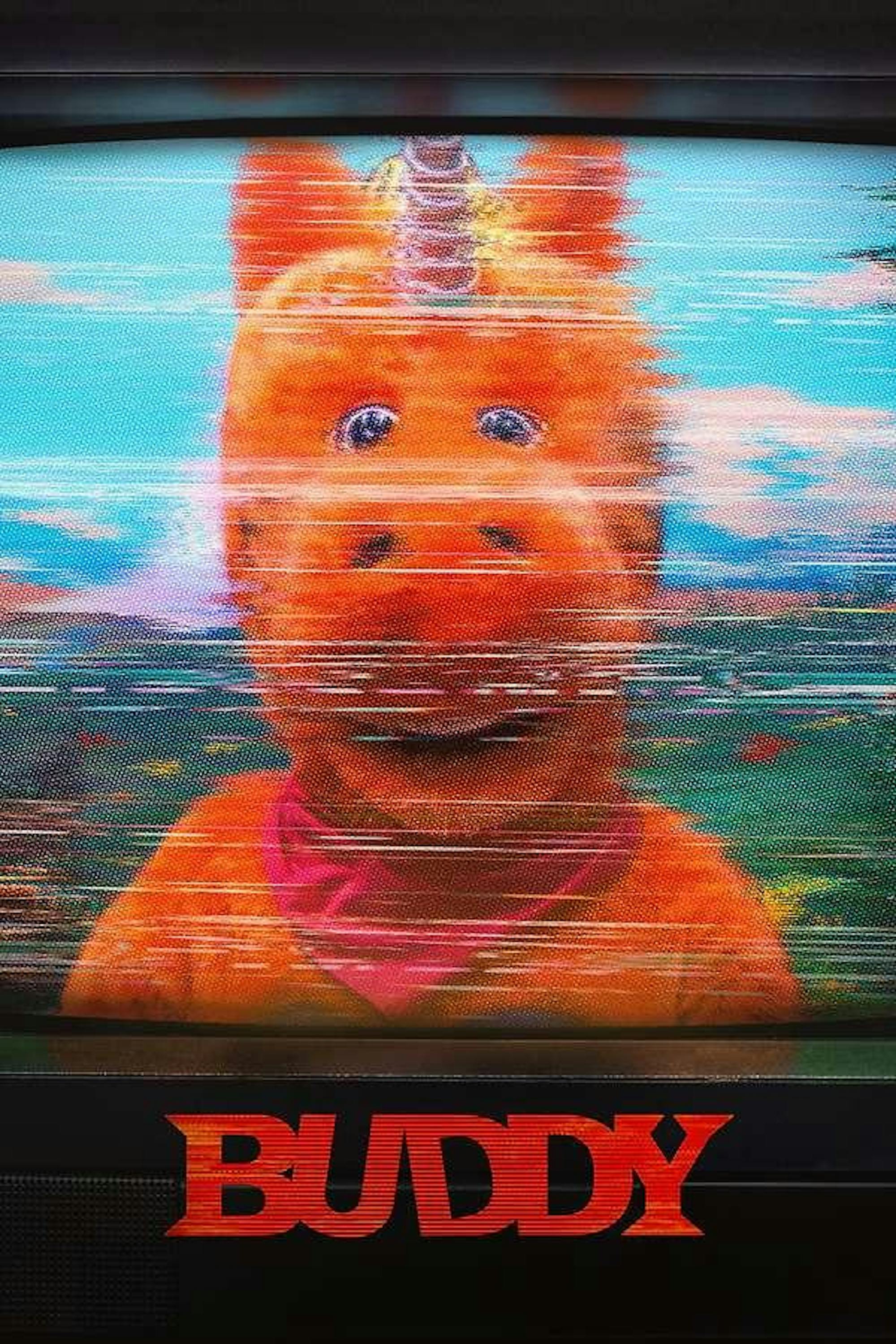
Remember It’s Buddy!, everyone’s favorite 1990s-style children’s show? Featuring a group of kids, anthropomorphic everyday objects, positive role model adults and a singing animal mascot that teaches important lessons? You might be thinking that this sounds more akin to the hit show Barney & Friends — but Buddy (2026) director Casper Kelly is here to jog your memory.
Buddy is a horror-comedy film with a plot primarily taking place inside a fictitious in-universe show (that nobody seems to remember) called It’s Buddy! In the movie’s opening sequences, the viewer is guided through a typical episode: There’s a colorful opening montage, a group of kids at a clubhouse, friendly sentient objects (including Patton Oswalt as a talking backpack named Strappy) and helpful grown-ups like Nurse Nancy and Mailman Miles. Then, of course, there’s a minor conflict that must be resolved with the help of Buddy (voiced by Keegan-Michael Key), an orange anthropomorphic unicorn who teaches the children valuable lessons about life and friendship through the power of educational songs. Finally, Buddy says, “That’s all the time we have,” the kids hug him and the credits roll. Everything resets and a new episode begins.
The world of It’s Buddy! seems perfect — that is, until one of the children, Josh, refuses to play their assigned part, making Buddy increasingly enraged. When Josh disappears and a replacement child materializes out of nowhere, the characters of the show become suspicious of their magical pal’s true intentions. What follows is a bizarre fever dream that is equal parts darkly comedic and existentially terrifying.
Casper Kelly has a track record of twisting American media nostalgia into works of absurdist horror. In his surreal Adult Swim short Too Many Cooks (2014), available to watch on YouTube, he parodies old sitcoms with an extended opening credit sequence that blurs genre lines and escalates into madness as a slasher villain murders the members of the cast. With Buddy, his first theatrically-released film, the question was whether Kelly could translate a similar concept from short to feature length. And, thanks to a few tricks up his sleeve, he largely succeeds in weaponizing our nostalgia for children’s media — a uniquely uncanny thing when viewed through adult eyes.
Kelly never ventures into the dangerous territory of dragging out the premise in an attempt to pad the runtime. He reveals his hand early (or at least what he wants you to think is his true hand): The child stars of It’s Buddy! quickly realize that Buddy is a malevolent force and attempt to escape from the picturesque, beautifully-constructed set of the television show. With the life-or-death stakes already revealed in the first act, the viewer may wonder how Kelly can possibly sustain this premise without it becoming unbearable by the time the (true) credits roll.
Enter a new character, Grace, played by Cristin Milioti, who is introduced separately from the events playing out within It’s Buddy! and serves as the closest thing to an audience surrogate as she investigates the mystery of the show. In a role that otherwise isn’t written with much depth, Milioti’s performance genuinely establishes a strong emotional anchor for the film.
Another smart move from Kelly is in his writing and direction of the child actors. Once the kids embark on a journey to escape the clutches of Buddy, with shot-for-shot references to masterpieces like The Wizard of Oz (1939) and The Night of the Hunter (1955), Kelly allows them to not only react to the confusion of the situation, but also to go through experiences that thrust them into a more mature world — such as learning about swear words, experimenting with drugs and confronting the nature of death and getting older. In this way, Kelly is able to sneakily pivot from experimental slasher into a psychedelic coming-of-age story set in an abstract world.
As the film progresses and several narratives collide, the script by Kelly and co-writer Jamie King never stops to heavy-handedly explain the premise to the audience — a pitfall that many similar films fall into, including this year’s Backrooms. Instead, the viewer must figure out how to escape Buddy’s hellish playground along with the protagonists. Whenever Buddy seems to run out of steam as an antagonist, he undergoes some sort of change or transformation to keep things fresh. With a brisk 96-minute runtime, the movie never overstays its welcome and arrives at a satisfactory conclusion.
Ultimately, Buddy is an impressive display of talent in uncharted territory for Casper Kelly, who is further making a name for himself in the field of reality-distorting horror-comedy. Though it certainly won’t appeal to everyone, it deserves to exist in the broader conversation of 2026 horror films despite not belonging to a franchise or smashing the box office in the manner of something like Obsession (2025). If you want a film with a vibrant color palette, fun gore effects and jokes that will make you feel as though you’ve been laced with hallucinogens, look no further than Buddy. You might just cry over an anthropomorphic mailbox.

Colton Sears is a member of the Class of 2028 in the Nolan School of Hotel Administration. He is a staff writer for the Arts & Culture department and can be reached at cds284@cornell.edu.


