

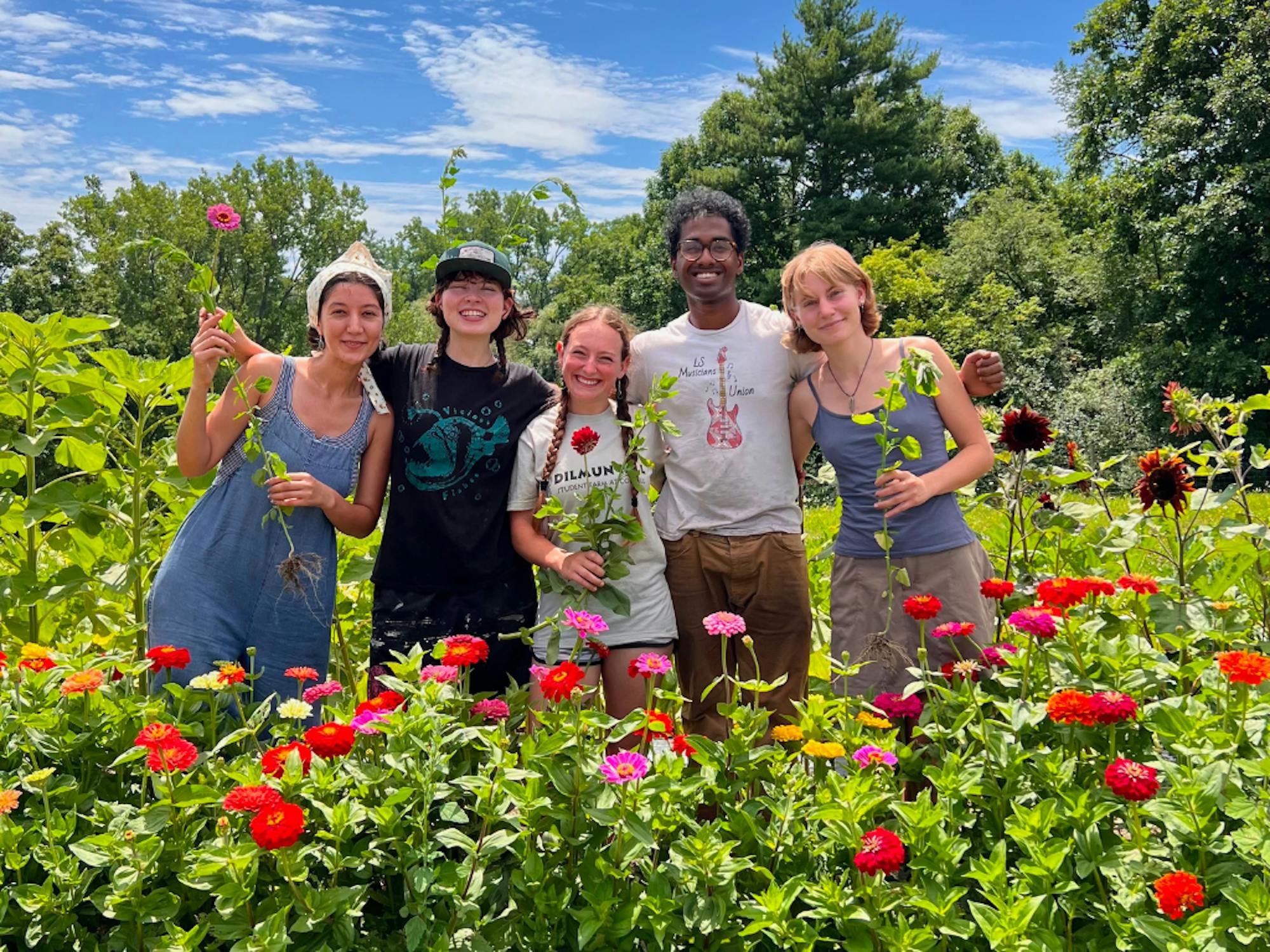
While some students spent their summer in offices, the student managers at Dilmun Hill Student Farm worked full-time growing produce for the Ithaca community.
The farm’s philosophy is to “learn by doing,” and that’s exactly what the students did.
The students — four full-time managers responsible for the farm as a whole and one part-time agroforestry manager — were involved in every step of running the farm. Before beginning full-time work in the summer, they spent the spring deciding which crops to grow, mapping where to plant each crop and ordering seeds. By May, it was time to prepare the fields: tilling and harrowing the soil, making beds and laying drip tape and landscape fabric.
“These were all just dirt and tarp,” said this summer’s student manager, Masha Avrutsky ’29, gesturing to fields and raised beds that were filled with fruits and vegetables. “Some of our crops were transplanted, meaning we started them out in a greenhouse and then we put the plants in the ground, versus some other crops were direct[ly seeded] in the ground.”
The students learned which crops to transplant and which to seed directly as they worked on the farm, rather than through a formal classroom setting. Students of any major can be managers, and at Dilmun Hill, most farming skills are learned on the job.
According to the student managers, Dilmun Hill harvested over 3,700 pounds of produce and grew 32 types of crops spanning 150 varieties as the students participated in the learning-by-doing practice this summer.
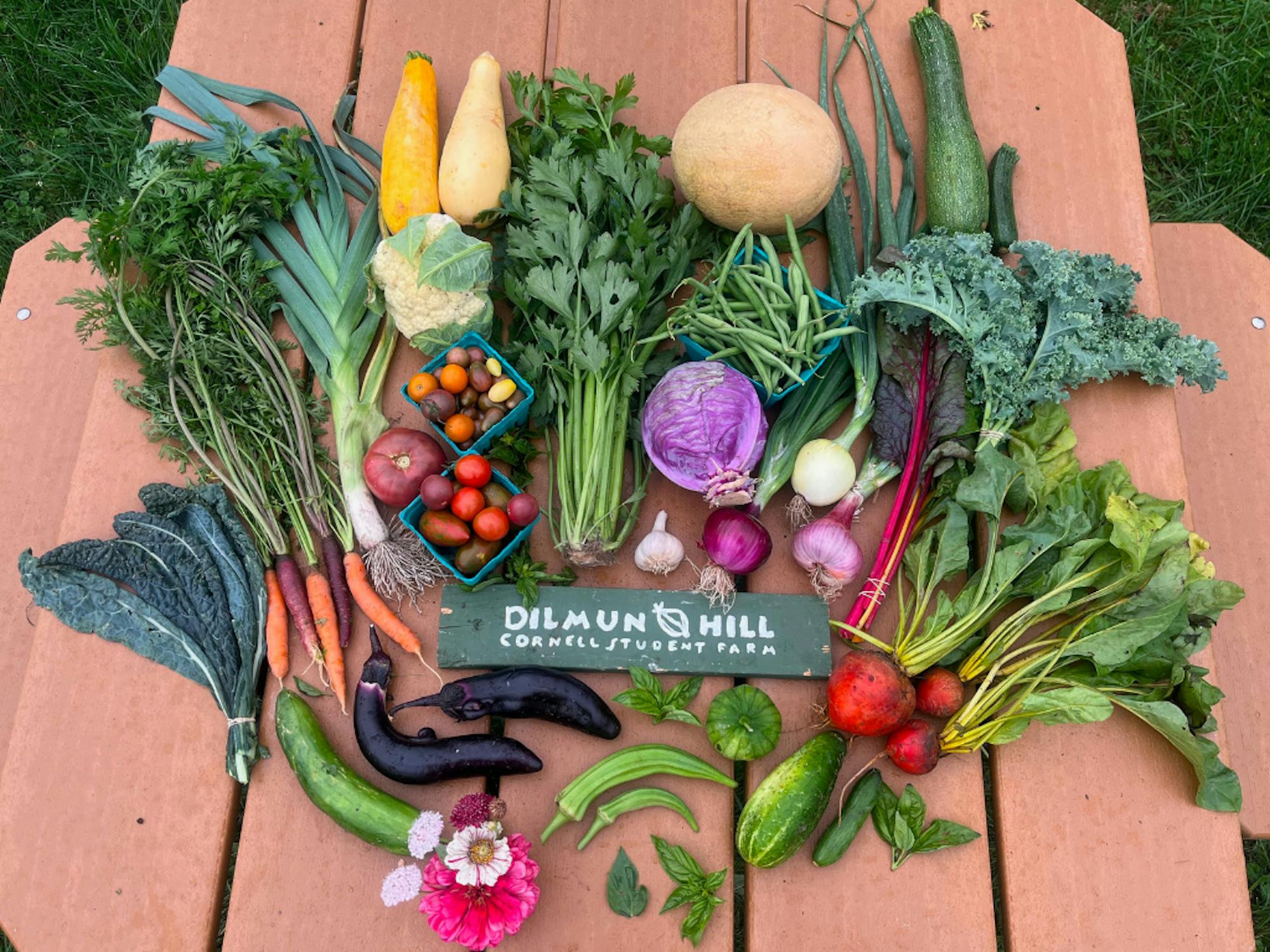
Dilmun Hill harvested over 3,700 pounds of produce and grew 32 types of crops spanning 150 varieties this summer. Provided by Bryn Terwilliger '27
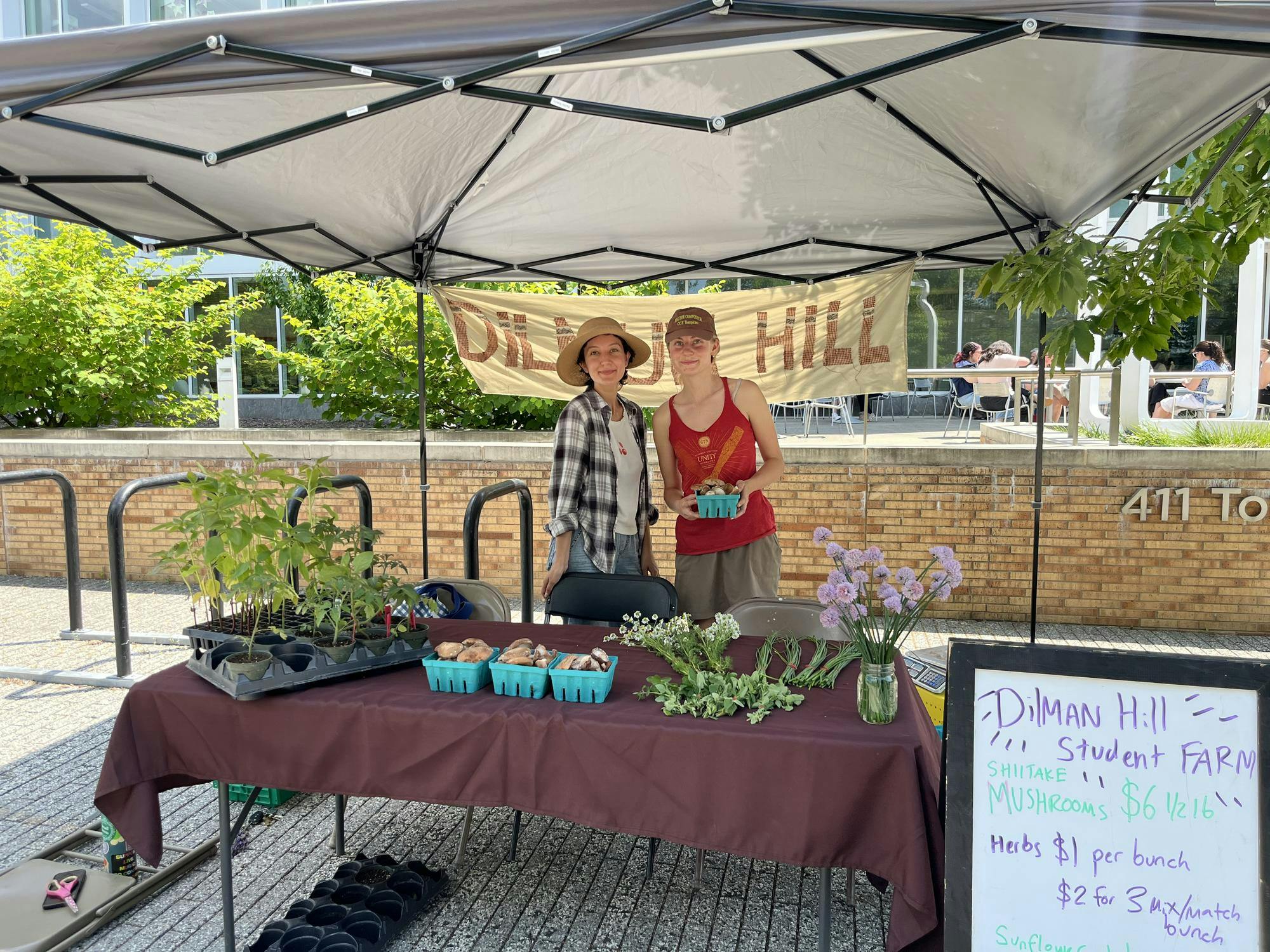
The produce was distributed at market stands around Ithaca and through Community Supported Agriculture, a program through which individuals buy shares of the farm and receive weekly portions of the farm’s harvest. In addition to markets and CSA, Dilmun Hill also donates produce to the Friendship Donations Network and sells it through Anabel's Grocery, the on-campus nonprofit grocery store aimed at addressing food insecurity at Cornell.
From Classwork to Farmwork
For students in the College of Agriculture and Life Sciences, working at Dilmun Hill is a way to experience firsthand what they learn in the classroom.
Avrutsky, who studies global development in CALS, was able to explore an interest in companion planting — or growing specific crops side-by-side — by growing basil throughout the farm to prevent pests.
Bryn Terwilliger ’27, a 2026 student manager and an agricultural sciences student, applied classroom knowledge of soil science to understand how the soil at Dilmun Hill holds water or dries out.
“We have three different types of soils on the farm, so that’s a very important thing to know how to manage,” Terwilliger said. “It was really important that I learned all of these things in my class, and it was really fun, too, because what I do at the farm … helps me to have more of an understanding.”
Working at Dilmun Hill also allows students to better understand challenges faced by farmers, which might feel distant or abstract in a lecture hall.
“Just working, being a farmer, I think about, ‘Oh, my crop is not growing so well … how is this going to affect me?’” said Shabana Mahdis ’29, a 2026 student manager and global development student. “So it's like putting yourself in the position of those people that go through those challenges … and facing those challenges in real life that you learn [about] in your classes.”
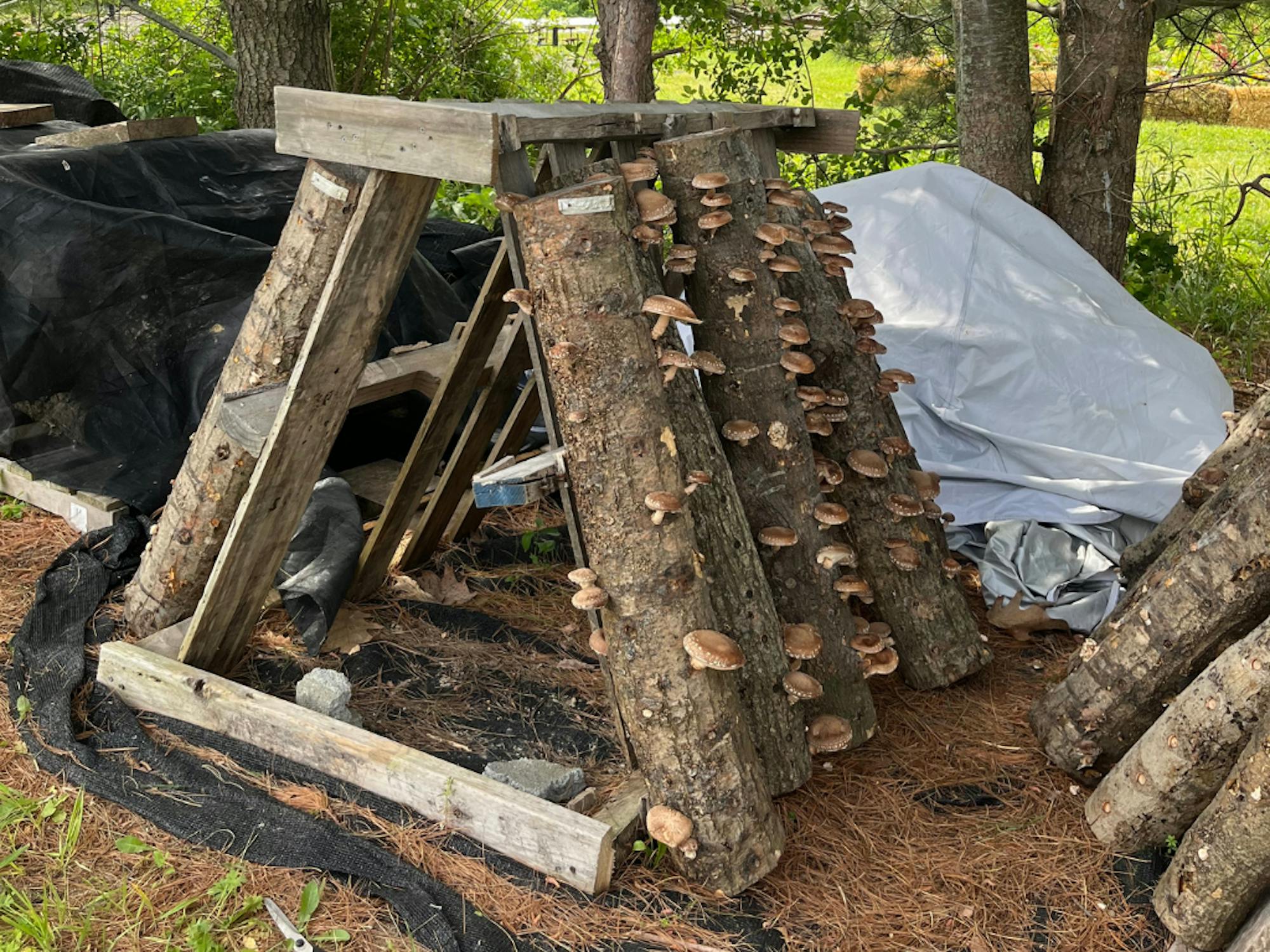
Dilmun Hill’s part-time agroforestry manager position especially calls for synergy between coursework and farmwork. This summer’s agroforestry manager, plant science student Jane Gugerty ’27, was responsible for specialty and perennial crops, including shiitake mushrooms and pawpaws.
Students outside of CALS can also manage Dilmun Hill through the lens of their major. Kannan Chockalingam ’28, who is majoring in economics, took an interest in the operations side of the farm, streamlining workflows for farm managers to improve efficiency.
“I feel like farms are the purest [business] you can have because you're exposed to production, the distribution, the marketing, the sales, every step of the supply chain,” Chockalingam said. “It just makes you very focused on how to achieve maximum operational efficiency.”
These opportunities to implement textbook knowledge gave students freedom to test their ideas and lead initiatives.
“We can have our little individual projects … if you want to grow something on the farm or if you want to try something new, you’re allowed to do that,” Terwilliger said.
Thirty Years of Student Impact
Independent projects are just one piece of the broader picture of student leadership at Dilmun Hill. Managers’ principal task is to work collaboratively as decisionmakers and leaders to run the whole farm, a student-run model that gives undergraduates a unique level of ownership over such a large-scale project.
“There's not many opportunities for people our age to make decisions, like big decisions, and tell other people what to do and manage something,” Avrutsky said. “I think the student-run model makes for a more decisive population of people.”
Working as a student manager can have benefits well beyond the farm, from developing decision-making and collaboration skills to helping students find clarity in their career path. Avrutsky entered Cornell with an undecided major, and working at Dilmun Hill led to a passion for food systems and the eventual decision to major in global development.
For other students, the farm provides another kind of benefit: a place of refuge from the demands of academic life.
“A lot of students and faculty tell me that [Dilmun Hill] is a place they love to go to get away from the stresses of school and real life and just really connect with nature and the Earth,” Terwilliger said.
Dilmun Hill celebrates its 30th anniversary this year, and although its footprint has grown from three to 12 acres, its mission to provide students with the opportunity to “learn by doing” remains the same. Looking to the future, the student managers hope that this mission will continue to connect the Cornell community not only to nature and food systems, but even to Ithaca itself.
“As people who are moving here and living here, I think it's important to get to know the place you live, and there's a very vibrant food scene in Ithaca,” Avrutsky said. “This is one of the very special places to learn about that food scene and become more connected with it.”


