

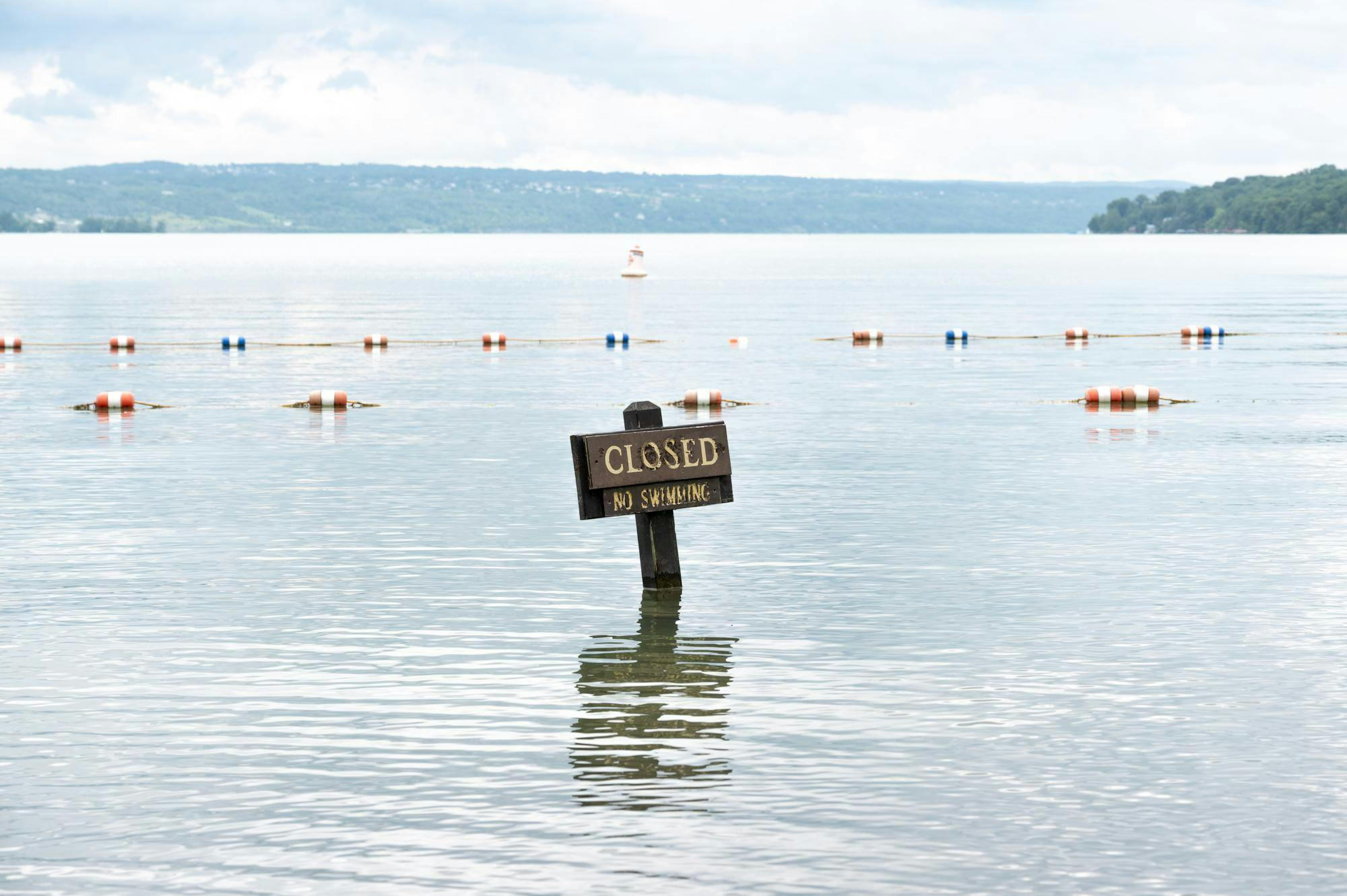
Plans for an AI data center drawing water from Cayuga Lake were met with heavy opposition from local activist groups before a state moratorium in July halted plans. But, the moratorium lasts for only one year. After its expiration, plans for the center could resume.
The Sun spoke with experts and local activists to break down the science behind how this data center could impact the ecosystem if construction were to proceed — and to learn about why groups are pushing for stricter regulation beyond a temporary moratorium.
Cayuga Lake Environmental Action Now! and No Data Center FLX, two such groups, emphasized concerns surrounding noise pollution, increased temperatures, water loss and runoff impacting the ecosystem of Cayuga Lake.
“If the project in Lansing goes through, 24/7 noise from fans cooling their equipment is projected to impact wildlife and humans on both sides of the lake,” No Data Center FLX wrote to The Sun.
Noise Pollution Harms Local Residents and Wildlife
Prof. Steven Jackson, information science, who has researched the impacts of bitcoin mining on Seneca Lake, emphasized that the noise and air pollution of the data center construction would affect the surrounding neighborhoods, as well as the nearby bird sanctuary.
A recent study highlighted that birds are especially vulnerable to noise pollution because they rely on sound for communication and information, and found that noise “significantly impacts” reproduction, communication, foraging behavior and physiology — even altering birds’ hormone levels after exposure.
“Noise has been a central concern in many other places that we’ve seen data center development,” Jackson said, pointing to reports “from very blue states to very red states around local communities being negatively affected by local data center development.”
Residents who live near data centers have reported sleep deprivation, insomnia, headaches, internal ear pressure and anxiety.
John Dennis, one of the founders of CLEAN!, emphasized that many would be affected from the proposed Cayuga Lake center due to its proximity to residential areas.
“Low frequency noise penetrates houses quite readily and the nearest house is less than half a mile [away],” he wrote.
A 2026 study showed that excessive noise from data centers can have a range of mental and physical health effects. Since the brain is constantly monitoring sounds for signs of danger, even during sleep, frequent or loud noise may lead to anxiety and stress in the short term. Long term exposure is associated with cardiovascular, cognitive and mental health impacts.
No Data Center FLX also pointed to noise complaints from TeraWulf’s data center operations in other locations.
“In Somerset, NY [TeraWulf] operates a bitcoin-turned HPC AI data center and residents have been complaining of the noise since their operations started,” No Data Center FLX wrote to The Sun.
Water Withdrawals Increase Temperature, Disrupt Environment
In addition to noise concerns, water withdrawn to cool the center can have harmful impacts to the environment.
“One effect [of water withdrawal] is potential [increases in] lake temperature and that connects to concerns that we’ve seen in aquatic ecology of the area such as harmful algae blooms,” Jackson said.
After circulating through a data center’s cooling systems, water discharges back into the surface waters at high temperatures, according to a study from ScienceDirect. This warmer discharge water increases the overall temperature of the lake, promoting harmful algal blooms.
Algal blooms occur when toxin-producing algae excessively grows in a body of water. The growth produces toxins that make people and animals sick, and they thrive in warmer water temperatures, according to the National Institute of Environmental Health Sciences.
Meghan Brown, a professor who specializes in aquatic biology at Hobart & William Smith Colleges, emphasized the potential effects of temperature pollution in Cayuga Lake if the data center were to use a million gallons of water per day for cooling.
“Some organisms have a really narrow temperature they can exist at,” she said. “Think about how organisms that we as a community tend to promote and like having in our lakes [would respond to temperature pollution].”
Cold-blooded species such as “insects, reptiles, and fish are highly vulnerable because their metabolic rate is tied to their body temperature, which is dependent on the temperature of the environment,” according to a study by the University of Michigan and National Oceanic and Atmospheric Administration.
Both Jackson and Brown would like to see further testing done on Cayuga Lake to ensure that the withdrawal of water would not harm the ecological environment.
Construction Concerns
Runoff into the lake from the center’s construction is another point of concern due to the coal ash landfill — once a coal-fired power plant turned landfill — situated uphill from the proposed data center site, according to No Data Center FLX.
“Their site plans also include new power lines through wetlands which can lead to compaction, increased runoff, reduced water holding capacity of the wetlands, permanent alteration of the wetland habitat, etc.,” No Data Center FLX wrote to The Sun.
Dennis warned of a detail many may be unaware of regarding the consequences of constructing the Cayuga Lake data center.
“[TeraWulf] is proposed to carve out a [more than] 20-acre level building platform from a forested hillside” to build the center, he wrote.
He noted that this hillside is directly downstream from a non-lined industrial waste landfill and is only half a mile away from the smokestacks of a coal plant that operated for over 60 years. Due to this, he added that flattening these 20 acres would likely dislodge a lot of contaminated sediment that may have PAHs — carcinogenic hydrocarbons associated with industrial chemical or fossil fuel plants — and heavy metals.
The chemical runoff into the lake would be absorbed and accumulated into freshwater organisms, potentially affecting the overall food web, a process known as biomagnification. As these toxic contaminants accumulate in organisms’ fatty tissues, they transfer to larger predators upon consumption and result in higher concentrations of chemicals in their bodies than in the surrounding environment.
Dennis emphasized that any “contamination of Cayuga Lake” would impact “the drinking water supply of about 100,000 people.”
Brown and No Data Center FLX also pointed to potential strains on the power grid, as well as increased prices, since TeraWulf’s proposed center would have a capacity of 400 megawatts.
“Data centers have a very different impact on our grid as they are concentrated in one location, place constant instead of transitory demand on the system, and cause sudden large impacts on market prices,” No Data Center FLX wrote.
Current State: Lawsuits and Pushback
No Data Center FLX and CLEAN! are currently suing TeraWulf and the Lansing Board of Appeals for the center’s current classification as a “general processing facility.” This term is not defined in Lansing’s zoning code, expediting development and potentially circumventing environmental or zoning restrictions.
“The lawsuit proceeding seeks to correct fundamental errors of law and violations of lawful procedure by Lansing ZBA in adopting an interpretation of the town’s zoning ordinances,” No Data Center FLX wrote.
Dennis hopes that the pushback of the data center will work in their favor. He explained that TeraWulf may not be able to handle a lawsuit with debt already accumulated.
“[TeraWulf] is a former bit-coin mining company on the lake. They have a lot of debt and [are] losing a lot of money, so it’s possible the company won’t survive a major shakedown in the data center industry,” he wrote.
With the moratorium now in place, Jackson and Brown as well as No Data Center FLX hope that Gov. Kathy Hochul and others will continue to take steps to protect ecosystems such as Cayuga Lake long term.
No Data Center FLX encouraged local residents and those who are interested in becoming active in environmental issues to participate in standing up against TeraWulf’s project.
“We are hoping people around this area will be inspired to stand up against a Maryland-based company,” No Data Center FLX wrote. “We do not believe they have our best interest in mind …. We encourage anyone who feels strongly about this to attend and witness the Planning Board meetings in Lansing, as they are open to the public.”


