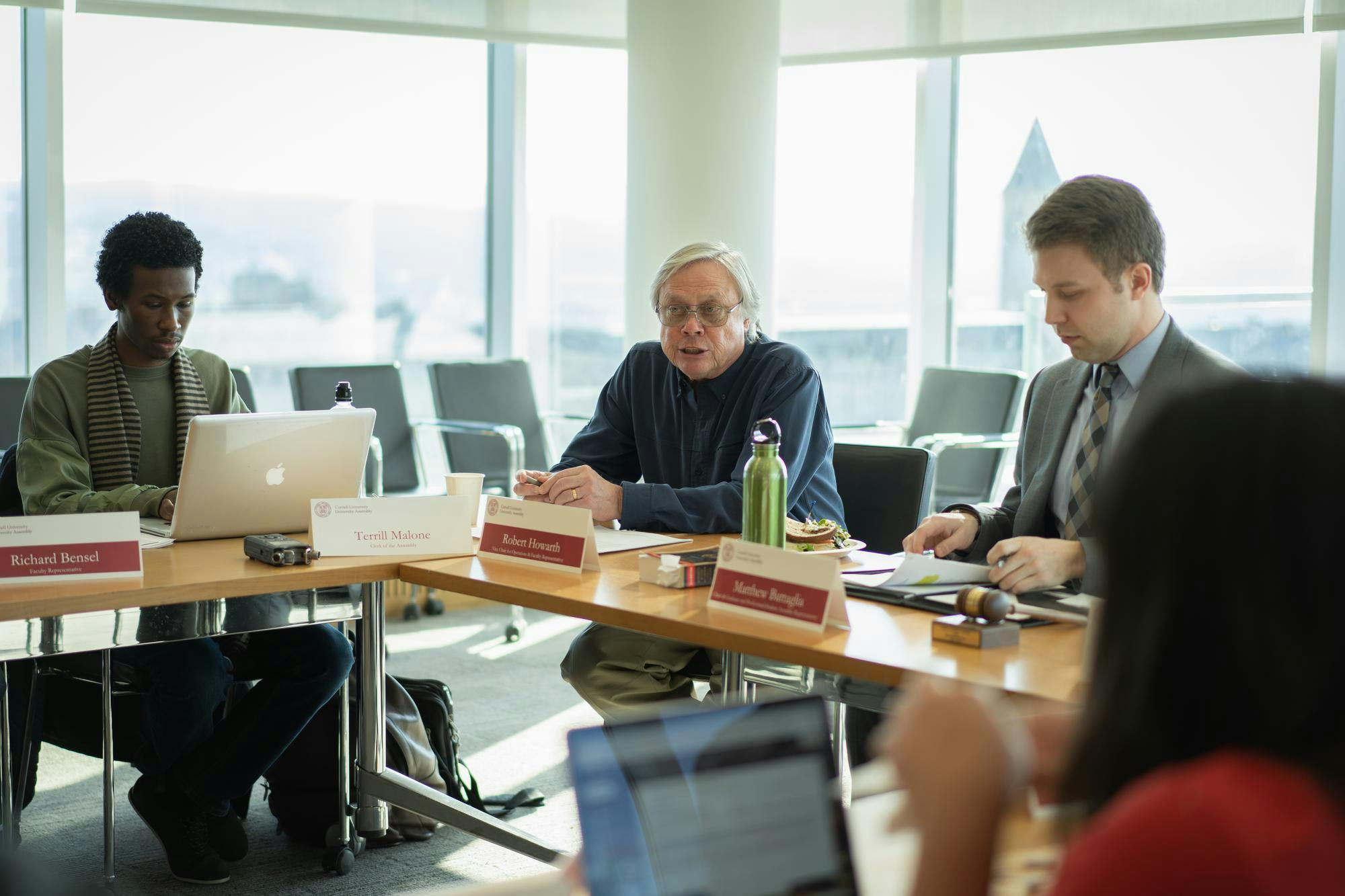
After three decades of teaching and renowned global research impact, Prof. Robert Howarth, ecology and evolutionary biology, will retire in December.
For Cornell students, Howarth was best known for teaching BIOEE 1610: “Introductory Biology: Ecology and the Environment,” but his work expands beyond campus to encompass science in education and policy efforts.
As he wrapped up his last semester teaching BIOEE 1610 in the Spring 2026 semester, The Sun spoke to Howarth about his career as an impactful figure in the world of environmental science.
Catalyst for Global Change
From making Time Magazine’s 2011 list of “People Who Mattered” to being featured in The Wall Street Journal as “someone fossil fuel companies should fear” for outraging fracking industry executives with the political influence of his research, Howarth’s work has powered changing minds.
“I like the challenge of answering a question,” Howarth said. “But I also like pulling science together, synthesizing science in a way that can have impact in the policy world or with the public.”
Exploring solutions to the most pressing climate catastrophes of our time through the lens of biogeochemistry, ecology and other intersections of environmental science has brought Howarth’s work to light at the international stage. With decades of building policy connections upon the backbone of climate science, he has increasingly integrated research and advocacy over the course of his career.
In 2007, while working on coastal nutrient pollution from agriculture, Howarth testified in federal court as “one of the key witnesses” in a case that got offshore oil banned off the coast of New England and then the entire Atlantic coast.
At this time, Howarth began facing political pressure and threats of funding cuts from companies like ExxonMobile.
“One day, I got a telephone call from the director of the lab I was working in. And he basically said that I was causing them problems with raising funding from Exxon. And I had to stop. I couldn't do this line of work anymore,” Howarth said.
Refusing demands to strictly focus on science and decrease visibility in the policy world, Howarth moved to a tenured position at Cornell.
Before that, the U.S. Senate had charged the National Academy of Sciences to examine nitrogen pollution in Chesapeake Bay and phosphorus pollution in the Mississippi River. Appointed as the chair of the investigation committee in 1998, Howarth spent two years testifying before the Senate to provide urgent updates which resulted in President Bush signing an executive order to confirm the impact of nitrogen in 2001.
In addition to being one of the most highly cited marine scientists in the world, Howarth has also been involved in energy policy. Examining methane from natural systems was part of his Ph.D. work, and at the time it was seen as an engineering challenge that had not been previously worked on.
The Power of Policy
Students of BIOEE 1610 get a snapshot of the policy work that Howarth engages with, but this arena carries influence across the globe.
Howarth has also tackled nutrient pollution issues in coastal oceans and lakes. His research provided clarity on the nutrient most responsible for polluting coastal oceans — nitrogen — which has policy implications.
“Once you accept that it’s nitrogen in coastal oceans versus phosphorus [in lakes], then you start taking on different management practices,” Howarth said.
Howarth had also been a co-chair on the Scientific Committee of Problems of the Environment that dealt with issues as a standing body of counsel of science, its work culminating in an international scope nitrogen project.
“That’s had a huge influence on how people think about nitrogen, both in the science world and in the policy world,” Howarth said.
In 2009, Howarth worked with Prof. Emeritus Anthony Ingraffea, civil engineering, to publish the first peer-reviewed academic paper that highlighted the massive greenhouse gas footprint of methane emissions from shale gas fracking.
Since then, Howarth has continued working in the policy interface with focus on why methane emissions make exports of liquified natural gas from the United States problematic. Howarth’s research was cited by President Joe Biden when he decided to pause new approvals of LNG exports from the United States in 2024.
“He writes these papers that make fossil fuel companies quake in their shoes,” said Kathryn Lajtha, a professor at Oregon State University who collaborated with Howarth on the journal that he founded, Biogeochemistry, from 1983 into the early 2000s.
“We make the mistake of spending too much time in our own lane,” Lajtha said. “In many ways, Bob was ahead of the curve.”
The Journey to BIOEE 1610
Originally from New Hampshire, Howarth became interested in the environment early in life, and was driven by curiosity to solve puzzles through research. This spark grew during a summer internship after his junior year at Amherst College with George Woodwell, founder of the Woodwell Climate Research Center.
Woodwell was a pioneer in pushing the ban on DDT, a chemical commonly found in insecticides that poses major health risks. Howarth drew inspiration from his advocacy efforts and considered Woodwell a key role model.
“I worked with him for a summer and came away thinking I wanted to do what he did: ecological research but also getting the information out into the public and into the policy arena,” Howarth said.
After getting a bachelor’s degree in biology in 1974, Howarth received his Ph.D. in biological oceanography in 1979 through a joint program between the Massachusetts Institute of Technology and Woods Hole Oceanographic Institution. There, he met his wife, Roxanne Marino Ph.D. ’01, who has been a key partner to him throughout his career. Howarth stayed in the area to do a post-doctoral fellowship with Woodwell at the Marine Biological Laboratory at The Ecosystems Center.
At Cornell, Howarth has been the David R. Atkinson Professor of Ecology & Environmental Biology since 1993. He had not expected his career to take him into a teaching role.
“I wanted to be a research scientist who worked on ecological science,” Howarth said. “I never envisioned becoming a professor.”
After studying methane from natural systems as part of his Ph.D., he followed the field and has taught courses with emphasis on his methane research, including the graduate course BIOEE 6680: “Principles of Biogeochemistry.”
But Howarth is more well-known for teaching the undergraduate course, BIOEE 1610. When Howarth began teaching the course in 1986, introductory-level ecology was two separate courses: one for science majors and one for non-science majors. This setup created a tradeoff between scientific ecological details and broader environmental ramifications, each resulting in imbalanced exposure to learning materials.
“I thought we were short-shrifting the non-science majors,” Howarth said. “We weren’t really telling them enough about how science works.”
Howarth successfully argued that everyone should understand the importance of their particular science interests to the real world and the class has been combined ever since. BIOEE 1610 is now a required course for biology and environmental sciences students, primarily taken by freshmen.
Within the course, Howarth brings in international policy current events, said Kathy Stenehjem, a Ph.D. candidate in ecology and the head teaching assistant for BIOEE 1610.
“He’s very passionate about teaching [and] bringing his research into the realm of environmentalism and using it to inform environmentalism,” Stenehjem said.
Stenehjem emphasized the abundant resources and flexibility he gives TAs as they learn to lead their own discussion sections.
“He really wants everybody to understand [and] to make sure the lectures are approachable,” she said.
Howarth also emphasized the critical need for all students to examine the role of ecology in science to guide their understanding about the pressing climate challenges of our time.
“I like teaching both to the people who are going to go on to the field, the scientists, but also those non-science students,” Howarth said. “Whether or not you’re going to be a scientist, you’re going to be a citizen.”
With his adjunct appointment at Woods Hole, Howarth will continue observing the coastal harbor that has been severely damaged by nitrogen pollution for the past 25 years. Funded by a grant from the National Science Foundation, he will serve as the project lead.
Through Cornell, he has received a grant from the Park Foundation to continue working on communication efforts towards methane and climate issues during his retirement.
Howarth will also focus on the status of toxic cyanobacteria blooms in the Finger Lakes, where blooms were not significant until about 10 years ago, according to Howarth, to increase understanding around the blooms’ origins and current trends. Despite no longer teaching at Cornell, he will continue working in the ecology realm.
In the spheres of research, policy and education, Howarth has persisted as a strong advocate, standing his ground in supporting climate sustainability. He continues to pave the way for a new generation of scientists.
Leah Chang is a member of the Class of 2028 studying environment & sustainability in the College of Agriculture and Life Science. She is a staff writer for the science and technology department and can be reached at lchang@cornellsun.com.