Have you ever spent a late night in the Physical Sciences Building? If so, you’ve definitely heard a combination of footsteps on the ground, but not just the ones passing by, finding a place to study. Instead, the footsteps have a rhythm to them, partnered with the unmistakable call of “five, six, seven, eight!” In the open areas next to Goldie’s Café, you’ll find the real beat of Cornell’s campus: its dance teams. Members tend to occupy PSB at any hour past 9 or 10 p.m., searching for a sense of rhythm amid the demands of their chaotic academic lives. Through this, dance has stuck with us, serving as a poignant reminder that intense work yields a well-deserved result.
At Cornell, dance teams operate on a level of intensity that most people don’t fully see from the outside. What looks like a polished, high-energy performance on stage is the result of weeks, sometimes months, worth of relentless practice, physical strain and mental discipline. And for many dancers, that journey starts long before making the team — I can speak from experience.
I’ve been dancing for 16 years, experimenting with different styles of dance including lyrical, modern, hip-hop and contemporary. Growing up, it was a constant in my life: I’ve competed in several competitions across the tri-state areas, spent hours of my junior and senior years of high school choreographing my own five-minute dances and spent over 12 hours a week in various dance rehearsals. I assumed that my past experiences would translate smoothly to Cornell, that my passions from childhood could remain as a part of my routine for the next four years in my new home.
To my unfortunate circumstances, it didn’t.
I auditioned for multiple teams during my first year at Cornell and got rejected from all of them, but I did not let that stop me from trying again. When something has been such a core part of your identity for so long, being told “no” forces you to rethink where you fit.
Auditions themselves are intense — fast-paced, high-pressure environments where you’re expected to pick up choreography quickly, perform with confidence and stand out in a room full of equally talented dancers. I remember my first audition at Cornell, where I was asked to learn a dance in less than a half hour and felt as if I was nothing but a number.
Most dance teams host their auditions during the same week, so if you choose to audition, you’ll find yourself spending a lot of time in Willard Straight Hall or PSB. You’ll be greeted with the same sentence every time, a statement that soon becomes the bane of your existence: “Hello! Thank you so much for coming to auditions! Please make your way over to the table right ahead of you, where you can find a pen and paper to tell us a little more about yourself.”
The paper has a number on the front that takes up the entire page, and on the back, it asks you for your name, your NetID, your year and why you chose to come to auditions. Once filling out that information, you go to the dance floor and face the mirror, following along with warm-ups and across-the-floor exercises. This is the part where we’re supposed to let our personalities shine through gestures and facial expressions, yet I’ve never felt more out of my element in a public setting.
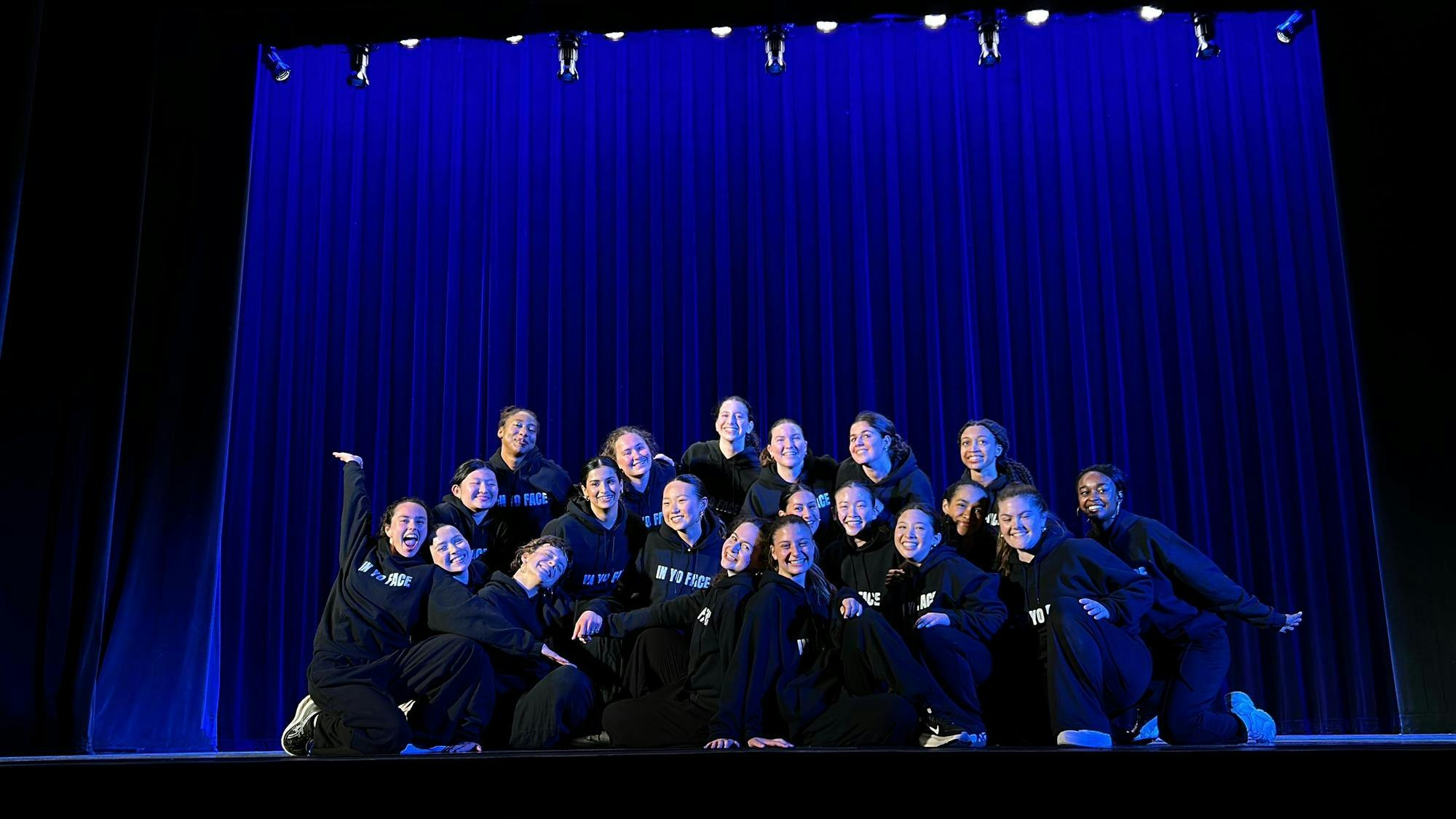
It wasn’t until my sophomore year when I discovered the Base Productions Dance Team, and the energy just felt right. I loved meeting the team, and the choreography was enjoyable to both learn and perform. Base performs an annual spring showcase, Base in Yo Face. Last school year, we conquered the State Theatre of Ithaca on April 24, 2025 with student-choregraphed dances spanning styles from hip-hop and contemporary. The show also features guest performances from other campus groups, like Cornell Sitara and Cornell Bhangra, and it is, in the truest sense, a celebration of what student dancers can build when given the room to create.
To prepare for this showcase, we had to undergo “hell week,” a tradition for Cornell dance teams and other performance groups. In the days leading up to a performance, rehearsals stack on top of each other. There are afternoon run-throughs, evening full-runs and my least favorite, ‘drilling’ routines, where you rehearse a dance continuously until your choreographer approves it. Rehearsals may end at 10 p.m. on a good night, but the work will certainly not end there. You’ll still have a pile of assignments to get through before the next day of ‘hell week,’ knowing you have a beautiful alarm to wake up to for your 8 a.m. class.
There are moments, deep in that stretch, when the question surfaces: Why did I sign up for this?
Somewhere between the late nights, the collective exhaustion and refusal to let the show fall apart, you look around and realize you’re surrounded by people who get it: the pressure, the passion and the particular kind of person who chooses to carry both at once. Dance teams at Cornell aren't just extracurriculars. They’re built-in communities — assembled by a shared passion for creative expression that is communicated through a language that only we understand.
Still, being on a dance team here can feel consuming and hard to manage, but I wouldn’t trade this experience for anything. It has truly been one of the most fulfilling and humbling commitments of my college years, teaching me the value of time management and reminding me to not overlook those moments I once took for granted, because in reality, it always works out.
If you have ever considered auditioning for a dance team at Cornell, consider this as your sign. Go even if you’re uncertain, or if the team intimidates you. Because on the other side of all that intensity, there’s a community waiting: a creative outlet that’s entirely yours and a reason to remember why you started dancing in the first place.

Maya Rothbard is a member of the Class of 2028 in the College of Arts and Sciences. She is a staff writer for the Lifestyle department and can be reached at mrothbard@cornellsun.com.