By the time that the TCAT 30 bus from North Campus reached Collegetown, it was already packed. Precariously balancing a bouquet in my lap, I watched as more students squeezed in, standing shoulder to shoulder as we made our way into the Commons. The crowd wasn’t for a Lot 10 Drag Show, but instead for something less widely recognized: the Multicultural Greek & Fraternal Council’s annual Greek Freak Showcase at the Ithaca State Theatre.
For many, Greek Life at Cornell is synonymous with trashy Friday night parties in dingy, dimly lit basements. While that association may hold some truth, it overlooks the entirely different world of multicultural Greek Life on campus. Cornell’s MGFC is made up of 15 culturally-based fraternities and sororities, including historically Black, Latinx, Asian and other multicultural organizations. While the histories and traditions of these organizations differ greatly, they are united by a shared emphasis on scholarship, service and cultural preservation, expressed through events like Greek Freak.
At the core of the event are the traditions of strolling and stepping. Unique to MGFC life, these practices trace back to the Alpha Kappa Alpha Sorority, Inc. and Black Greek Letter Organizations in the early 1900s, where they emerged as forms of cultural expression and resistance for Black students who were racially excluded from white Greek organizations. Strolling is a rhythmic choreography of stomping, clapping and singing, performed to a compilation of remixed songs; meanwhile, stepping, having evolved from hymnal recitation in Black church services, often features an organization’s signature step, call and move. “Each organization in the National Pan-Hellenic Council has signature moves, and they are all connected to a certain history or tradition in our respective organizations,” shared Natalie Maloon ’26, president of the Mu Gamma Chapter of Delta Sigma Theta Sorority, Inc. “For example, imitating an elephant in Delta Sigma Theta Sorority, Inc. is very significant in the background of our organization. … It allows us to connect more as a chapter, organization and also with the legacy of those before us.”
At Greek Freak, these legacies are both preserved and reimagined with honor. This year’s showcase followed an action movie theme, but the prompt didn’t limit organizations’ creativity as they layered their cultures and histories into familiar narratives. For example, the Tau Chapter of Alpha Kappa Delta Phi International Sorority, Inc. built a Lara Croft-inspired storyline centered on the search for the “sisterhood diamond," reaffirming the unbreakable bonds of the organization. Meanwhile, the Alpha Chapter of Las Hermanas of Latinas Promoviendo Comunidad/Lambda Pi Chi Sorority, Inc. combined smooth reggaeton rhythms into their "Mission Impossible" inspired routine, and the Horaeziel Chapter of Mu Sigma Upsilon Sorority, Inc., visiting from SUNY Cortland, highlighted their identity as the first multicultural sorority in the nation through a Wonder Woman-esque performance that featured members speaking multiple languages, including ASL.
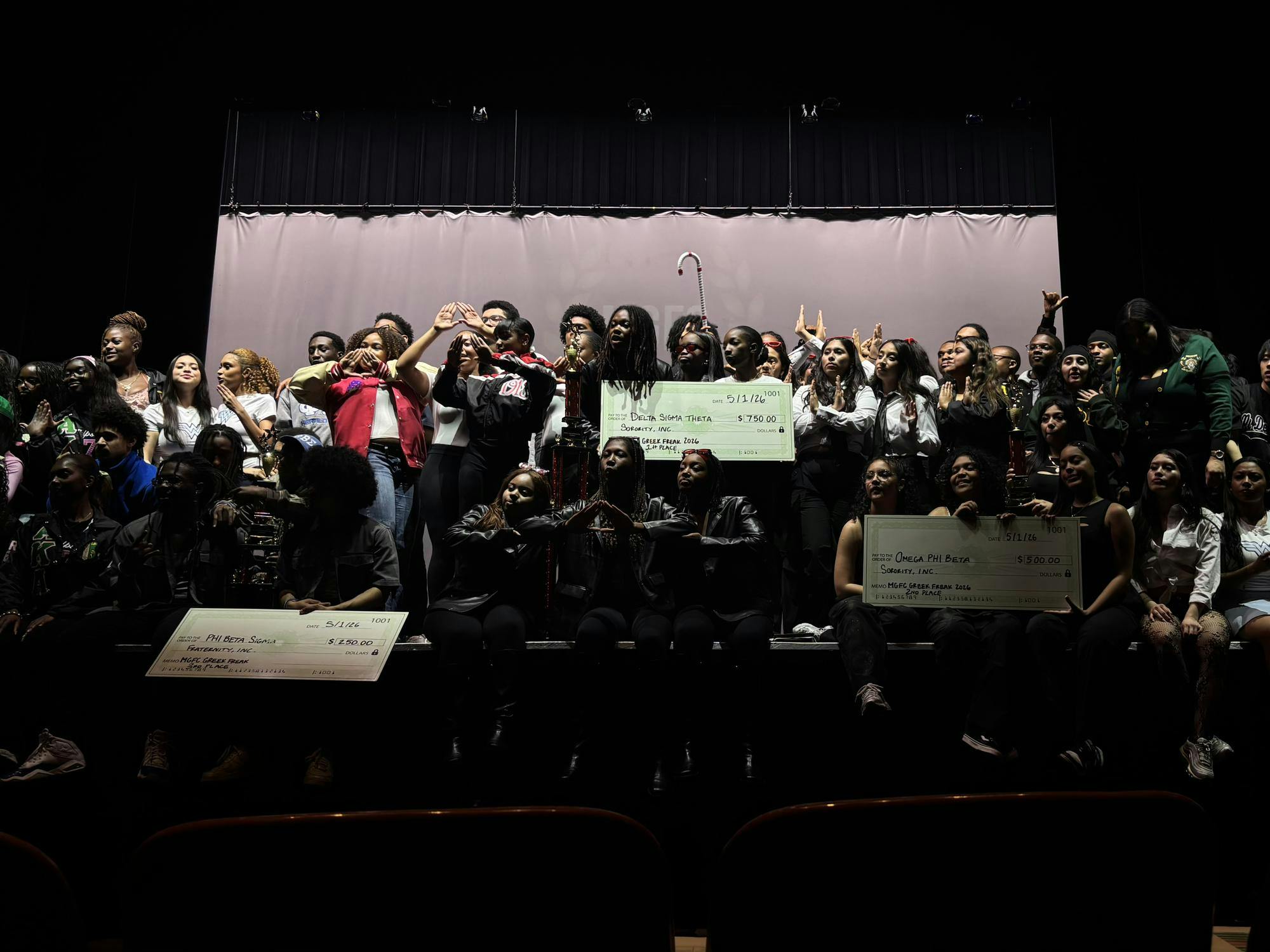
However, amidst the variety, one performance profoundly stood out for both its execution and depth. The Mu Gamma Chapter of Delta Sigma Theta Sorority, Inc., entering the night as the showcase’s two-time reigning champions, delivered a Matrix-inspired routine. Framing their performance around the choice between the blue pill and the red pill, they positioned sisterhood, scholarship, service and social action as a conscious reawakening. Even from several rows back, the physical demands of the performance were evident, and the members' discipline was even more so. Remaining tightly synchronized, members projected chants and songs with striking clarity even as the routine intensified, eventually culminating in a symbolic “breaking of the simulation” as they moved toward purpose and a collective identity. Their performance earned them first place for a third consecutive year, along with a $750 prize. The Nu Chapter of Omega Phi Beta Sorority, Inc. placed second, followed by the Kappa Xi Chapter of Phi Beta Sigma Fraternity, Inc. in third.
Another standout moment from the evening came from the Mu Upsilon Chapter of Alpha Kappa Alpha Sorority, Inc., which recently reactivated at Cornell after nearly a decade. Their performance featured members from their newly initiated line of 49, “one of the largest lines in PWI history,” shared sorority member Florie Donna ’29, making their presence on stage just a few short weeks following their initiation all the more striking.
Moments like these underscore what Greek Freak makes visible; on a predominantly white campus, the showcase creates a space for cultural identity to be boldly celebrated. And while many are hesitant to attend events outside their immediate communities, students emphasized the value of showing up nevertheless. “I’m in SFL, and I think it's really important for the councils to take part in each other’s activities,” said Irididan Ramos-Santiago ’29, a member of the Kappa Delta sorority. “It shows you a different perspective of what sorority and fraternity life can look like.”
But, even for those outside of Greek Life, the experience can still prove meaningful. As Emely Nunez Lemus ’28 put it, “You don't even have to understand it. It’s fun to come support and see what else Cornell has to offer.”
That openness is central to the showcase’s purpose. Maloon explained, “[Greek Freak] allows people who are not familiar with our traditions to witness them in a setting that provides context and respect.” She added that this kind of “cultural expression and familiarity can be rare in a PWI like Cornell but shouldn’t be. I hope Greek Freak opens more people up to the cultural expressions of multicultural Greek organizations and our traditions.”
Still, Cornell has room to grow in extending visibility and support to multicultural Greek Life on campus; it’s on the broader community to engage with and uplift the vibrancy these organizations bring, particularly through events like Greek Freak. This visibility is, ultimately, what the MGFC community hopes will endure beyond a single night of performances. As Maloon put it, “I hope [people] see how much pride each member has in their organization.”

Leslie Monter-Casio is a member of the Class of 2028 in the Brooks School of Public Policy. They are a staff writer for the Arts & Culture department and can be reached at lmontercasio@cornellsun.com.