If you only had an hour to live, how would you remember your life? That is the fundamental question that I AM GOING TO DIE (And All They Gave Me Were These Lousy Cupcakes) attempts to answer. Presented by LibLab Productions as a part of the Old Greeny Fringe Festival, a week-long fringe festival that celebrates the legend of the Old Greeny cryptid of Cayuga Lake, I AM GOING TO DIE (And All They Gave Me Were These Lousy Cupcakes) is a one-act improvisational play that relies on an interactive audience. The play, written by Lochlan MacLean and February Schneck, was conceived after MacLean was diagnosed with terminal cancer, which led them to reevaluate their conceptions of life and death. The original idea for the play centered on a character who changed with each performance, and after MacLean’s passing, Schneck carried it to its current form. The early conceptions of the play shine through: The plot is entirely dependent on audience choice, while the underlying theme of how we consider life in the face of death is the driving force of the show.
The play starts with the unknown character desperately trying to piece together their life after being faced with an inevitable death warrant. The circumstances of the character’s life remain fuzzy throughout the duration of the play, as every detail needs to be brought up by either the character or the audience, with only so much performance time to cover a character’s entire lifetime. The performance starts out slow, with only the character’s impending death confirmed, but quickly picks up as different aspects of their identity come to light. As soon as the anonymous character became an actress from San Diego named “Candace Gladstone,” chosen by an audience member, I found myself increasingly engaged and invested in the unfolding story.
The play thrives best with an outgoing, unreserved audience that is quick to engage — leaving the performance’s success at the whim of the crowd and creating a dangerous state of affairs. A shy audience makes for an awkward, dry experience, while an eager crowd fosters an exciting performance. This is the play to bring your friends to, so that you feel comfortable enough with your fellow audience to essentially take on a role in the production. Audience interactive plays are inherently an active rather than passive experience, more akin to an escape room than a movie.
The performance I attended had a relatively small audience of around six people; however, I believe the nature of the play thrives on a smaller crowd. The enticement of interactive plays is that the audience is part of the show. The ability to impact the plot, such as by deciding the character’s name or hometown, is part of the plot. In a group of six, every audience member has the chance to play a key role in the play, which would likely not be the case with a larger crowd. As someone who loves spontaneity and storytelling, being a main author in an unwritten story is the main attraction of these kinds of improvisational shows. As one show can only cover so many plot points, this is a show for the few, not the many.
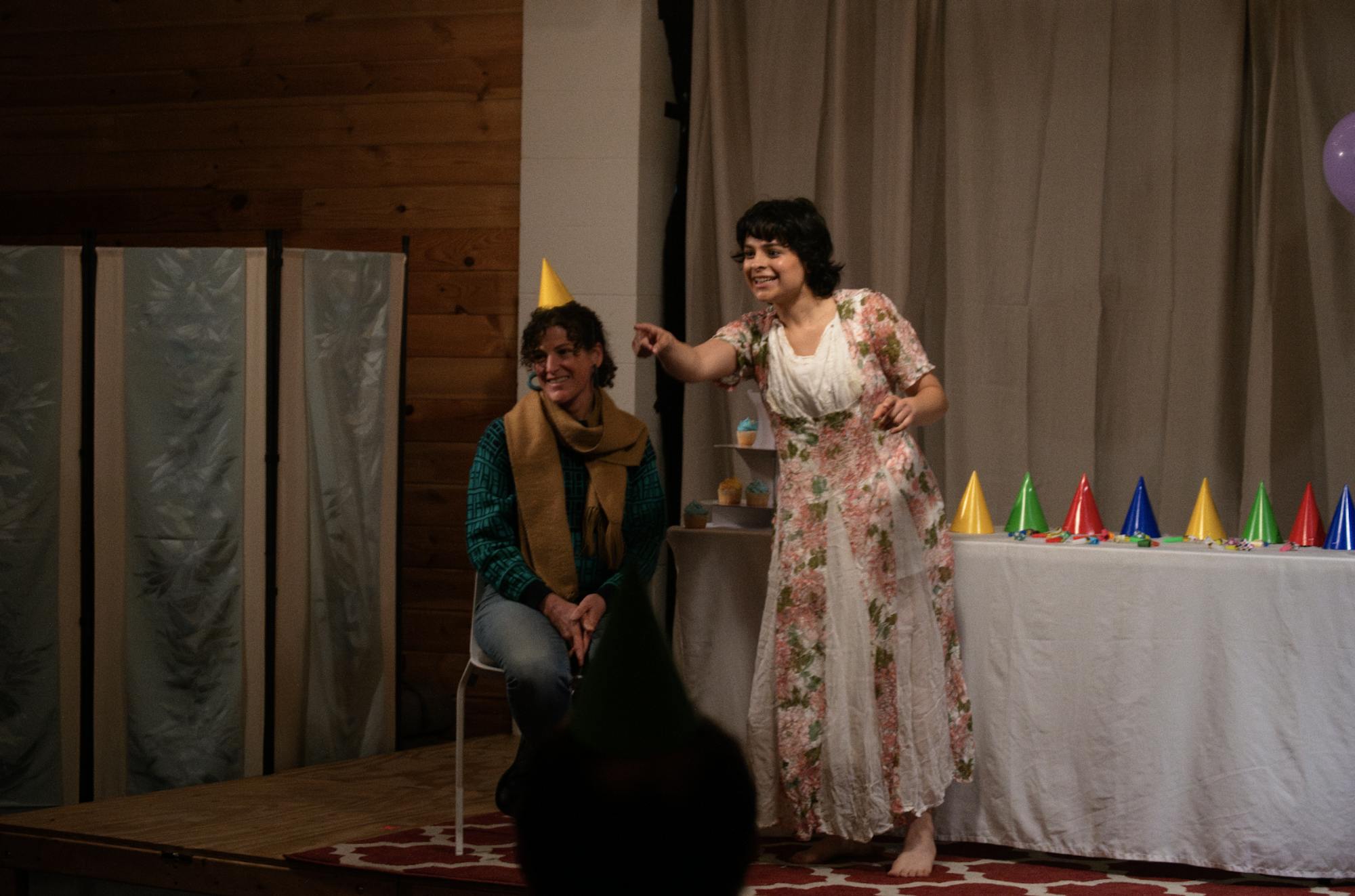
Actors are important in any play, but especially so when there is no script and only one actor. Valeria Aveces, who graduated from the Neighborhood Playhouse, a professional acting conservatory in New York City, played the anonymous character about to die in the April 30 show. Aveces did a wonderful job of smacking down any awkwardness, drawing out participation that didn’t feel forced when the audience was slightly hesitant to engage. Being in the audience felt like being a student in an improv class. Additionally, her dramatic acting style gave more power to every detail the audience filled in. It is difficult for a character developed on the spot, from scratch to be sufficiently formed enough to garner audience investment. Aceves’s intense, expressive acting burned the character into my head, making Candace Gladstone real from the moment of her conception.
Beyond impulsivity, the themes of identity and death are also central to the play’s impact. It is intentionally comedic about death, which makes the audience comfortable enough with the often-taboo topic to delve deeper. Candace Gladstone’s overly flippant treatment of her death touched on the unspoken notion that death is so unimaginable that the only way to deal with it is through jokes. Similarly, creating an entire life from scratch in about an hour touches on the vast array of stories and people out there. As much as our own lives and the lives of those we know seem so unique and special to us, there are billions of people out there who thought the same and are no longer with us — so much so that we can concoct one of those stories in a short play. At its core, I AM GOING TO DIE (And All They Gave Me Were These Lousy Cupcakes) offers the chance to help create a life about to become a memory. To create a life like our own.
Caroline Kelly is a member of the Class of 2028 in the College of Arts and Sciences. She is a staff writer for the Arts & Culture department and can be reached at ckelly@cornellsun.com.