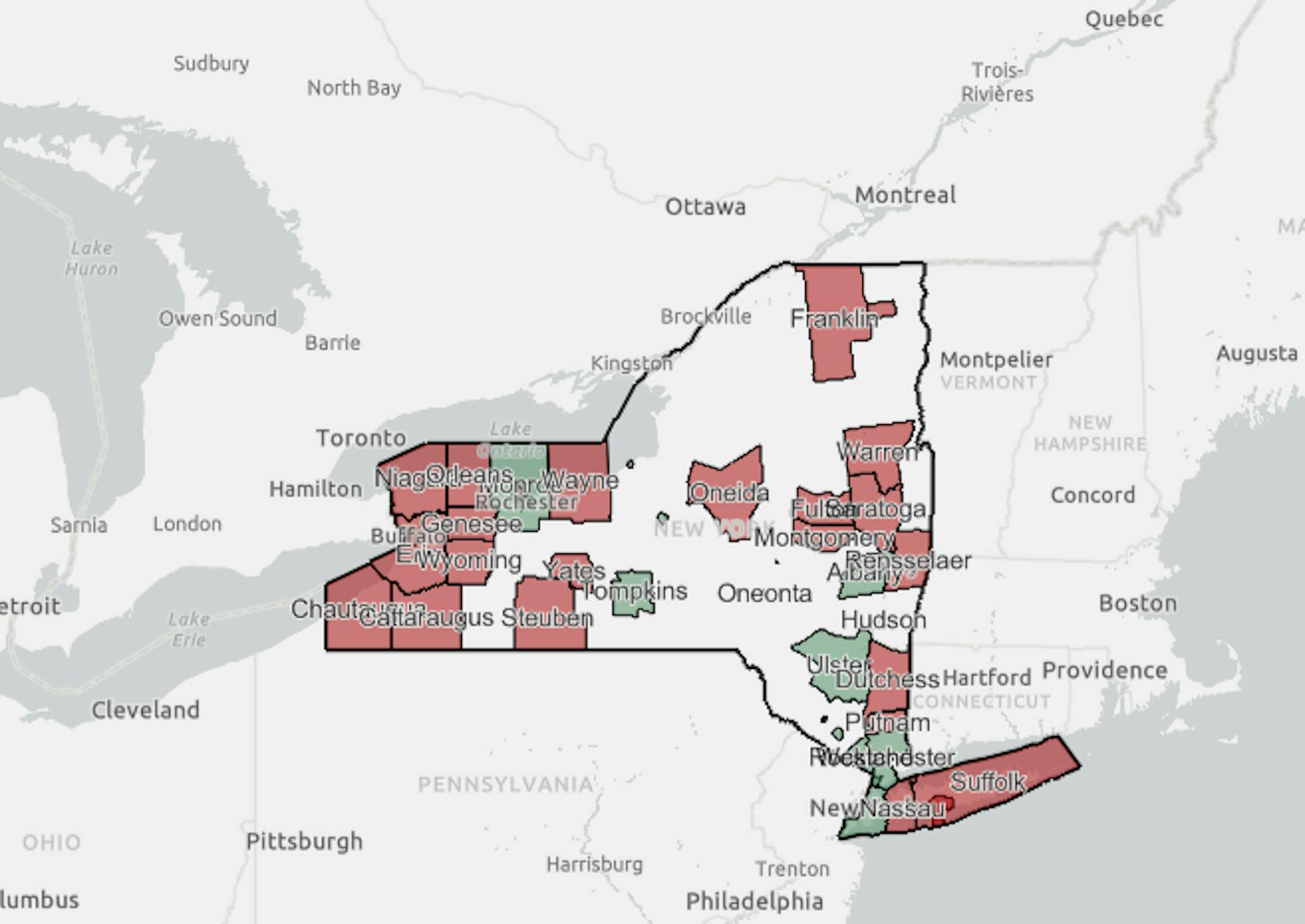
Researchers at the Cornell Jeb E. Brooks School of Public Policy launched an interactive map in January that highlights immigration policies in different regions of New York State.
The map was created by the State Policy Advocacy Clinic, a program housed in the Brooks School in which undergraduate and Master of Public Administration students work with New York State stakeholders to create “state-level policy initiatives” that “[prioritize] projects that advance rural equity and human rights,” according to the program’s webpage.
The mapping project, called “Local Approaches to Immigration Across New York State,” visualizes how local entities are currently responding and engaging with immigration policy across New York. The map provides a statewide perspective on different “policies, government officials’ statements, and community resources related to immigration,” according to Hattie Seten, a policy and advocacy fellow at the clinic.
The map seeks to present complex information about immigration policy in a manner that is interactive and straightforward, Seten wrote in a statement to The Sun. The map gives users the ability to layer different data metrics to visually gain a better understanding of immigration policies both within their community and statewide.
“There have been several significant changes in federal immigration policy recently, and the effects are felt differently in localities across New York State,” Seten wrote. This prompted the clinic to create the map.
The clinic “recognized a need for more accessible information on how local governments are engaging with immigration policy, so that communities and policymakers can make informed decisions that respect due process and human rights,” Seten added.
To gather the data, a team of 12 researchers used methods ranging from “reviewing publicly available government contracts [to] parsing through hours of government meeting minutes from localities across the state,” researcher Noah Freedman ’26 wrote in a statement to The Sun.
Freedman wrote that the clinic compiled statements from private organizations, such as chambers of commerce, and used demographic data from the American Community Survey and U.S. Census Bureau. It also analyzed bill sponsorship records for key immigration bills being considered within each New York State legislative district, according to Freedman.
In expanding the publicity of the project, the clinic has worked alongside “state and local policymakers, advocates, academics, immigration policy experts, and community members,” wrote Keten Solomon Abebe ’27, who also worked on the project, in a statement to The Sun.
Abebe added that the map had originally been shown to Bitta Mostofi, former senior advisor to the director of the U.S. Citizenship and Immigration Services and current advisor to New York mayor Zohran Mamdani.
Since then, “[t]he map has [...] reached state and county legislators, ... immigration experts and community members, and … communities across the state with media outlets, including WRVO, Central and Northern New York’s NPR station,” Abebe wrote.
“Across these audiences, the map has been consistently recognized as a valuable resource as it consolidates the many factors that shape New York State’s evolving immigration landscape into a single, interactive tool,” Abebe wrote.
Seten wrote that upon the map’s publication, numerous stakeholders have suggested the addition of new metrics, including “adding electoral vote distribution patterns, immigration detention and deportation data by county and state legislative districts, and data on demonstrations related to immigration policy.”
Anezka Rodriguez Vigil ’26 expounded on inclusion regarding immigration labor policy in a written statement to The Sun, highlighting an interest in exploring the intersection between immigration and local labor inclusivity to these immigrants, noting quantitative metrics such as the concentration of H-2A visas for temporary immigration agricultural workers by county or the availability of immigrant worker support programs.
Montán referenced the clinic’s other projects and tools, such as a comparative analysis of different proposed immigration legislation bills in New York during the 2025-2026 legislative session, as instrumental to influence the decision-making of policymakers at every level of New York State government.
Rafael Montán ’26 expressed that part of the clinic’s goal is to inspire other states to replicate the tools created by the clinic. He hopes that the clinic’s projects influence a larger movement to advocate for the rights of immigrants across the U.S. in an effort to considerably allow immigrant rights to reach the policy table.
Montán pointed to specific examples of the map’s implications in uncovering public school districts that unconstitutionally solicited information about immigrants.
“Being able to identify where the problems are at this local level makes it easier to [effect] change,” Montán wrote. “Tools like these empower policymakers and community members alike, which is what we need to be doing in a time of great uncertainty surrounding immigration policy.”
Seten wrote that the clinic will remain responsive to community needs and will leverage input to continue their refinement of the project.
Montán acknowledged that “this information could be useful to anyone advocating for the rights of immigrants in their state.”
Joshua Cohen is a member of the Class of 2029 in the School of Industrial and Labor Relations. He is a contributor for the News department and can be reached at jmc746@cornell.edu.