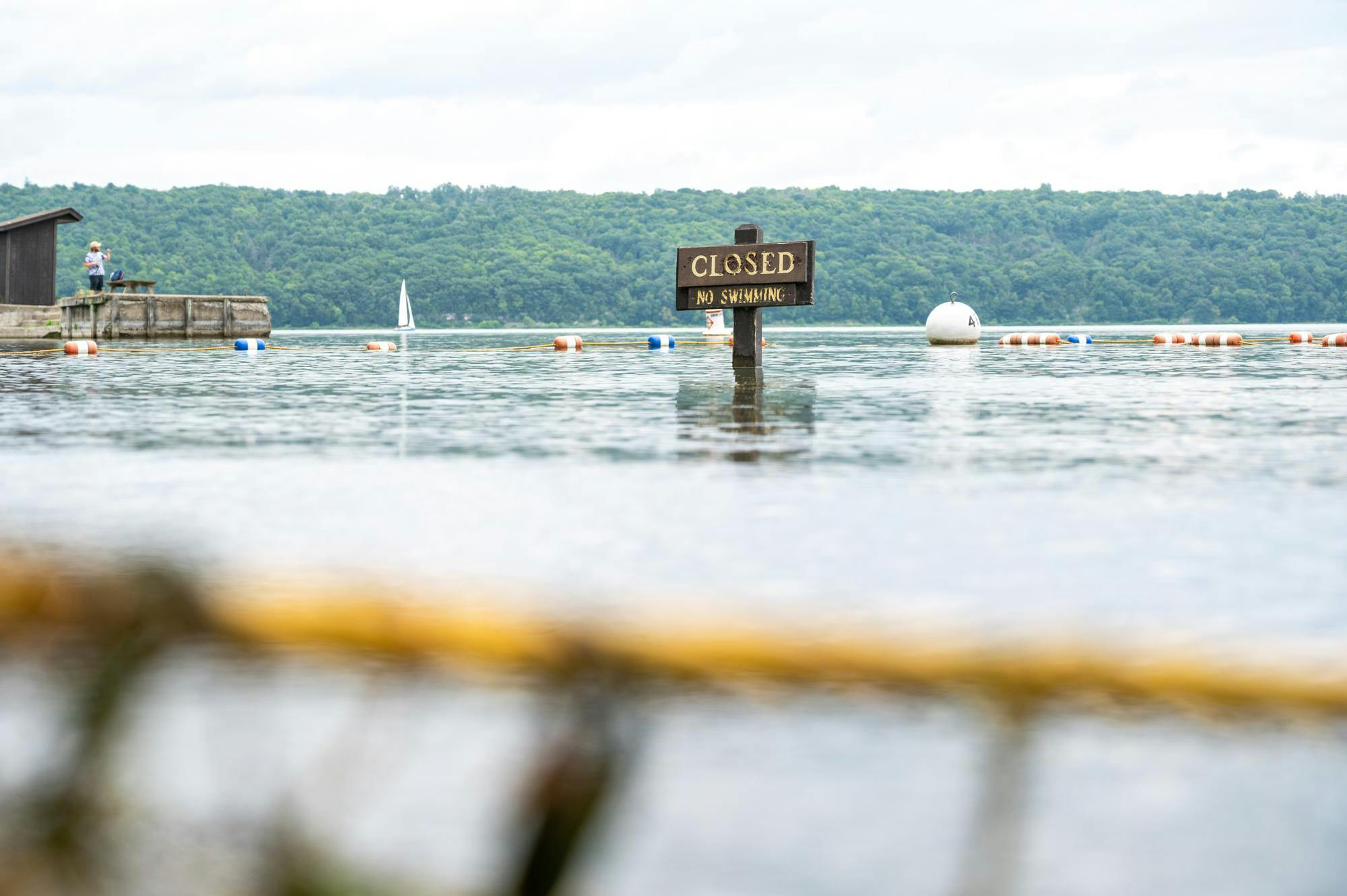
Two environmental groups’ suit against TeraWulf, its subsidiaries and the Lansing Zoning Board of Appeals for categorizing a proposed data campus as a “general processing facility” may proceed, Judge Mark Masler ’93, who sits on the Tompkins County Supreme Court, ruled on Tuesday.
ZBA and the developer respondents are required to file their answers by May 22.
FLX Strong and Cayuga Environmental Action Now sued TeraWulf and the ZBA in January to block the ZBA’s classification of TeraWulf’s proposed data center as general processing on the land where the now-decommissioned Milliken power plant is located, adjacent Cayuga Lake. Afterwards, TeraWulf and the ZBA filed a motion to dismiss the case.
FLX Strong and CLEAN alleged that the noise from the proposed data center raised concerns of environmental harm to Cayuga Shores and would be audible to petitioners from within their homes.
In order for Masler to have dismissed the suit altogether, TeraWulf and the ZBA would have had to prove that the harm petitioners alleged was speculative, and that the case was not likely to be successful. In deciding motions to dismiss, the judge must assume all claims made by petitioners are true.
“The alleged harm,” Masler wrote, denying ZBA and TeraWulf’s motion to dismiss, “is not speculative.”
The ZBA previously voted, 3-2, in December to categorize the center as “general processing,” which is not defined in the Lansing Zoning Code. General processing is not allowed “lakeshore,” as part of the land uses or activities allowed by the ZBA.
“Judge Masler's decision affirms what we long knew: that Lansing and other area residents can reasonably be said to face harm from TeraWulf's ecocidal development intentions,” Ken Woltkin, an FLX Strong member, wrote in a press release. “Our challenge to the ZBA's decision is not one of personal vendetta, but instead a matter of highly consequential legal misinterpretation.”
Christopher Tessaglia-Hymes, a field researcher at the Cornell Lab of Ornithology, and Harold Mills, a member of FLX Strong and an audio signal processing engineer of 40 years, both raised the idea that the “constant, pervasive noise” created by the data center would emit would be "detrimental to bird populations at Cayuga Shores,” and would inhibit birdwatching, according to the suit.
TeraWulf and the ZBA argued that the harms described by the petitioners were purely speculative, and therefore the case should be dismissed.
Masler wrote that these testimonies were enough to establish that these claims were not speculative and thus TeraWulf and the ZBA’s arguments "fundamentally misconstrue the law and contradict the principle that allegations made in support of standing must be accepted as true and constructed in the manner most favorable to petitioners.”
Masler’s decision also affirmed FLX Strong and CLEAN’s argument that this was a zoning-related matter, Masler wrote, as it pertains to the enjoyment of those who visit Cayuga Shores.
Mills, who resides two miles south of the proposed data center, further asserted that the volume of noise generated by the center would impair his living conditions, and would be audible from both inside and outside of his home.
Masler continued that such matters of noise reaching a petitioner’s home are squarely within matters to be protected by zoning ordinances. Thus, Masler wrote that the circumstances present a suitable controversy “that is ripe for review in this proceeding.”
FLX Strong and CLEAN additionally claimed that ZBA misused the label “general processing,” which Masler wrote could not be described as “entirely unreasonable as a matter of law.”
This decision will “protect the natural beauty of Cayuga Lake and its surrounding community,” wrote FLX Strong and CLEAN in a press release sent to The Sun.
The decision comes after Monday’s Lansing Planning Board review of TeraWulf planning documents and the New York State Department of Environmental Conservation’s decision to grant TeraWulf affiliate Cayuga Operating Company a permit to draw 1 million gallons of water a day from Cayuga Lake.

Giselle Redmond is a member of the Class of 2028 in the College of Agriculture and Life Sciences. She is an assistant news editor for the 144th Editorial Board and can be reached at gredmond@cornellsun.com.

Atticus Johnson is a member of the Class of 2028 in the College of Arts and Sciences. He is a news editor for the 144th Editorial Board and can be reached at ajohnson@cornellsun.com.